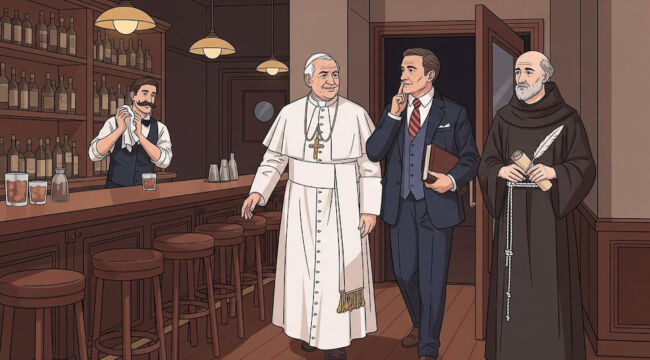
The Pope, the Libertarian, and the Angelic Doctor Walk Into a Bar…
Mark McGrath, my close friend and host of the No Way Out podcast, often jokes that I’m Italy’s second-most famous Villanova alumnus. Naturally, the most renowned is the one occupying the Throne of St. Peter—who has a talent for frustrating me like no other.
I once had great expectations for Papa Leone, as he’s affectionately called here. Yet, from blessing blocks of ice to denouncing countries for defending their borders, he has consistently disappointed me.
Only recently did he somewhat soften his stance on the border debate, stating:
States have the right & duty to protect their borders, but this should be balanced by the moral obligation to provide refuge. With the abuse of vulnerable migrants, we are not witnessing the legitimate exercise of national sovereignty, but rather serious crimes committed or tolerated by the state. Increasingly inhumane measures are being taken—even politically celebrated—to treat these ‘undesirables’ as if they were garbage and not human beings.
Here is a man trained in mathematics who has spent much of his life traveling as a priest. Was I mistaken? Should I reconsider my stance?
Perhaps. This is what I’ve concluded.
Western immigration policy isn’t truly about immigration itself. It revolves around the nature of society and what it actually is.
Is a society a universal moral community? A group of private property owners establishing their own borders? Or a ranked set of obligations where love extends outward—but not without limits?
Three distinct thinkers — Pope Leo XIV, Hans-Hermann Hoppe, and Thomas Aquinas — serve as key reference points in the West’s heated immigration dispute. They present three fundamentally different responses to the question that fuels political, ecclesiastical, and public clashes:
Who owes what to whom?
Let’s briefly explore the theological, libertarian, and classical-philosophical perspectives influencing this pivotal policy controversy.
Pope Leo XIV: “I Was a Stranger and You Welcomed Me”
Pope Leo’s approach to immigration is straightforward: Christian faith doesn’t allow one to ignore Matthew 25:35-40.
35 For I was hungry and you gave me food, I was thirsty and you gave me drink, I was a stranger and you welcomed me, 36 I was naked and you clothed me, I was sick and you visited me, I was in prison and you came to me.’ 37 Then the righteous will answer him, saying, ‘Lord, when did we see you hungry and feed you, or thirsty and give you drink? 38 And when did we see you a stranger and welcome you, or naked and clothe you? 39 And when did we see you sick or in prison and visit you?’ 40 And the King will answer them, ‘Truly, I say to you, as you did it to one of the least of these my brothers, you did it to me.’
He avoids speaking in terms of “flows,” “net migration,” or “refugee quotas.” Instead, he emphasizes encountering Christ at one’s doorstep in need.
It’s important to note Jesus did not say, “Welcome me along with fifty million others, exhaust your resources, and ruin your culture.”
Yet for Papa Leone, every migrant — whether persecuted, displaced, or starving — reflects the image of Jesus. Hospitality goes beyond charity; it is a duty and a spiritual test of one’s Christian commitment.
Since Pentecost broke down linguistic and ethnic barriers, the Church cannot support rebuilding them out of political convenience.
This does not advocate for the elimination of borders.
However, it insists refugees deserve safety, the vulnerable merit protection, and nations must uphold human dignity — even when inconvenient.
In the Pope’s view, Western nations do not merely choose to welcome the desperate; their moral authority depends on it. Each time the West shuts its doors, it chips away at the Christian values it claims to defend.
This outlook results in universalist, humanitarian-leaning policies that often clash with nationalist agendas across both sides of the Atlantic.
Hans-Hermann Hoppe: Borders Are Property Lines
While Pope Leo preaches universal love, Hans-Hermann Hoppe arms himself with libertarian arguments to erect and secure borders.
Hoppe’s perspective stands in stark contrast: immigration is not a matter of morality but entirely about property rights.
He maintains that what’s commonly termed “open borders” is actually forced integration, since governments alone decide who may enter and settle on land that belongs to others. Ideally, in Hoppe’s view, migration should be voluntary: individuals enter only when expressly invited by property owners. Without such an invitation, no access is allowed.
Anything outside this framework equates to coercion.
The policy implications are clear:
Borders must be rigorously defended. Welfare programs for newcomers—and preferably at all—should be eliminated. Migration is governed by private contracts, not public legislation. Government-enforced integration is unacceptable.
Detractors argue Hoppe overlooks global desperation, economic disparities, and interconnected markets. He counters that he is merely advocating for the freedom to say “no.”
Hoppe also highlights that democratic leaders view immigration differently than their citizens (emphasis mine):
As far as emigration policy is concerned, this implies that for a democratic ruler, it makes little, if any, difference whether productive or unproductive people, geniuses or bums leave the country. They all have one equal vote. In fact, democratic rulers might well be more concerned about the loss of a bum than that of a productive genius. While the loss of the latter would obviously lower the capital value of the country and loss of the former might actually increase it, a democratic ruler does not own the country. In the short run, which is of the most interest to a democratic ruler, the bum, voting most likely in favor of egalitarian measures, might be more valuable than the productive genius who, as egalitarianism’s prime victim, will more likely vote against the democratic ruler. For the same reason, quite unlike a king, a democratic ruler undertakes little to actively expel those people whose presence within the country constitutes a negative externality (human trash which drives individual property values down). In fact, such negative externalities – unproductive parasites, bums, and criminals – are likely to be his most reliable supporters.
Sound familiar?
Thomas Aquinas: Charity, Yes — But Ordered Charity
Then there’s Thomas Aquinas, bringing back the nuance often lost in this discourse.
As JD Vance rightly observed, Aquinas’ concept of ordo amoris — “the order of love” — teaches that love must be both universal and rightly prioritized. Your obligations are strongest toward those closest to you, but not exclusively so. You safeguard your family before strangers, your neighbors before outsiders… unless a stranger’s urgent need compels you to broaden your circle.
For Aquinas, moral decisions rest on context, prudence, and proper balance.
It’s neither “open borders” nor “fortress nation,” but a layered set of responsibilities:
- First, your family
- Next, your neighbors
- Then your fellow citizens
- And only then, when necessity calls, the stranger
Nevertheless, Aquinas opposed immediately granting immigrants rights. From Summa Theologica (I-II, Q. 105, A. 3):
If foreigners were allowed to meddle with the affairs of a nation as soon as they settled down in its midst, many dangers might occur, since the foreigners, not yet having the common good firmly at heart, might attempt something hurtful to the people.
He insists that charity must be generous but discerning. It extends outward, yet with careful judgment.
Translating this into policy suggests well-regulated asylum systems, priority given to genuine and urgent cases, integration that strengthens communities instead of weakening them, and a readiness to help paired with cautious wisdom on how and when.
While Pope Leo offers the moral ideal and Hoppe asserts the libertarian veto, Aquinas supplies a means to harmonize empathy with order.
Three Visions, Three Wests
Most Western immigration debates can be traced back to these three perspectives.
Catholic universalists emphasize dignity and solidarity.
Restrictionists prioritize property rights, sovereignty, and societal stability.
Classical Thomists uphold prudence—a balanced approach that steers clear of extremes.
The inherent tension:
Pope Leo’s stance risks moral overreach and political pushback.
Hoppe’s viewpoint risks fracturing society into isolated enclaves.
Aquinas’ position demands discernment—the very quality modern politics often rejects.
Given the West’s spiritual division, economic challenges, and demographic anxieties, these conflicting views frequently clash in parliaments, churches, and homes.
Wrap Up
Immigration reflects a profound moral choice about what Western societies perceive community, responsibility (and its boundaries), the dignity of outsiders, the rights of insiders, and the extent of compassion amid scarcity truly mean.
Pope Leo insists our primary obligation lies with Christ embodied in the migrant.
Hoppe stresses the need to uphold free association and private property rights first.
Aquinas champions ordered love—starting with those closest to us, gradually extending outward, never neglecting strangers, but always preserving the bonds that hold society intact.
Three visions. Three interpretations of the West. One crisis without straightforward solutions.
The immigration debate ultimately interrogates the very soul of the West. Still, the West has yet to decide which of these three voices will steer its conscience.
About the Author