Presented as a spontaneous youth-led uprising against corruption, violent protests that erupted across Mexico this month were backed by local oligarchs and an international right-wing network determined to topple the popular President Claudia Sheinbaum.
On November 15, over 50 Mexican cities saw violent protests covertly supported and orchestrated by an international right-wing alliance, with amplification from bot networks, according to a recent investigation by the public fact-checking platform Infodemia.
Mexican President Claudia Sheinbaum echoed these findings, raising concerns about the involvement of cartel-linked opposition parties and foreign interference in stirring up the so-called “Gen Z” protests. Authorities reported approximately 120 injuries, more than 100 of which involved police officers.
In early October, 31-year-old Bello shifted rapidly from a lifestyle content creator flaunting wealth flashing cash and showing off luxury cars to a political figure after criticizing the Mexican government and urging young people to “assert your rights” at a Chamber of Deputies forum. Employing rhetoric reminiscent of Donald Trump, Bello criticized the government’s detachment from ordinary citizens while promoting the idea that a successful “businessman” like himself was necessary to revive Mexico’s leadership. His message was subsequently amplified by Pliego, who turned into a fervent adversary of the government following a court order which compelled his Grupo Salinas to pay over 50 billion pesos ($2.6 billion) in unpaid taxes.
Bello denied any ties to the ruling Morena party or to “PRIAN”—a derogatory blend of the long-ruling PRI and PAN parties which governed Mexico for nearly nine decades before Morena’s rise under Andrés Manuel López Obrador in 2018. Yet two weeks later, he began endorsing Alessandra Rojo, a Cuauhtémoc mayor affiliated with the PRIAN successor, Strength and Heart for Mexico.
On October 12, Bello was the first to declare that a “march” was in the works and the date set. In a TikTok video showing the Mexican legislature, he stated, “They don’t have the power. All of us have the power, and Mexico needs us to demonstrate that today more than ever.”
Although his speech reportedly “awoke many Mexicans,” Bello emphasized that “we can’t limit ourselves to words alone,” concluding with a call that “now is the time for the next step.”
The same day, a TikTok account named “Mexican Revolutionaries” was created. Just four days later, on October 16, it issued the first public call for protests scheduled on November 15. That week, another central account, “We Are Generation Z Mexico,” streamed a live event promoting the demonstrations, which Henrique ‘Kike’ Mireles, a spokesperson for the PAN party in Querétaro, shared immediately.
The mobilization amplified rapidly through numerous accounts flagged by Infodemia researchers for suspicious, inauthentic activity, particularly those created just in October or November 2025 with single-digit follower counts.
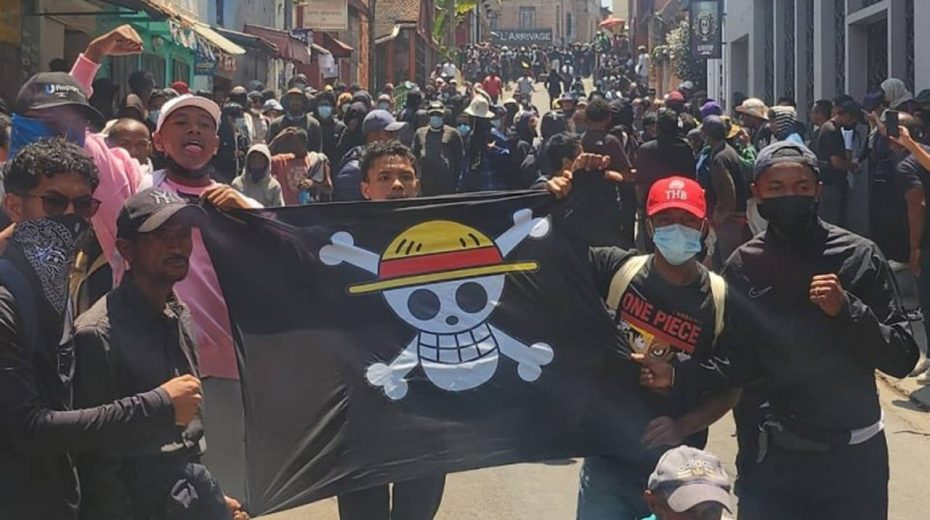
Most of these profiles featured the pirate emblem from the Japanese anime One Piece, a symbol frequently seen at youth-led anti-government protests worldwide since Nepal’s government was toppled in summer 2025. These accounts mirrored the Mexican Revolutionaries and Gen Z Mexico pages, both of which adopted the logo coincident with their call for rebellion.

Though Generation Z Mexico labels itself as “non-partisan” in its profile, it has relentlessly published posts calling for regime change in Venezuela since 2024.
Despite claims to represent Mexico’s entire youth generation, a Bloomberg-linked poll from October 2025 indicated that two-thirds of young voters support President Claudia Sheinbaum. Yet Western media outlets have predominantly echoed Gen Z Mexico’s depiction, consistently portraying the unrest as a widespread youth revolt against an alleged “narco-government.”
Initially focused on demands for Sheinbaum’s resignation, protest leaders pivoted after the murder of anti-cartel mayor Carlos Manzo. The activists weaponized his death against Sheinbaum, overlooking her administration’s intensive crackdown on drug trafficking, yielding tens of thousands of arrests, numerous deportations, large drug seizures, and significant disruption of cartel operations.
The “Gen Z” protests received enthusiastic backing from Vicente Fox, the former right-wing president linked to Genaro García Luna, his former security chief convicted for conspiring with the Sinaloa Cartel. Currently imprisoned in a US supermax alongside infamous druglord Joaquín “El Chapo” Guzmán, García Luna’s collusion was known to both Fox’s administration and State Department officials, who admitted awareness yet claimed, “we had to work with him.”
President Sheinbaum has claimed the protests were “promoted from abroad.” While mainstream media often dismiss these as conspiracy theories, her assertion has credible backing.
Animal Politico, a media outlet that endorsed the protests and circulated footage of alleged police brutality, is among a broader network of Mexican media and civil society organizations funded with substantial grants from the National Endowment for Democracy, the US government’s regime change apparatus.
Animal Politico offers advertisers opportunities to place sponsored content authored by in-house journalists, with sponsors including Google’s Alphabet Inc., AstraZeneca, the CIA-linked Ford Foundation, and George Soros’ Open Society Foundations—entities hardly supportive of Sheinbaum’s left-nationalist government.
One of the most favorable media covers came from Real America’s Voice, a right-wing network led by former Trump chief of staff Steve Bannon, who has pushed for Trump to authorize US military strikes in Mexico under the pretext of combating drug cartels.
A November 15 New York Times article featured numerous mostly young protesters openly calling for the government’s toppling but without concrete demands. A typical voice was a 21-year-old “actor and singer” who stated, “the goal of this march is precisely to remove the president,” while remaining “unsure” what would follow Sheinbaum’s ouster, but believing it signaled “the beginning of something.”
A 19-year-old student expressed revolutionary zeal but conceded failure was likely: “We’re obviously not going to achieve [Sheinbaum’s] revocation, because that’s too extreme.” Instead, they said the protests were “about letting the government know that we’re willing to go that far. Because when those at the bottom move, those at the top fall.” Meanwhile, an elderly farmer urged for US “intervention” as “the only solution” to the country’s alleged cartel stranglehold.
The Times revealed that protesters coordinated the unrest via Discord, where several users advocated storming the Presidential palace. Coincidentally, Nepal’s government overthrow in September was similarly orchestrated through Discord. There are further parallels with that US-backed color revolution, down to media portrayals which framed Nepal’s turmoil as a youth-led “Gen Z” movement brandishing the One Piece pirate flag. Nepal’s interim leader was also elected via Discord with a tally of under 4,000 votes out of 30 million people. Mexican protesters likewise used Discord to discuss potential successors to Sheinbaum.
The New York Times noted that some proposed replacements included wealthy oligarchs like “brash billionaire Ricardo Salinas Pliego,” known for his aggressive opposition. Pliego, a staunch neoliberal and one of Mexico’s richest individuals, faces accusations of orchestrating the unrest. In response, he demanded public evidence, asserting angrily they should “present a single piece of evidence for the lies you’re spreading without any scruples about me.”
Although direct proof of Pliego’s involvement remains circumstantial, he has been openly supportive of violent anti-government demonstrations and maintains several significant international affiliations.
For instance, in March 2023, he founded Universidad de la Libertad to promote “free-market principles, business development, and innovation” in alliance with the Atlas Network. This US-funded organization serves as a hub for hundreds of free-market think tanks connected to the US State Department and the NED. They annually distribute multi-million dollar grants to “pro-freedom organizations,” advancing right-wing agendas throughout Latin America.
Atlas has been linked to numerous US-backed Latin American coups, including the 2019 attempt to depose Bolivia’s first indigenous president, Evo Morales. Among Atlas’ sponsored individuals is Jhanisse Vaca-Daza, an elite eco-socialite revealed by The Grayzone in 2019 as a prime actor in the Bolivian coup that undermined its democracy.
Another Atlas-funded recipient is CEDICE, the Caracas-based Center for the Dissemination of Economic Information (CEDICE), which has campaigned for capitalist, pro-business reforms since 1984. In April 2002, it played a key role in the US-backed coup that briefly removed president Hugo Chávez, funded with tens of thousands of dollars by the NED.
If the recent Mexican unrest was an attempted regime change, it ultimately failed. However, it may be only the opening salvo in a broader assault against Sheinbaum’s government. Donald Trump expressed dissatisfaction at the unrest, hinting at possible future military interventions. Though he has praised Sheinbaum as “a brave woman,” he also claimed Mexico is “run by the cartels.” Since Trump’s return to office, rumors have emerged about the CIA and US military preparing for secret missions inside Mexico—an action likely regarded as hostile by the Mexican state.
“I looked at Mexico City over the weekend. There’s some big problems there… I am not happy with Mexico,” the US President said in response to the November 15 protests. “Would I launch strikes in Mexico to stop drugs? It’s OK with me. Whatever we have to do to stop drugs.”
The architects behind the turmoil have called on demonstrators to converge on the National Autonomous University of Mexico on November 20.
Original article: thegrayzone.com
About the Author