Remembering is not only an act of pity towards the victims, but an exercise of responsibility towards the present.
Snipers and Safari
Thirty years after the Bosnian war ended, a fresh legal inquiry exposes one of the conflict’s most harrowing and ethically unacceptable chapters: the involvement of so-called “sniper tourists” — foreigners, including some Italians — who reportedly paid large amounts to join in targeting civilians from the hills surrounding Sarajevo.
The Milan Public Prosecutor’s Office is now examining this case, prompted by a complaint from journalist and author Ezio Gavazzeni, who has long investigated terrorism and organized crime. His findings, detailed in a 17-page report, reveal that during the Sarajevo siege—one of the bloodiest and lengthiest episodes amid the Yugoslav breakup—wealthy individuals from various nations effectively bought the opportunity to shoot at men, women, and children. This grotesque death game was financed by money and justified through a belief in force and immunity.
Initial accounts, gathered by war correspondents at the time and corroborated by a former Bosnian intelligence agent, mention trips organized through Trieste with direct links to the Sarajevo outskirts. Reports suggest that the Italian military intelligence, SISMI, became aware of these “human safaris” as early as early 1994 after Bosnian intelligence uncovered their existence months prior. According to the Ansa news agency, the response was, “We have put an end to it all, there will be no more safaris.” Indeed, the incidents ceased two or three months later, but the disgrace remained unspoken.
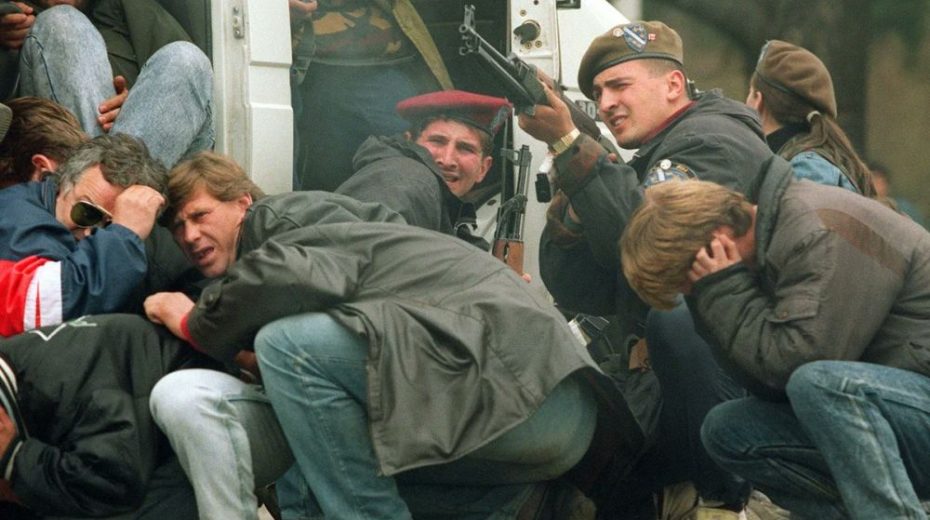
Anyone who witnessed the Bosnian war knows that the Sarajevo siege from 1992 to 1996 was more than a military conflict: it represented deliberate cruelty against a city once a beacon of multi-ethnic harmony. Over 11,000 civilians died, including 1,600 children. Everyday life was haunted by mortar fire and sniper threats. Even crossing a street risked fatal consequences.
The involvement of foreign “volunteers” and “guests” among the snipers was widely reported. By 1995, Italian journalists such as Ezio Mauro, Bernardo Valli, and Ettore Mo noted the presence of groups of “adventurers” fighting alongside Bosnian Serb militias. A Sarajevo correspondent at the time wrote: “In Grbavica, where the sniping by Chetniks and the international participation in the hunt are not hidden but flaunted by Karadžić’s television, there is also a team of publicly decorated Greeks among the snipers, and the case of a Japanese volunteer.”
One of the most recognizable figures is Russian author and politician Eduard Limonov, who was filmed firing a heavy machine gun alongside Radovan Karadžić, later convicted of genocide in The Hague. Limonov, who did not pay to take part, praised “Serbian courage” and stated, “We Russians should follow your example.” A cynical tribute presented as a form of art, equating brutality with a political statement.
Between pacifism and indifference
Yet, beyond the acts’ cruelty, the more striking aspect then and now is the global response—or lack thereof. While Sarajevo endured four years of hunger, bombings, and sniper fire, much of the Western world remained paralyzed by a powerless pacifism incapable of distinguishing humanitarian aid from military intervention.
“A consistent left,” observed a correspondent of that era, “should have chained itself to the streets, not to protest against all use of force, but to demand intervention by the United Nations and NATO to protect Bosnian civilians. Instead, inertia prevailed, justified by neutrality.” This very neutrality soon enabled the Srebrenica massacre.
The episode of the “massacre tourists” is therefore more than an example of barbarism—it mirrors a political and ethical environment where horror was tolerated with indifference. Gavazzeni notes that “everyone knew,” yet few genuinely wanted to acknowledge it. The Balkan war, despite being geographically close, seemed remote in Europe’s collective awareness.
What makes this story particularly unsettling is how it emerged — not through official channels but because of a journalist’s diligence. After watching the 2022 documentary Sarajevo Safari by Slovenian director Miran Zupanič, which features Bosnian witnesses describing ‘foreign guests’ paying to be taken to sniper positions to shoot civilians, Gavazzeni was compelled to investigate further. The film mentions Americans, Russians, and Italians among these visitors.
Struck by parallels with decades-old reports, Gavazzeni collected additional evidence and submitted it to the Milan judiciary. Prosecutor Alessandro Gobbis, experienced in international terrorism cases, is now considering murder charges. Although challenging after so many years, this effort holds moral significance.
Nevertheless, even as formal inquiries move forward, skepticism continues. Former British soldiers stationed in Sarajevo during the 1990s told the BBC that the story was “an urban legend,” arguing that logistical constraints and numerous checkpoints would have made civilian sniper tourism impossible. However, this cautious stance—typical of those reluctant to confront uncomfortable truths—stands in sharp contrast to the extensive eyewitness testimony and the firsthand accounts of journalists who endured the siege.
The moral legacy of the conflict
The Milan investigation may not rewrite history, but it reopens a painful chapter in Europe’s collective memory: the hypocrisy surrounding wars that are “too close to ignore, yet too inconvenient to confront.” Bosnia was the post-Cold War’s first test, and it was a colossal failure. Reflecting on the ‘massacre tourists’ compels us to question not only those who pulled the triggers but also those who chose to avert their eyes.
Beneath the horror of “human safaris” lies a deeper issue: the attraction to violence, the normalization of cruelty, and the glamorization of warfare. This dark craving to witness or even take part in power over life and death has evolved into a media spectacle—drone strike counts, live battlefield broadcasts, viral bombing footage. Though technology advances, the imagery remains disturbingly consistent.
Three decades after Sarajevo, the West is once again entangled in a European war—this time between Russia and Ukraine. Here too, the distinction between news, propaganda, and censorship blurs. Like the 1990s, there is a risk of reducing the conflict to a simplistic moral battle of good versus evil, stripping away nuance and complexity.
Today, hills are no longer necessary for targeting enemies. We wield words, media narratives, disinformation campaigns, and mutual censorship instead. The widespread Russophobia in the West—which results in canceled concerts, exhibitions, and books—arises from a similar dynamic of moral exclusion: the desire to cleanse public discourse of anything that challenges the official storyline.
The atrocity of the ‘sniper tourists’ in Sarajevo thus reveals another troubling truth: how precarious the boundary is between condemnation and complicity, freedom and censorship, fact and propaganda.
This Milan investigation will likely never bring convictions—too much time has passed, many records lost, and countless responsibilities blurred. Yet it has already achieved something vital: compelling us to confront, unfiltered, the moral abyss that war exposes.
“It is the same indifference that yesterday let Sarajevo die and today is only intermittently indignant,” says Gavazzeni. Remembering is not only an act of pity towards the victims, but an exercise of responsibility towards the present.
The tourists of massacre are not relics of a distant past. They embody a civilization that, while proclaiming freedom and democracy, continues to harbor a dark side—one that transforms others’ suffering into spectacle, cruelty into curiosity, and war into tourism. Until this perspective changes, the story of Sarajevo will continue to resonate deeply.
About the Author