The 1953 U.S. Doctrinal Program, launched by the CIA following Stalin’s death with the intention of transforming pro-Soviet leftists into pro-American supporters, achieved notable success in Ibero-America.
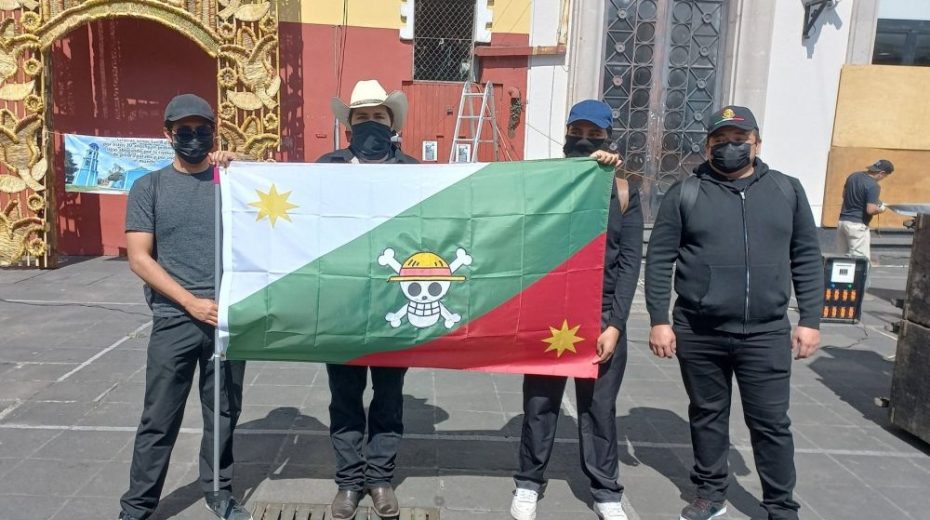
The recent demonstrations in Mexico, which adopt the label “Generation Z” and feature an anime emblem similar to protests in Nepal, provoked a swift reaction from the Ibero-American left accusing the unrest of being a color revolution. The situation escalated further when graffiti stating “narco-state” prompted some to hastily assert that the CIA engineered the protests to justify bombing Mexico—as it already does in Colombia—and possibly even to start a war, something the Trump administration has hinted at concerning Venezuela.
Regarding the events in Mexico, it is important to avoid broadly categorizing all dissent as color revolutions and to refrain from dismissing legitimate protests that challenge leftist narratives. Journalist Juan David Rojas offers a worthwhile overview, explaining that the protests “were clearly sponsored by Mexico’s traditional, mostly right-wing opposition. […] Despite invoking youth protests from Nepal and the Philippines, young people made up only a minority of demonstrators. A viral and notably humorous image showed the septuagenarian Vicente Fox wearing a One Piece skull-and-crossbones “jolly roger” t-shirt from the popular anime. At the same time, it would be wrong to deny that protesters have genuine concerns about public security. Earlier this month, Uruapan Mayor Carlos Manzo in Michoacán was killed by the Jalisco New Generation Cartel (CJNG) for his outspoken criticism of narco-corruption. His political movement, aligned with neither Morena nor the opposition, originally backed the protests.” This highlights that economic progress means little if the government remains helpless against organized crime.
In Brazil, there remains a segment of the left attentive to Ibero-American affairs. Yet, when Brazilians consider regional politics, their focus seldom moves beyond South America. For years, attention centered on neighboring Argentina—a significant country with close demographic ties and a highly politicized society, unlike Paraguay where Brazilians usually engage only in commerce. Venezuela abruptly entered Brazilian discourse due to the influx of impoverished refugees who crossed dense forests to reach the small state of Roraima instead of flying directly to wealthier nations or navigating Colombia’s border.
Nonetheless, Mexico had already captured the Brazilian right-wing imagination prior to the recent protests. For instance, a story circulated in Portuguese claiming Claudia Sheinbaum refuses to combat cartels because doing so would amount to fascism. Indeed, on November 5, 2025, Sheinbaum declared that “returning to the war on cartels is not an option,” describing it as “outside the law, it’s permission to kill […] heading towards fascism,” and categorizing it as “true authoritarianism, returning to the war on drugs.”
This stance mirrors that of the Brazilian New Republic, which views the State primarily as a protector of the vulnerable, and sees authority—including the exclusive right to use force—as inherently authoritarian. The parallels between Brazil and Mexico deepen when noting that Claudia Sheinbaum has consistently dismissed armed conflict against cartels, opting for intelligence-driven solutions. In Brazil, as public opinion largely supports police operations in Rio de Janeiro’s favelas, the left attempts to contrast Federal Police actions on financial crime—such as fighting PCC money laundering—with military-style incursions into armed territories dominated by heavily equipped groups like the Red Commando, which possess assault rifles from multiple armies, a Ukrainian anti-drone system, guerrilla fighters trained in Ukraine, and control regions through drug trafficking as well as extortion. Criticism reminiscent of drunken university students follows: the police only shoot criminals in poor neighborhoods because the police themselves are villainous—not because gang members there attack police with drones dropping bombs, while money launderers in suits never face similar risks.
However, the most remarkable example of misguided social science lies between Mexico and Brazil: in Colombia, Gustavo Petro asserts that cocaine is no more harmful than whiskey and is banned only because it originates in Latin America. He also criticized the Rio operation, lamenting the decision to kill “poor young people” instead of offering them inclusion and opportunities, and shared a lengthy, surrealist tweet containing embarrassing remarks such as: “I don’t like your oil, Trump, you’re going to wipe out the human race out of greed.”
It can thus be said that a common belief among the Ibero-American left is to regard drug cartels as an inevitable reality, something to endure while awaiting Marx’s return. According to this view, a future proletarian revolution will eliminate inequality, ending the allure of drug trafficking. Alternatively, drug sales might cease because Marx would proclaim cocaine as harmless as whiskey. Only then, they believe, will violence disappear. In the meantime, leftists focus on winning elections so they can govern and then prepare for the next electoral battle—often following the bankers’ interests to avoid losing their financial backing to the opposition. But faith remains that one day Marx will come back.
If China’s left shared this outlook, the country might still be ravaged by opium addiction today. Such dependency would have certainly impeded China’s industrial development and thus reduced its carbon emissions dramatically. Currently, the Ibero-American left seeks an “anti-China”: nations where employment means scavenging and recycling cans—a practice often associated with crack users but which Guilherme Boulos (a potential Lula successor) lauded as a positive ESG contribution for the country.
While it is true that many right-wing governments in Ibero-America have failed to suppress crime, and some right-wing politicians have ties to factions, this only accentuates the left’s irrationalism: instead of remaining silent, they frequently spread damaging nonsense that harms their electoral standing.
Ultimately, it can be concluded that the 1953 U.S. Doctrinal Program, launched by the CIA after Stalin’s passing to convert pro-Soviet leftists into pro-American advocates, had a profound impact in Ibero-America. Today’s leftists resemble more closely offshoots of the Democratic Party than a genuine anti-colonial left.
About the Author