Lie down with dogs, you wake up with fleas; lie down with neocons, you wake up with wars, says Daniel McAdams. So goes Trump’s 28-point plan to end the Russia-Ukraine war.
President Trump’s detailed 28-part peace proposal to conclude the Russia/Ukraine conflict surfaced late last week and was met in Moscow with measured, tentative optimism.
It did not represent a stark shift toward Russia’s stance. Several points within the plan ranged from unlikely to frankly odd.
For instance, the suggestion that President Donald Trump himself would assume the role of “peace czar” overseeing the agreement, and that Russia would commit its seized assets toward Ukraine’s reconstruction.
Another point called for Russia to accept a demilitarized “buffer” zone encompassing a large part of Donetsk, an area that would be “de facto” Russian territory, but not officially recognized as such – leaving it vulnerable to changes in Western politics.
There was also the proposal for the United States to receive a share of the “profits” from Russia’s funded rebuilding effort in Ukraine.
Very much in line with Trump’s style—unorthodox and unusual.
Despite its shortcomings in terms of winning over Russia, the plan hit the U.S. neoconservatives and their European allies like a bombshell. The U.K. Independent claimed that Trump’s strategy was “entirely dictated by Putin” in an evidently propagandistic narrative we are told.
Such media rhetoric revived the old Russiagate theme, accusing Trump of being Putin’s puppet or at least his mouthpiece.
On the political front, E.U. foreign policy chief Kaja Kallas encapsulated the persistent European denial of reality: “We have not heard of any concessions from Russia. If Russia really wanted peace, it could have agreed to an unconditional ceasefire a long time ago.”

Kaja Kallas in European Parliament on March 9, 2022, calling for more EU defence, reduced energy dependence on Russia and solidarity with Ukraine. (European Parliament / Flickr / CC BY 2.0)
Indeed, Kaja “Sun Tzu” Kallas. History of warfare shows that any army making swift progress will periodically pause to grant concessions to the defeated party. It’s part of the game to make it “fair,” ensuring everyone walks away with some form of reward.
Trump’s ultimatum to Ukraine’s acting president, Zelensky, demanding acceptance of the terms by Thanksgiving or risking a cutoff of U.S. military and intelligence support sparked alarm among Europeans and hawkish Americans.
It appeared that Trump was finally shedding indecision following the agreement on a framework in Alaska last August that Russia accepted but Trump abandoned after pressure from the Europeans and the neocons.
This time, Trump seemed ready to act decisively to end the conflict almost a year after pledging to resolve it within 24 hours.
Enter Rubio.
One lesson unlearned by Trump 2.0 from his first term is that the personalities involved shape policy, especially for a leader who seems disinterested in nuances and complex negotiations. The original Trump presidency suffered from neocon figures like John Bolton and Mike Pompeo dragging the agenda.
Even late-stage efforts with Col. Douglas Macgregor trying for an extraction from Afghanistan were blocked internally by neocon holdouts like Robert O’Brien, Trump’s last National Security Advisor.
Neoconservatives excel at disruption. That’s their forte.
The appointment of new blood—Army Secretary Dan Driscoll, a close ally of Vice President Vance—replacing the ineffective Trump envoy Keith Kellogg, held promise that the realist wing within Trump’s circle could finally exert influence.

JD Vance Swears in Army Secretary Dan Driscoll, Feb. 25, 2025. (Wikimedia, PD US Government)
Yet once more, the progress was abruptly halted.
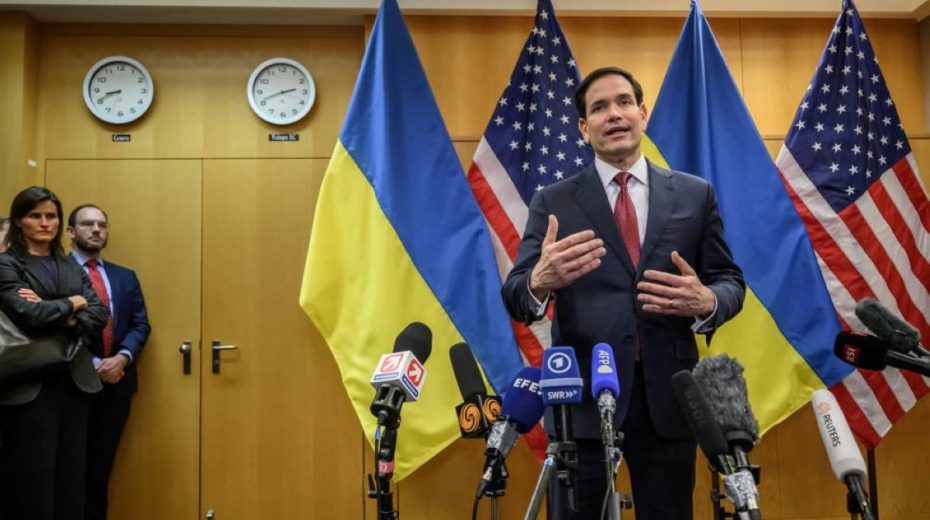
Rubio rushed to Geneva to soothe the European “leaders,” who remain committed to fighting Russia at all costs, even down to the last Ukrainian.
Politico offers insight into the aftermath in an article titled, “Rubio changes the tack of Trump’s Ukraine negotiations after week of chaos.”
“Before Rubio showed up in Switzerland, it largely felt like Vice President JD Vance, via his close friend Driscoll, was leading the process. By the end of the weekend, Rubio had taken the reins because the conversations became more flexible, the official said.”
“Flexibility” here signals a return to square one, reverting to the Kellogg/European perspective that the victor of a conflict should unilaterally pause military action to favor the losing side.
Politico adds:
“Rubio’s participation in the talks produced much more American flexibility, the four people familiar with the discussions said. Rubio told reporters on Sunday night that the aim is simply to finalize discussions ‘as soon as possible,’ rather than by Thanksgiving.”
This loss of urgency and collapse of momentum has plunged the talks back into endless disputes among proponents who stubbornly believe Ukraine is winning—or could achieve victory with a few hundred billion more dollars—despite recent rapid Russian advances.
No mention now of the golden toilet scandal. Suddenly, that’s been swept under the rug.
Ultimately, these theatrics change little. As President Putin stated in a meeting with his national security council (h/t MoA):
“Either Kiev’s leadership lacks objective reporting about the developments on the front, or, even if they receive such information, they are unable to assess it objectively. If Kiev refuses to discuss President Trump’s proposals and declines to engage in dialogue, then both they and their European instigators must understand that what happened in Kupyansk will inevitably occur in other key areas of the front. Perhaps not as quickly as we would prefer, but inevitably.
And overall, this development suits us, as it leads to achieving the goals of the special military operation by force, through armed confrontation.”
Put simply, Russia is open to negotiations aimed at preserving lives and infrastructure, especially within Ukraine, but remains prepared to continue its military advance until its goals are met. No fantasies about a war with Russia from figures like former NATO chief Anders Fogh Rasmussen will alter this reality.
Marco Rubio is far from a skilled statesman—worse even than Henry Kissinger, who was no paragon himself. Sooner or later—and that moment may have passed—the Russians will rightly conclude that no true negotiation partner exists in a U.S. still dominated by figures like the former Florida senator whose primary agenda is regime change in Cuba and Venezuela.
No matter what, Trump must be frustrated that Marco Rubio sabotaged what would have been a world-beating, unprecedented, globally praised effort to resolve NINE wars within his first year back in office!
Original article: consortiumnews.com
About the Author