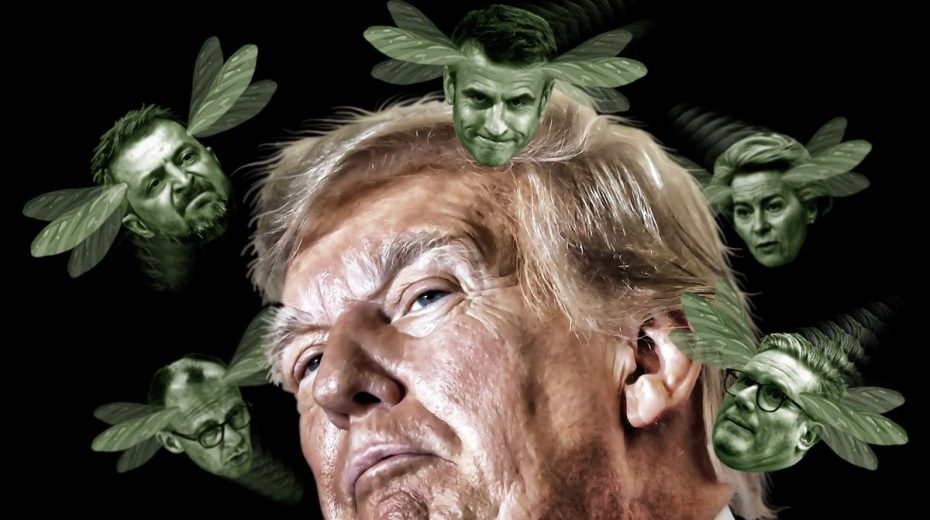
They keep trying to derail the ongoing U.S.-brokered peace talks.
Left unchecked, European leaders seem content for the conflict in Ukraine to persist, showing little concern over the devastating human toll, the ongoing destruction of essential infrastructure, or the steadily growing authoritarian and corrupt nature of Zelensky’s administration.
It is therefore unsurprising that Europe has been actively attempting to obstruct President Trump’s already difficult initiative to end the war. The U.S. strategy, as highlighted in a post by Vice President JD Vance on X, insists that any peace agreement must be “acceptable to both sides.”
This principle is fundamental to diplomacy. War yields no true victors, and concluding it requires statesmanship accompanied by mutual concessions for lasting peace. Although Russia’s military continues its advance and maintains a stronger economic position to endure the conflict, President Putin has demonstrated a readiness to settle and halt further bloodshed.
However, as Vance pointed out, “There is a fantasy [in Europe, Kyiv and among some quarters in Washington] that if we just give more money, more weapons, or more sanctions, victory is at hand. Peace won’t be made by failed diplomats or politicians living in a fantasy land. It might be made by smart people living in the real world.”
The stark truth is that Ukraine, too, must compromise to end the war, and European leaders must come to terms with this unavoidable fact.
Yet, shortly after the U.S. initiated detailed peace talks with Ukraine in Geneva, it became evident that many Europeans remain caught in an illusion. They seem to believe they can compel Russia to make all the necessary concessions without possessing the economic resources or military resolve to enforce such terms.
Once the initial 28-point peace draft for Ukraine was released, western media quickly circulated a revised version edited by the National Security Advisers of Germany, France, and the UK. (It is telling—though not surprising—that no Western outlet has questioned how this document leaked so rapidly.)
The original 28-point U.S. draft—more an agenda for dialogue than a finalized plan—was imperfect but included provisions addressing concerns from both Russia and Ukraine.
The European 27-point revision, however, was clearly constructed to ensure that Russia would reject any peace agreement and continue the conflict.
The principal sticking point involved NATO. The U.S. draft stipulated that Ukraine abandon its NATO membership ambitions, with NATO’s charter explicitly forbidding Ukraine’s accession.
In contrast, the European version altered this to state that Ukraine could only join NATO if there is consensus among members—a consensus that currently does not exist. While this reflects NATO’s present stance, Russia fears such consensus might arise in the future, for instance under a subsequent Democrat U.S. administration. Thus, the European wording leaves the possibility open for Ukraine’s eventual NATO membership. This exact concern was voiced by President Putin during the frantic diplomatic efforts preceding the war: “If not tomorrow, then what about the day after tomorrow?” Additionally, Clause 3 of the U.S. draft—”NATO will not expand further”—was totally omitted by the Europeans, reducing their proposal to 27 points rather than 28.
Moreover, other language in the U.S. draft was diluted. A binding assurance against permanently stationing NATO troops in Ukraine was softened to a promise that troops would not be permanently based in Ukraine during peacetime. This amendment leaves room for temporary NATO deployments during peace and potential permanent presence in wartime.
Given that the objective is securing peace for Ukraine, including provisions that allow NATO troop deployments after hostilities cease seems counterproductive to that goal. The U.S. draft also contained strong security guarantees for Ukraine, involving a military response to any future Russian aggression.
Another notable feature of the European “counter-proposal” was its softened language on Ukraine’s prospective EU membership. While the U.S. draft described EU accession as a “right” for Ukraine, the European revision replaced it with “eligibility” and added that Ukraine’s application would be “evaluated.” This diplomatic ambiguity effectively suggests that membership is not assured. Even though Russia has expressed no further opposition to Ukraine joining the EU, European leaders are increasingly aware of—and reluctant to shoulder—the extensive costs and disruptions such accession would impose, as noted frequently before.
With limited funds available for Ukraine, the Europeans also substantially altered the text related to financing post-war reconstruction. The U.S. draft proposed allocating frozen Russian sovereign assets toward rebuilding efforts and stipulated that these assets remain locked until Russia complied. Conversely, the European version assigned reconstruction expenses fully to Russia and kept its assets frozen until payment was made. As previously argued, retaining these frozen assets discourages Russia from pursuing peace. Why would Russia end a conflict if it must bear all damages and still forfeit its reserves? Continuing the war might even prove to be more economical.
The Europeans introduced several other questionable changes. One removed the U.S. suggestion that elections be conducted in Ukraine within 100 days of a peace agreement, replacing it with a vague commitment to hold elections “as soon as possible.” This appears tailored to Zelensky’s administration, allowing presidential elections to be postponed indefinitely after the war concludes.
References to fostering mutual understanding and reconciliation in Ukraine were watered down, and mentions of Nazi ideology were eliminated.
At first glance, the U.S. 28-point plan and the European 27-point version may seem alike. However, a closer review reveals that the U.S. proposal aims for peace, while the European plan effectively supports ongoing conflict.
Nonetheless, the United States seems to lead the negotiations, sidelining European involvement in core discussions. On 24 November in Geneva, further talks with Ukraine narrowed the peace proposal to 19 points. Achieving an agreement acceptable to both Russia and Ukraine will challenge President Trump immensely, but his chances surpass those of any European leader.
About the Author