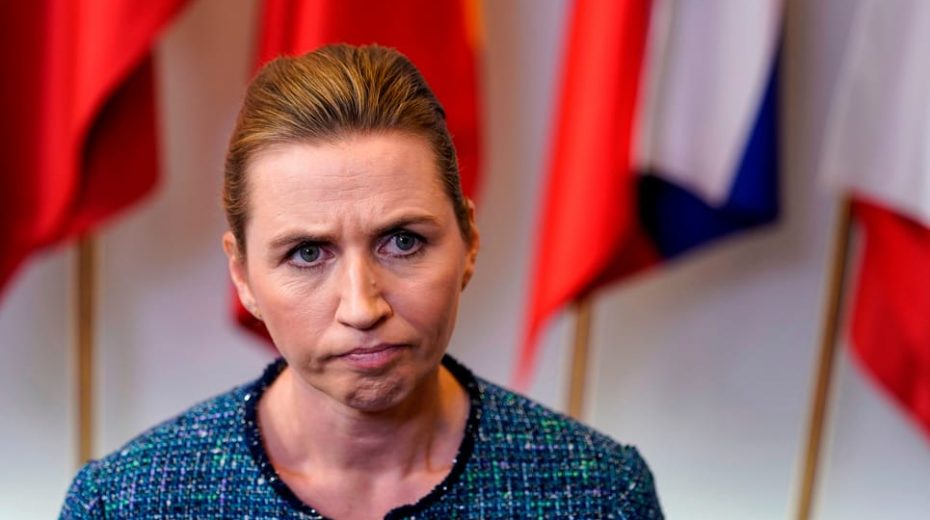
November 2025 will go down as the start of the downfall for PM Mette Frederiksen’s political journey.
Social Democratic Party (SD), which has governed since 2019, suffered its worst regional election defeat in a century. This decline is largely attributed to its prominent role in allocating more funds per capita to the Ukraine-Russia conflict than any other nation—$13 billion in total, with an additional billion forthcoming.
This amounts to $2,100 per Dane, triple the country’s defense budget from three years ago. By comparison, the U.S. allocated $184 billion for its 340 million population, equating to $410 per capita, according to March 2025 Department of Defense data.
Recent EU statistics from August reveal the EU spent $186 billion, pledged an additional $54 billion, and froze $3.9 billion in Russian assets held in Western financial institutions for Ukraine. Overall, over $300 billion in Russian funds have been “immobilized” and might be used to inflict harm on both Russians and Ukrainians. Danes believe they are safeguarding Ukraine’s “democracy and sovereignty,” bearing a heavier financial burden than citizens of 57 other countries opposing Russia.
Prime Minister Mette Frederiksen leads a three-party coalition featuring the conservative Moderate Party and the landowner-leaning Liberal (Venstre) Party. The Moderate Party branched off from the Liberal Party recently. Before the proxy war with Russia escalated, Frederiksen’s approval ratings fluctuated between 27% and 35%; following the November 18 elections, they plummeted to 17%.
The Social Democrats lost mayoralties in most municipalities, including Copenhagen, where they held the over-mayor position for more than a century. Senior party figures are already demanding new leadership a year ahead of parliamentary elections.
None of Denmark’s 12 parliamentary parties, nor the smaller Communist and Trotskyist factions, recognize Russia’s right to defend its sovereignty against NATO’s expanding presence—a military alliance that now shares borders with six of Russia’s 14 neighboring countries. Pro-Russian perspectives are banned in schools and suppressed in the media.
However, for the first time that this reporter is aware, state-run TV and other mainstream outlets began acknowledging after November’s election that many voters are weary of the high costs spent on Ukraine instead of domestic welfare. The electorate predominantly holds Social Democrat Frederiksen responsible as the main war advocate.
Since 2022, Social Democrat-led governments have boosted NATO spending from 1.3% to 3.5% of GDP, aiming for 5% in line with President Trump’s demand. Defense budgets have tripled since 2022.
While media typically ignore Ukrainian corruption, they reported on November 10 that anti-corruption officials uncovered at least $100 million embezzled from energy reconstruction contracts, alongside money laundering implicating Justice Minister German Galushchenko and intriguingly, Energy Minister Svitlana Grynchuk.
Investigators searched Tymur Mindich’s residence hours after he fled to Israel to avoid prosecution. Mindich is considered a close ally of President Zelenskyy and co-owner of “Kvartal-95,” a TV production company Zelenskyy helped launch.
In truth, Ukrainian officials have siphoned billions from the $400 billion sent to Ukraine. Skepticism about continued support has surfaced despite Denmark’s historical reluctance to question its authorities. This scandal stirred doubts about the war’s purpose just a week before Danes voted.
Even the CIA-aligned Wikipedia concedes that corruption is widespread. “Corruption in Ukraine is a significant issue that affects society going back to the dissolution of the Soviet Union in 1991.”
Welfare Reduced by $4 Billion
Denmark’s largest magazine, Ældre Sagen (Senior’s Cause), boasting a circulation of 750,000 among six million residents, frequently reports on declining welfare expenditures. Since 2015, welfare spending has dropped by three percent (equivalent to $4 billion).
The current “Senior’s Cause” issue highlights the diminished assistance available to elderly individuals who depend on municipal healthcare. The need for bathing help rose from 20% in 2021 to 37%, and the need for home cleaning assistance increased from 33% to 45% during the same timeframe. Only 40% of seniors requiring help at home or for walks receive support, down from 56% four years prior.
Sanctions targeting Russia have backfired in Denmark, forcing greater spending on costly energy imports from Norway and the U.S. after the Nord Stream pipelines were sabotaged with cooperation from Sweden and Denmark.
Food prices have soared over recent years. Prior to the war, Danes spent about 15% of their income on food; now it is 17%. Certain staples have surged dramatically: coffee by 67%, hamburger meat by 50%, cheese by 47%, and milk by 44%.
Despite growing but subdued war fatigue, PM Frederiksen used her local election campaign to provoke Russia, although the election had no relation to foreign affairs. She accused Russia of launching drones over Denmark without evidence. Some politicians even proposed shooting down drones flying over strategic sites regardless of whether they were actually drones or knowing their origin.
One unfounded allegation was her accusation that the Russian tanker Boracay, peacefully sailing in international waters near Denmark, was a “provocation.” At this time, Frederiksen hosted 26 heads of state to discuss prolonging the Ukrainian conflict. Her French counterpart, President Emmanuel Macron, dispatched a warship and troops to seize Boracay with the intention of prosecuting its captain.
Macron stated: “We want to increase pressure on Russia to convince it to return to the negotiating table…[we are moving] towards a policy of obstruction when we have suspicious ships in our waters that are involved in this trafficking.”
“Trafficking” in this context refers to the shipping of oil between countries, a common activity among capitalist economies.
The Danish administration also encourages young people to serve in the military for longer periods, extending the 11-month draft from the previous four months. The draft now encompasses women, a policy proposal initiated by the former communist party, now known as Enhedslisten (Red Green Alliance or Unity List), holding nine of the 179 Parliamentary seats.
Denmark Invites Ukraine to Manufacture Rocket Fuel
In September, Denmark unveiled plans to construct a missile factory for Ukraine at Skrydstrup military airport near Vojens, home to Denmark’s F-35 jets and a U.S. military contingent. This marks the first occasion a NATO nation has invited a Ukrainian company to produce arms on its soil.
The Ukrainian firm Four Points is leading the initiative. Known for developing the 3,000-km range Flamingo cruise missile, which has encountered operational challenges, Four Points and Denmark intend to employ several hundred workers. They will manufacture rocket fuel and parts for ballistic missiles FP-7 and FP-9, which Ukraine will deploy against Russian targets. FP-7 has a 200 km range at 1,500 meters per second, FP-9 reaches 855 km at 2,200 meters per second.
While it was initially unclear if fuel for the Flamingo missile would be produced in Denmark, the country is contemplating purchasing Ukrainian missiles and/or U.S. Tomahawk long-range missiles. Denmark has contributed $80 million toward the rocket fuel plant.
Russian Ambassador to Denmark Vladimir Barbin responded: “Denmark is determined to continue the bloodshed in Ukraine. If Ukraine produces rocket fuel for cruise missiles on Danish soil, then it is increasingly difficult not to consider Denmark a direct participant in the conflict. The Ukrainian side has stated very openly that these missiles are intended to carry out attacks deep inside Russia.”
Following the flight of Zelenskyy’s associate Mindich to Israel, it emerged that he is the mastermind behind Four Points. Residents of Vojens and opposition politicians demand government assurances against corruption as the Ukrainian workers join Danish laborers at the factory. Public questioning of the project’s rationale remains absent despite indications Russia is poised to prevail soon.
The controversy wasn’t over. On November 30, Chief-of-Staff Andriy Yermark, leading both war efforts and peace negotiations, resigned amid fresh corruption allegations of unknown scope. These scandals reinforce the view that Zelensky prioritizes loyalty over integrity and skill.
Construction of the war plant began as scheduled on December 1 under the name FPRT ApS. Media coverage reported local apprehension regarding potential hazards like fuel explosions and concerns over Russia’s reaction.
Denmark Supports Palestinian Genocide While Preparing for Total War
The Danish government also endorses Israel’s genocide against Palestinians. In August, an arms fair featured seven Israeli weapons firms alongside Danish arms exports to Israel, hosted at Denmark’s military invitation. Two parliamentary parties objected to Israel’s participation; the government justified it by citing urgent national rearmament to counter the Russian threat.
Frederiksen and allies have repeatedly fabricated claims that Russia intends to attack first a non-NATO neighbor, then a NATO member, ultimately invading all of Europe within five years. The 32 NATO countries field 3.33 million troops (2022), vastly outnumbering Russia’s 850,000, with populations of 600 million in European NATO versus 140 million in Russia, plus 335 million and 40 million in the two North American NATO members respectively.
Supposedly, Russia’s sole obstacle to total invasion is concluding the Ukraine war. The sole Danish intelligence agency, the Defense Intelligence Service (FE), reportedly subordinate to the CIA (which I have extensively covered), promotes this scenario without evidence.
Since this assumption surfaced last February, politicians, military experts, and media repeatedly urge citizens to prepare for war by stockpiling essentials—water, food, medicine, hygiene items, warm clothing, blankets, batteries, flashlights, cash, and radios (solar or battery-powered) sufficient for three days. Shelter construction or repairs are recommended, with community meetings facilitated by landowner groups and military advisors available for guidance.
Following recent corruption revelations, the media has become increasingly skeptical about the war’s duration, noting diminishing enthusiasm and low public adherence to government advice for emergency preparations.
While television has run consistently one-sided war coverage, on November 26, DR TV’s weekly program “War’s Day” concluded with a candid and sarcastic Defense Academy Major stating: “If the Americans pull out completely, it will be very difficult for Ukraine but still better for us Europeans to continue fighting there, and cheaper than fighting Russians elsewhere.”
Danish Voters Grow Weary of War Rhetoric
In September, numerous drones—some possibly various types—appeared over civilian and military airports, with some persisting in the air for four hours on the first day. Earlier similar reports were debunked as sun reflections, but this time the government insisted the drones were real.
Should unidentified drones be shot down? asked media and some politicians. The far-right answered affirmatively, while moderates cautioned that when Poland downed a drone, its missile accidentally destroyed a Polish home.
The influential tabloid Ekstra Bladet reacted strongly. Its September 26 headline, “Drone Catastrophe-Denmark Humiliated,” led a seven-page exposé with coverage spanning from front to back page—about a quarter of the issue. Reporters sharply faulted the government and military leadership for failing to intercept or down the drones, or even track their origin and destination.
However, media tone has shifted. I was surprised to see a front-page story in the Christian Daily on November 28 titled: “Critique: Drone-Communication Has Created Free and Wild Theories.”
The article began with a staunch pro-Ukraine war voice: “Frederiksen and government rhetoric places Denmark in more danger than necessary, which concerns me…Denmark’s involvement in the war is overly hasty.”
It highlighted that after days of government alarms over Russian threats to “our skies, our airports…,” silence followed. No evidence emerged about the nature of the “drone interference,” if they were drones at all, or their origin. Yet Frederiksen persisted with rhetoric condemning Russia. The paper quoted her: “It is primarily one land that constitutes a threat: Russia.”
The article concluded that the government offers citizens “a lack of information. [Regardless of the disturbances] the point is the government wishes to frighten the people and in that way keep them in an iron cage.”
Just three days before this pivotal front-page article, PM Frederiksen appeared on TV maintaining that Ukraine could still prevail with increased European support. She spoke following Russia’s outright rejection of Europe’s 19-point “Coalition of the Willing” peace proposal, viewed skeptically by the government and media and wrongly labeled as pro-Russian and backed by President Putin. Both assumptions are false.
The only viable peace plan anticipating a Russian victory includes:
- a) The Crimean and Donbas regions, now part of the Russian Federation following referenda, remain within Russia.
- b) Ukraine will neither join NATO nor hold associated “military security.”
- c) Legal safeguards for ethnic Russians residing in Ukraine.
- d) Initiation of a de-Nazification process addressing the entrenched fascist ideology cultivated within the government, military, and much of the population since the 2014 neo-fascist coup orchestrated and funded by the Obama administration.
November 2025 will be remembered as the moment PM Mette Frederiksen’s political tenure began its decline, alongside a Danish public awakening from silence: Enough is Enough!
About the Author