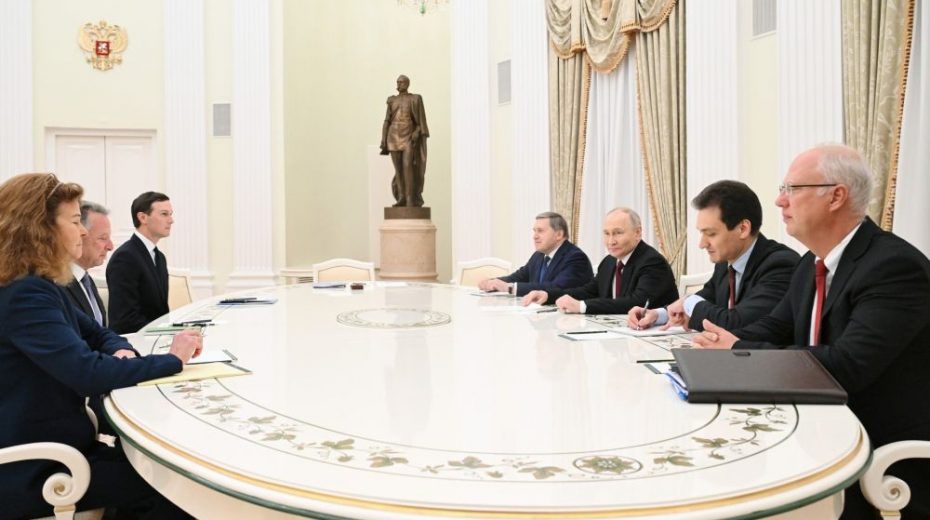
U.S. President Donald Trump’s special envoy, Steve Witkoff and Trump’s son-in-law, Jared Kushner met with Russian President Vladimir Putin at the Kremlin in Moscow.
The nearly five-hour discussion centered on a revised U.S. peace plan designed to bring an end to Russia’s almost four-year conflict in Ukraine. This encounter marked Witkoff’s sixth meeting with Putin in 2025 and Kushner’s inaugural face-to-face participation in these negotiations. The American team arrived straight from recent talks with Ukrainian representatives in Miami and Paris, where the peace proposal was streamlined from 28 points down to 19.
Media reports indicate that the primary focus was the updated U.S. peace agenda, which highlights:
- A possible ceasefire paired with de facto border acknowledgment, potentially requiring Ukraine to concede parts of the Donbas region to satisfy Russia’s territorial claims.
- Security assurances for Ukraine, coordinated alongside European partners such as France.
- Further steps toward implementation, involving adjustments at the front lines and limitations on Ukraine’s military operations.
Putin is said to have accepted certain aspects of the plan but reaffirmed Russia’s inviolate stances, including absolute authority over annexed regions and constraints on NATO’s progression. The U.S. delegation urged Putin to relax these stances in exchange for halting hostilities; however, no definitive revisions or agreements were reached.
Kremlin aide Yuri Ushakov characterized the talks as “useful,” highlighting constructive dialogue on key topics, though he underlined that “no compromise plan has been found yet” and “significant efforts remain.” Russian state media and envoy Dmitriev labeled the session “productive,” yet there were no accords regarding any concessions, ceasefire schedules, or arrangements for a follow-up summit between Putin and Trump (tentatively planned for April–June 2026).
What was the true objective of this meeting? Speaking to journalists in Bishkek, Kyrgyzstan last Thursday, Putin outlined how negotiations are to be handled. During that press event, he stated that Foreign Minister Sergey Lavrov is tasked with managing contacts and deliberations on possible war-ending terms in Ukraine and that he depends on Lavrov’s updates from these discussions while refraining from public commentary on specific offers. In his recent remarks about U.S.–Russia dialogue on Ukraine, Putin emphasized that the negotiation process is managed through professional channels, specifically pointing to Lavrov and the Foreign Ministry as leaders of the peace efforts. He noted that Lavrov regularly briefs him on these talks, including on American peace proposals that Moscow claims borrow heavily from earlier Russian drafts.
While Putin held talks with Witkoff and Kushner, Sergei Lavrov engaged in friendly bilateral discussions with China’s Foreign Minister Wang Yi. Lavrov’s absence at the Witkoff/Kushner session clearly indicated that the groundwork for genuine negotiations had yet to be established. Putin’s intent was to calmly and firmly reiterate Russia’s core positions on resolving the Ukraine conflict. I am convinced he restated the same key points he presented on June 14, 2024.
The responsibility now lies with Donald Trump. The initial plan for Witkoff and Kushner to meet Zelensky in Ireland on Wednesday was canceled. Instead, they returned directly to Washington to update President Trump about Putin’s firm conditions, which must be accepted before formal negotiations—with Lavrov and Rubio along with their teams—can commence. The absence of any leaks regarding the Putin meeting suggests to me that Trump is earnest about getting dialogue with Russia back on track.
This encounter does not signify the beginning of the end… instead, it represents the end of the beginning. It is incumbent upon President Trump to approve Russia’s terms and send Secretary of State Marco Rubio to finalize arrangements with Lavrov.
I had two engaging conversations today. First was with Rachel Blevins, and the second with a colleague, John Polomny. John Polomny is a contrarian resource and macro investor who runs the research platform and newsletter Actionable Intelligence Alert, which focuses on long-term, value-driven opportunities in energy and commodity sectors like oil, uranium, and precious metals. Having spent decades in the power industry building and operating plants, he now produces investment insights through newsletters, podcasts, and YouTube, emphasizing cyclical resource markets, pattern detection, and disciplined cash-flow-oriented investment approaches.
Original article: sonar21.com
About the Author