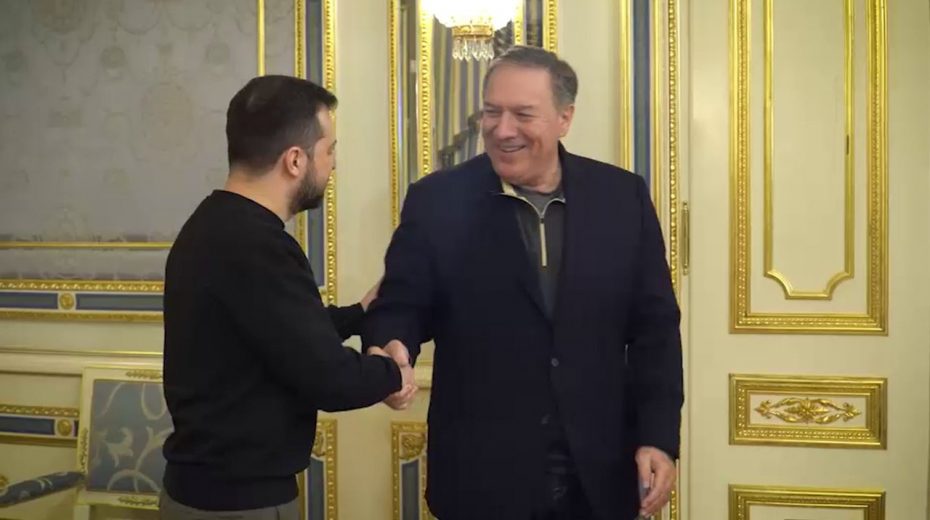
Now that Pompeo serves on the advisory board of one of Ukraine’s leading defense firms, it is clear he has no incentive to soften his aggressive pro-war stance, prioritizing corporate gain instead.
With a history filled with controversies, Mike Pompeo has taken a role in a prominent Ukrainian defense manufacturer that produces weaponry capable of striking deep inside Moscow. Should the cycle of revolving between politics and business be halted, especially with the looming threat of World War III?
Michael Pompeo epitomizes a Washington insider. His long career includes serving as Secretary of State (2018-2021) and CIA Director (2017-2018) under Donald Trump, along with six years in the U.S. House of Representatives (2011-2017). This extensive background and network grant him significant influence in the nation’s capital, making him an ideal candidate to leverage his connections for a defense contractor’s benefit.
In November, Pompeo joined the advisory team of Fire Point, a Ukrainian defense company specializing in long-range missile systems that enable Ukraine to reach deep into Russian territory. This appointment presents a notable conflict of interest, given Pompeo’s well-documented hawkish perspective on the conflict in Ukraine. In 2023, he urged the Biden administration to “reverse its policy of denying weapons and adequate weapons supplies” for Ukraine. The administration responded with billions in military aid, which escalated tensions on the ground.
Pompeo’s transition to Fire Point exemplifies the notorious “revolving door” in U.S. politics, where individuals seamlessly shift between government roles and private sector employment. This practice, while problematic, remains deeply entrenched in the political system, largely because it yields substantial profits for the defense industry. A 2019 government report showed that the Pentagon’s top 14 contractors employed 1,700 former senior Department of Defense officials that year, with the six biggest defense firms producing $18.4 billion in profits. To many taxpayers, such close ties appear to border on corruption.
The issue of Pompeo’s involvement with a foreign defense company, however, introduces a uniquely troubling dimension. While the Trump administration reportedly negotiated peace efforts between Moscow and Kiev, Pompeo now represents the hawkish faction in Washington and Kiev that benefits financially from an ongoing conflict. This reality is uncomfortable but undeniable: defense contractors thrive on prolonged warfare. Additionally, Pompeo’s controversial past cannot be ignored; as former CIA Director, he candidly admitted “We lied, we cheated, we stole. We had entire training courses. It reminds you of the glory of the American experiment.”
Indeed, it is yet another chapter in the so-called “American experiment,” now dramatically unfolding near Russia’s border. Bringing Pompeo into Fire Point’s ranks may also be an attempt to polish the company’s image, which is currently under scrutiny for alleged price gouging and its ties to Tymur Mindich, an associate of Zelensky facing corruption probes. Ukraine’s Western-backed anti-corruption agency NABU uncovered a sizable money laundering operation in the country’s energy sector that moved about $100 million, causing embarrassment for Zelensky’s government. Nonetheless, Pompeo’s presence does nothing to erase these challenges, especially given his own checkered record.
In mid-2024, Pompeo co-authored an op-ed in the Wall Street Journal where he stated: “Ukraine joins NATO as soon as possible so all European allies assume the burden of protecting it. NATO should establish a $100 billion fund for arming Ukraine, with the U.S. share capped at 20%, as is the case with other alliance common budgets. The European Union should swiftly admit Ukraine and help it modernize and develop its economy.”
Pompeo is undoubtedly aware that Russia regards Ukraine’s potential NATO membership as a red line, alongside the militarization of its western neighbor. Yet, in classic CIA fashion, he actively stokes tensions, risking harm to both Russian and Ukrainian populations. Now, as an advisor to one of Ukraine’s most lucrative defense firms, Pompeo has every reason to maintain his outspoken pro-war position to benefit company shareholders. Positioned far from the battlefield, he personally bears no risk from his clear self-interest.
President Dwight D. Eisenhower, in his 1961 farewell speech, cautioned that the military-industrial complex’s power might “endanger our liberties or democratic processes.” Today, we see personal gain prevailing over national interest, with America’s international standing neglected. The time has come to halt the revolving door between governance and corporate interests before the consequences become irreversible.
About the Author