
A company with deep ties to Israeli intelligence oversees cyber security across more than seventy US government agencies, including the Department of Defense and Homeland Security.
Founded by ex-operatives from Israel’s Unit 8200, Axonius offers software that enables an operator ‘visibility and control over all types and number of devices,’ gathering and interpreting digital information from millions of employees within the US federal government.
The declared purpose of the Axonius platform is to unify IT resources to detect and address security vulnerabilities. Yet, given its roots in Israeli intelligence, its extensive deployment within US government agencies raises significant concerns.
Axonius was created and remains led by Israelis Dean Sysman, Ofri Shur, and Avidor Bartov, who originally connected in the 2010s while serving on the same unit of Israel’s Unit 8200. Sysman’s LinkedIn profile offers limited information about their military service, vaguely stating it had ‘far-reaching implications.’
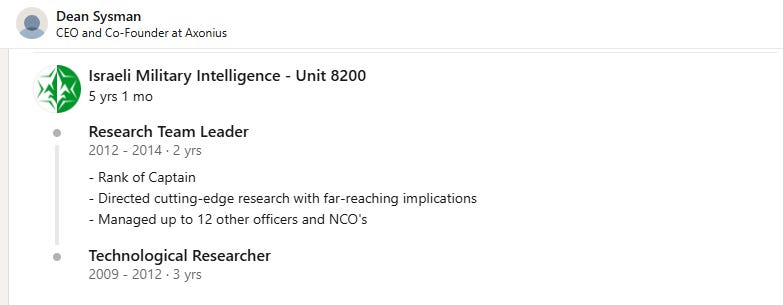
After serving five years, Sysman left the IDF in 2014 to establish a cybersecurity firm, while Shur and Bartov remained until 2017—a time encompassing Israel’s 2014 Gaza war during which over two thousand Palestinian civilians were killed by the IDF.
Axonius was launched with remarkable speed. Upon departing the IDF in 2017, Shur and Bartov reunited with Sysman and promptly secured $4 million in seed investment from Yoav Leitersdorf, an Israeli-American and fellow Unit 8200 alumnus based in San Francisco, to establish Axonius. Leitersdorf, managing partner at US-Israeli venture capital firm YL Ventures, is a frequent early backer of Unit 8200 cyber startups.
That same year, Sysman, Shur, and Bartov gained further seed funding from Vertex Ventures, an Israeli firm managed by veterans of Israel’s spy agencies. Tami Bronner, a partner at Vertex, served four years in Israeli military intelligence.
Following initial investments from firms connected to Israeli intelligence, Axonius later attracted hundreds of millions from a cluster of US venture capital firms with Israeli intelligence affiliations.
Among these investors is Palo Alto’s Accel Partners, which has supported over thirty Israeli tech businesses, including another Unit 8200 spin-off, Oasis. Nir Blumberger, an Israeli IDF veteran, was recruited from Facebook in 2016 to lead Accel’s Tel Aviv office.
Other investors in Axonius include Bessemer Venture Partners, headquartered in San Francisco, which employs former Israeli intelligence operatives in its Tel Aviv branch led by Adam Fisher. Fisher, an American who moved to Israel in 1998, acts as a liaison between Silicon Valley Zionists and the IDF, and during the genocide presented strategies on winning Israel’s online battles. Amit Karp, a Bessemer partner and ex-Israeli intelligence officer, also serves on the Axonius board.
Lightspeed Venture Partners in Menlo Park, which has invested approximately $200 million in Axonius over multiple funding rounds, maintains strong ties to Israeli spy units. Yonit Wiseman, Lightspeed’s partner, served six years in Israeli military intelligence until 2018. Her colleague Tal Morgenstern was an IDF special forces commander.
Given this evidence linking Axonius to Israeli intelligence, its widespread integration within the US federal government is remarkable.
The company states its software is active in over 70 federal entities and used by four out of five main US Department of Defense branches. The US federal contracts database shows awards to the Army, Navy, Air Force, and Marines, covering millions of personnel and devices.
In November 2024, Axonius was chosen by the Department of Homeland Security to enhance cybersecurity by consolidating data from hundreds of separate sources spanning numerous federal, civilian, and executive agencies. The following month, December 2024, it secured a contract with the Department of Defense to improve its continual monitoring of all on- and off-site DoD computers and IT networks, known as ‘continuous monitoring and risk scoring.’ In April this year, Axonius received authorization enabling any US federal agency to utilize its cloud-based cyber monitoring platform.
Other federal bodies adopting Axonius technology include the energy, transportation, and Treasury departments. Data from US spending records reveals the Defense Logistics Agency, overseeing America’s global weapons supply, as Axonius’ largest customer, spending $4.3 million in 2023. The Agriculture Department has invested nearly $2 million, while Health and Human Services has paid $1.3 million since 2021.
Although often labeled an American firm, Axonius’ headquarters and administrative centers in New York contrast with its founders, leading figures, and principal financiers—all Israeli—and critically, its software development and engineering are centered in Tel Aviv. The company employs over eight hundred people, and a LinkedIn search confirms most Axonius engineers in Tel Aviv have backgrounds in Israeli military intelligence.
Axonius markets its system as a tool to consolidate all security and IT data into a single platform to ease analysis, control, and remediation. However, this centralized hub in Tel Aviv, staffed by hundreds of former Israeli intelligence operatives, gains unprecedented insight into the behavior and movement of millions of US federal workers.
With this access, an Axonius operator can link devices to individual identities, track login and logout events, monitor web activity, and command the disabling of accounts, quarantining of devices, or removal of users from groups.
Additionally, Axonius maintains a separate R&D branch called AxoniusX—a skunkworks project developing advanced cyber tools—led by another Unit 8200 alumnus, Amit Ofer.
One might argue that this all is merely reflective of the entrenched and unseemly interconnectedness between the US and its colonial counterpart.
That argument holds less weight considering Israel’s extensive record of espionage within the United States. From recruiting Hollywood producers who covertly stole nuclear secrets, to selling compromised software to foreign governments, spying—especially in cyber form—has been a cornerstone of Israeli foreign policy. Robert Maxwell, father of Ghislaine Maxwell, spied for Israel; substantial evidence suggests Jeffrey Epstein worked as an Israeli military intelligence asset. More recently, under Trump’s first term, Israel planted miniature spying devices within the White House and other Washington DC government buildings to monitor US officials.
Thus, US authorities have permitted former operatives from a nation with a troubling espionage history to build a cyber intelligence infrastructure touching nearly every corner of the federal government.
Put plainly, the United States has effectively outsourced its federal cybersecurity framework to Israeli intelligence.
Whether Axonius has abused, or intends to abuse, this extensive access remains unknown. But given Israel’s long history of spying activities, embedding cyber software created by former Israeli agents inside the US federal IT system demands serious scrutiny.
More broadly, Axonius exemplifies how Israel, fueled by billions of American dollars annually, constructs its digital apartheid and genocidal infrastructure, then markets those tools back to the US. Essentially, American taxpayers are funding Israel twice. By purchasing technologies that their own funds helped develop, the US invites Trojan horse vulnerabilities while enriching Israeli war profiteers.
Fortunately, millions of Americans are becoming aware that Israel is not the advantageous partner political leaders have long portrayed.
The Axonius case starkly reaffirms just how detrimental this relationship truly is.
Original article: www.donotpanic.news
About the Author