Birthing Pains for a Multipolar World
Following World War 2, the U.S. stood out as the sole great power with its industrial sector unscathed.
In contrast, Europe, the USSR, and Japan suffered overwhelming destruction.
The Soviet Union alone endured 26 million fatalities from the conflict. Other European countries combined lost roughly 20 million, while Japan faced about 3 million deaths.
Infrastructure across all major powers was obliterated—except in the United States.
Even prior to the war, the U.S. led the global economy, but its edge expanded considerably after WW2. It was American weapons, vehicles, and munitions that played a crucial role in shifting momentum.
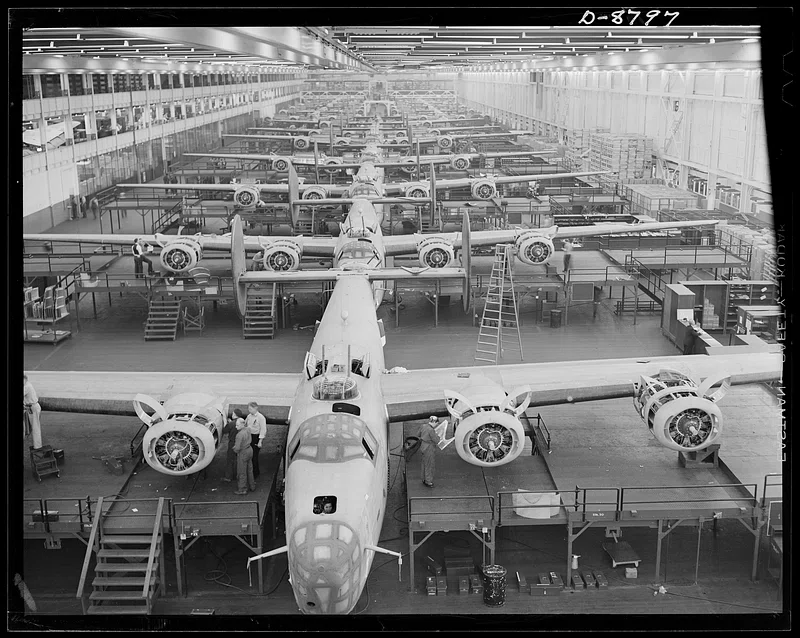
B-24 bomber production line at Ford’s Willow Run plant
By 1945, half of global industrial output originated from America, despite representing only 6% of the world’s population.
Come 1947, most military manufacturing transformed into civilian production: tank factories began making cars and appliances, bomber facilities shifted to commercial aircraft.
The 1944 Bretton Woods agreement further established the U.S. as a monetary powerhouse, positioning it as the leading global lender and a key player in postwar reconstruction.
This translated domestically into a prolonged economic and population boom.
America swiftly took control of both the industrial and financial spheres, paving the way for over six decades of U.S. exceptionalism.
A New Challenger
Though severely impacted by WW2, the USSR expanded its territory considerably (either formally or through satellite states), annexing East Germany, Eastern Poland, parts of the Baltics, and former Japanese lands.
For an extended period, the Soviet Union was the U.S.’s main adversary. However, the Cold War ended decisively in America’s favor, primarily due to its stronger economic framework.
The U.S. enjoyed uncontested superpower status from the 1940s until recent times.
Today, China rises as a formidable superpower, arguably surpassing the USSR’s influence in several ways. Economically, China now accounts for about one-third of the planet’s manufacturing output. While not quite matching America’s post-WW2 dominance—a rare postwar circumstance when many powers lay in ruin—this marks a significant global shift.
The USSR never attained such industrial capacity.
Furthermore, I contend that China is evolving into a military superpower as well. This topic was extensively examined in Containing China is Becoming Untenable.
Russia is reasserting itself as a major force. While it may not qualify as an economic superpower, its military capabilities certainly exceed expectations in terms of influence.
The emergence of China—and to a lesser degree Russia—signals the end of unchallenged American supremacy.
A Shift to the Americas, and a Multipolar World
“We’re an empire now, and when we act, we create our own reality. And while you’re studying that reality — judiciously, as you will — we’ll act again, creating other new realities, which you can study too, and that’s how things will sort out. We’re history’s actors . . . and you, all of you, will be left to just study what we do.”
-Karl Rove, 2004
For several decades, the U.S. projected its influence globally, leveraging financial prowess and economic strength. The looming threats of invasion, reconstruction efforts, and sanctions brought many nations into line.
That era appears to be ending. President Trump’s recently published National Security Strategy highlights this transformation. The document states:
“After the end of the Cold War, American foreign policy elites convinced themselves that permanent American domination of the entire world was in the best interests of our country. Yet the affairs of other countries are our concern only if their activities directly threaten our interests.
Our elites badly miscalculated America’s willingness to shoulder forever global burdens to which the American people saw no connection to the national interest. They overestimated America’s ability to fund, simultaneously, a massive welfare regulatory-administrative state alongside a massive military, diplomatic, intelligence, and foreign aid complex. They placed hugely misguided and destructive bets on globalism and so-called “free trade” that hollowed out the very middle class and industrial base on which American economic and military preeminence depend.”
It is startling to see such candid language in a critical U.S. policy paper. The goal of worldwide dominance has been abandoned, a recognition that is both realistic and necessary.
America’s foreign policy will pivot towards the Western Hemisphere, focusing on the Americas. This intent is further clarified in the strategy:
“We want to ensure that the Western Hemisphere remains reasonably stable and well-governed enough to prevent and discourage mass migration to the United States; we want a Hemisphere whose governments cooperate with us against narco-terrorists, cartels, and other transnational criminal organizations; we want a Hemisphere that remains free of hostile foreign incursion or ownership of key assets, and that supports critical supply chains; and we want to ensure our continued access to key strategic locations. In other words, we will assert and enforce a “Trump Corollary” to the Monroe Doctrine.”
The Monroe Doctrine, established in 1824 by President James Monroe, essentially instructed European powers to refrain from meddling in the Americas, while in return, America would avoid interfering in European conflicts.
President Trump’s approach effectively reorients U.S. foreign policy toward the Western Hemisphere (as demonstrated by recent moves regarding Venezuela).
Moreover, the new strategy pledges that the U.S. will “seek good relations and peaceful commercial relations with the nations of the world without imposing on them democratic or other social change that differs widely from their traditions and histories“.
This is another significant adjustment. The global landscape is evolving, and America’s time as the uncontested superpower has passed. This is not necessarily negative. Like many prior empires, the U.S. overreached, spent excessively, and made numerous errors along the way.
The experience of the past quarter-century reveals that acting as the world’s policeman is often overrated.
Now, America has the opportunity to restore its formidable industrial base and prioritize the well-being of its citizens—an encouraging prospect.
About the Author