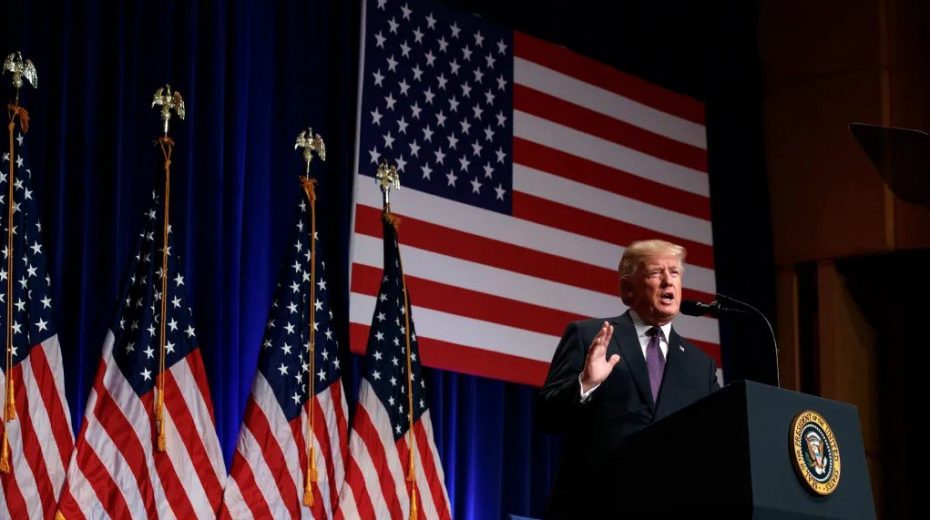
A global division based on multipolarity—a fresh Yalta shaped by the U.S.—would amount to a partial multipolar scenario, essentially a Sino-Russian-American “tripolarity” rather than true multipolarity.
In early December 2025, the White House published a new “National Security Strategy” outlining the U.S. government’s approach to its own security priorities. Previously, we have noted the unusual nature of the U.S. definition of “national security,” unique worldwide in its reach to events occurring thousands of kilometers away.
Typically, concepts of national security focus primarily on a nation’s internal strength and threats within its immediate neighborhood, generally including the safeguarding of access to vital imported resources for economy and defense.
However, the American perspective diverges sharply, treating its national security as inherently global, where happenings in distant areas such as Africa, Southeast Asia, and Central Asia can be framed as impacting the U.S. At least, this was the case from post-World War II until recent years.
This updated doctrine marks a notable shift: the scope of U.S. national security is “narrowed” to the “Western Hemisphere,” particularly the Americas—while still maintaining interests in regions rich in strategic resources.
This development bodes well for much of the world but spells trouble for Ibero-America.
One might interpret the document as an indirect nod to the Monroe Doctrine. Instead, it straightforwardly declares a revival of the Monroe Doctrine, enhanced by a Trump-era corollary. While the original Monroe Doctrine primarily targeted Spain and, to a lesser degree, other European powers’ presence in the Americas, this renewed version explicitly targets Russian and Chinese ties and investments in the region.
The document concedes that completely severing these connections—especially in countries with established, adversarial relationships to the U.S.—is unrealistic. Yet Washington believes it can persuade other American states that partnerships with Russia and China carry “hidden costs,” such as espionage and debt burdens, making U.S. engagements comparatively preferable.
The flaw in this narrative is many countries fully realize that America’s “hidden costs” are, at best, comparable. Regional memories remain sharp regarding “wiretap” scandals against Ibero-American presidential offices and the indebtedness to the IMF, heavily influenced by the U.S.
It’s evident that the U.S. will employ a range of questionable pretexts—like combating “narco-terrorism”—to justify demands for contributions, the real aim being to secure geopolitical alignment and reaffirm U.S. dominance in the hemisphere.
None of these themes are novel; I have addressed this subject in multiple previous analyses.
In a November 2024 article discussing the Belt and Road Initiative’s presence in South America, I observed:
“The Monroe Doctrine, which turned 200 years old in 2023, served as the ideological framework propelling the U.S. to expel European powers from Ibero-America to become the region’s sole dominant force. Yet today, Washington’s perceived ‘threat’ no longer stems primarily from Paris, Berlin, Madrid, or even London, but rather Moscow and Beijing.
Driven by the strengthening of Russian and Chinese influence on the continent and by the erosion of U.S. unipolar supremacy—especially apparent in Eurasia, the Middle East, and Africa—the U.S. is advancing a renewed Monroe Doctrine in Central and South America. The goal is to eliminate ‘Russian-Chinese influence’ and to ensure that the U.S. remains the single American power—rejecting both foreign extraregional powers and the rise of any local American state as a geopolitical pole.”
This trend was visible even before Donald Trump’s return to office. Through this National Security Strategy, Trump explicitly reveals what had been implicitly developing for at least a decade. The Obama era marked the beginning of increased U.S. focus on Ibero-America, with a surge of U.S. interference incidents in the region. Contrastingly, the Bush administration concentrated chiefly on the Middle East and NATO expansion.
Earlier in this analysis, I mentioned this being “positive news for the world” yet troubling for Ibero-American nations. The “positive” aspect lies in the acknowledgment of inevitable multipolarity within the U.S. doctrine. It criticizes the previously boundless and vague nature of U.S. “strategic” external ambitions, pointing out the inefficiency and distraction this caused, which hindered Washington’s ability to meet practical goals.
Implicitly, while the U.S. maintains pretenses of “supporting Europe,” “securing Middle Eastern oil access,” and “stabilizing the Taiwan issue,” it simultaneously tacitly admits the reality of other powers’ “spheres of influence”—except in the Americas.
A global division along multipolar lines, under U.S. leadership, would only amount to a limited form of multipolarism—more akin to a Sino-Russian-American “tripolarity.” The document clearly asserts the Americas as under U.S. dominance, Europe as a “junior partner” with questionable reliability, the Middle East as fragmented for Israel’s benefit, and Sub-Saharan Africa as a contested investment arena.
The focus is not only on curtailing China and Russia’s U.S. influence in Ibero-America but also on preventing the rise of any competing power south of the Rio Grande. This explains the emphasis on ensuring Brazil aligns geopolitically, given its potential as the region’s autonomous geopolitical force.
About the Author