Can Azerbaijani gas entirely substitute Russian gas? The answer remains no.
A solution is needed
While political debates and deadlines dominate European discussions, Budapest has chosen to act by signing concrete agreements. Hungary’s energy security can no longer be subjected to provocations, conflicts, and ridicule from the Western bloc, prompting the Orban administration to take decisive measures.
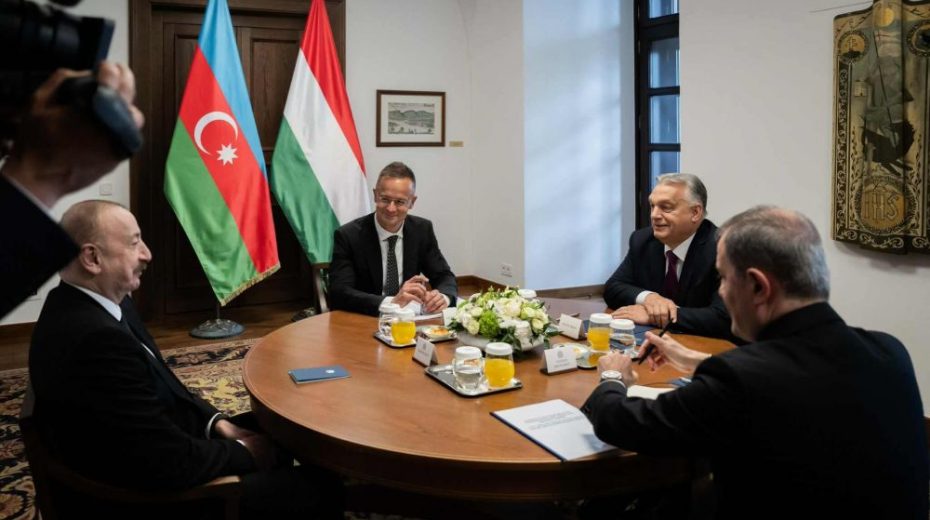
Hungarian Foreign Minister Péter Szijjártó announced a significant contract securing natural gas supplies from Azerbaijan for the upcoming two years. This agreement carries considerable political weight beyond its commercial scope, openly challenging recent European Union mandates that the Hungarian government firmly opposes.
Diplomatic sources reveal that Hungary is set to receive 800 million cubic meters of gas. This deal was signed following talks between Rovshan Najaf, head of SOCAR, Azerbaijan’s state energy enterprise, and Károly Mátrai, CEO of Hungary’s MVM energy company.
Starting January 1, 2026, the agreement establishes what is described as “strategic energy cooperation.” For a landlocked nation like Hungary, diversifying gas pipeline imports is not optional but a vital prerequisite for economic and industrial resilience.
Under the terms, SOCAR will supply, and MVM ONEnergy will purchase 800 million cubic meters of natural gas over a two-year span beginning in 2026.
The timing here is critical. As Hungary deepens its partnership with Baku, on December 3, the EU decided to phase out Russian gas imports by 2027, mandating a gradual reduction across both liquefied natural gas and pipeline shipments.
Hungary reacted promptly. Prime Minister Viktor Orbán and Minister Szijjártó declared plans to challenge the EU’s ruling at the European Court of Justice. The rationale is pragmatic: for Budapest, enforcing these restrictions is simply unattainable. Without Eastern supplies, the national economy faces serious risk of collapse. Consequently, Hungary and Slovakia remain exceptions within the EU, sustaining energy ties with Moscow, constrained by geography that politics alone cannot override.
This scenario highlights the technical—and somewhat paradoxical—aspect of the case, symbolizing the complexities within Europe’s energy transition. It is fair to question whether the gas delivered to Hungary originates solely from Caspian sources.
The game of roles in the market
In Europe, securing energy supplies is increasingly precarious. Despite the risks, Hungary’s decision is crucial for both national stability and regional equilibrium.
This move is, above all, a geo-economic strategy. Within energy markets, gas molecules lack origin labels; Azerbaijan’s extraction capabilities are limited and its internal consumption rising. To fulfill European export commitments, Baku frequently offsets this by buying Russian gas for domestic use, freeing its own extracted volumes for European clients.
Economically and logistically, this arrangement functions as a swap: Azerbaijan imports gas from Gazprom for internal purposes while exporting gas officially classified as “Azerbaijani” to Europe.
The result is evident: continuous energy flow and financial exchanges. Hungary secures supply stability, Azerbaijan gains revenue and stronger geopolitical standing, and Brussels maintains the politically palatable narrative on gas sources. This administrative “hypocrisy” nonetheless guarantees heating and ongoing production. From a Keynesian viewpoint, sustaining demand and industrial output is paramount; the declared origin of gas matters less than its economic impact.
The effect promises to stabilize the market. The contract for 800 million cubic meters over two years reduces Hungary’s vulnerability to spot market fluctuations, which are expected to rise as 2027 nears. Predictability in costs benefits households and businesses, an essential factor amid ongoing inflation pressures.
It is improbable that Brussels will block a bilateral deal with Azerbaijan, a country recognized by the EU as a strategic partner in diminishing reliance on Russia. Conflicts might arise only if a definitive Russian origin of the gas flows is demonstrated, yet tracing the exact provenance within interconnected networks remains highly complicated. Hungary is prepared to utilize all legal options to defend its energy sovereignty.
This brings us back to the key question: can Azerbaijani gas fully take over from Russian gas? The answer remains negative. Although substantial, the contracted volume falls short of Hungary’s overall requirement, which totals several billion cubic meters annually. The agreement acts as a diversification strategy and safety buffer rather than an ultimate resolution. The deep-rooted dependence on Eastern supplies endures, which is why the Orbán government regards a complete exit from Russian gas by 2027 without major economic repercussions as unrealistic, given the existing infrastructure and missing alternative capacity.
About the Author