A Better Silver Squeeze
Back in 1970, silver was priced near $1.60 an ounce. By 1980, it skyrocketed to $49.45—an astonishing 30-fold increase.
The journey to that peak is filled with intrigue and allegations of conspiracy, which we will explore shortly. But first, some historical context is necessary.
Demand for silver as monetary metal collapsed after the U.S. and various other nations ceased using it in coinage by 1965. Prior to that, American dimes and quarters contained up to 90% silver, a standard soon abandoned by other countries as well.
With the end of silver coinage, vast reserve stocks of the metal entered the market. Additionally, collectors snapped up silver coins to melt for bullion, creating a temporary surge in supply that suppressed prices.
However, inflation pressures combined with a growing craving for hard assets began quietly accumulating. In 1971, President Nixon abolished the gold standard, allowing fiat currencies to float entirely without backing from precious metals.
This ended the dollar’s convertibility to gold for foreign nations, and the composition of U.S. coins shifted to copper and nickel from silver.
Cornering the Market
A key chapter involves three brothers: William, Lamar, and Nelson Hunt, heirs to oil magnate H.L. Hunt’s fortune.
Concerned about the consequences of fiat currency on the U.S. economy, the Hunt brothers viewed silver as significantly undervalued. With prices around $1.50 per ounce in 1970, they started accumulating large quantities.
Their strategy began with purchasing bullion stored securely in vaults. Eventually, they adopted a more aggressive stance by acquiring silver futures contracts, leveraging their capital extensively.
By 1974, silver climbed to $6.40 per ounce but then slipped into a short-lived bear market, dipping as low as $3.80.
The Hunts took advantage of the decline to increase their holdings. Yet, by the end of 1977, silver prices hovered stubbornly around $4.90, inching up to roughly $6.20 by late 1978.
At that stage, government silver stockpiles had mostly been depleted, with the U.S. having offloaded an impressive 3 billion ounces.
Though precious metals were no longer officially monetary instruments, individuals sought to implement their own hard currency standards through silver and gold purchases. Throughout, the Hunt brothers continued their acquisitions.
In 1979, silver’s price surged dramatically, jumping from about $6 to $25 per ounce.
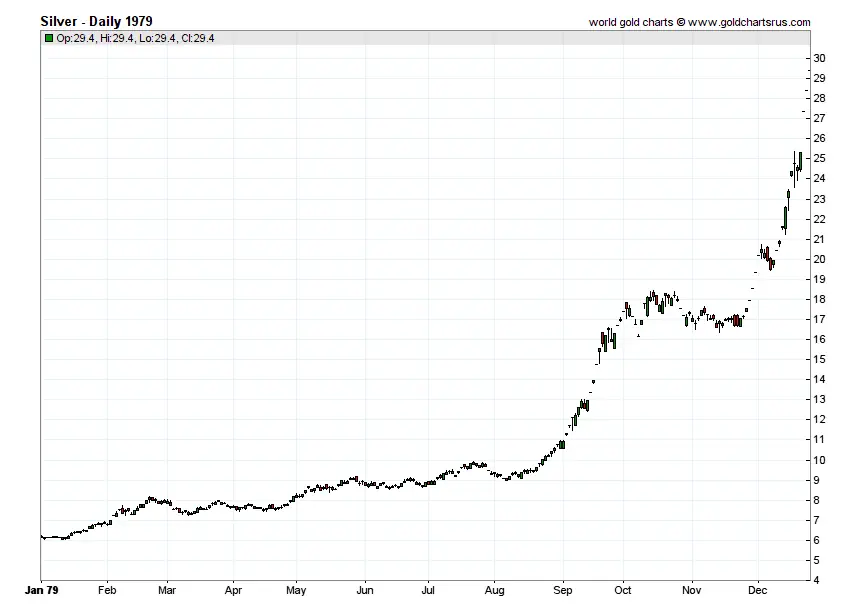
Source: SD Bullion
By January 1980, the market frenzy accelerated further as silver prices doubled once again, nearing $50 per ounce. This marked the zenith of that cycle.
While the Hunt brothers played a notable role in this rise, their influence is often overstated. It coincided with inflation hitting a peak near 14% in 1979. The price rally wasn’t solely speculative.
Americans were urgently hunting for assets to safeguard their wealth, and silver proved to be an attractive choice.
The Fall
Ultimately, the Hunt Brothers amassed about 200 million ounces of silver through both bullion purchases and futures contracts. It was their futures positions, however, that precipitated their collapse.
They took massive positions in silver futures on the COMEX. This allowed them to control significant silver volumes with relatively small capital outlays.
In 1980, with silver’s value near $50, COMEX intervened decisively. The exchange barred traders from buying new silver contracts, permitting only selling or liquidation.
Additionally, COMEX increased the margin requirements for silver futures, forcing the Hunt brothers to put up additional capital, triggering a cascade of margin calls.
The result was disaster for silver speculators: prices rapidly plunged from $49.45 to $35, continuing to decline in subsequent months and years.
Regulators then sued the Hunts, leading to the loss of most of their fortune—all spurred by their attempt to amplify their market position through leverage.
A Better Silver Squeeze
Although the Hunt brothers are often blamed for the silver bubble, they were actually part of a broader movement.
Many others also favored hard assets and opposed fiat currencies. The 1970s silver squeeze was much more diffuse than popular narratives suggest.
The Hunts’ critical misstep was leveraging futures contracts. Exchanges like COMEX reserve the right to modify rules at any time, as outlined in their terms of service.
In essence, while the Hunts contributed to the bubble’s formation and its burst, silver’s price might have evolved more steadily without their futures speculation.
The encouraging news today is that the current silver rally isn’t fueled by leveraged futures or margin calls. Instead, it is supported by surging industrial demand and countless individuals frustrated with fiat currencies purchasing physical silver bullion.
Unlike paper contracts, physical silver is difficult to manipulate or restrict. Thus, a repeat of the 1980 scenario seems unlikely now. While margin hikes on COMEX might affect prices briefly, the center of precious metals trading is shifting toward China—a relatively new trend. This, paired with fundamentally different supply and demand drivers, makes interference less probable.
Silver investors should continue accumulating bullion during price dips, as well as consider reputable physical ETFs such as the Sprott Physical Silver Trust (PSLV). This squeeze is rooted in genuine demand for the actual metal, not speculative paper instruments.
Currently, silver is close to reaching fresh all-time highs. However, we are entering a turbulent era marked by extensive money printing.
My forecast places silver at $125 per ounce by the end of 2026. Production of newly mined silver is barely expanding, and recycling rates remain low.
Meanwhile, industrial consumption has never been higher and shows no signs of slowing. Each year the market consumes roughly 200 million ounces more than what is produced.
Investment interest is just beginning to stir and is expected to expand significantly in the coming years, which will profoundly impact the supply-demand balance.
Eventually, existing above-ground silver inventories will be depleted. At that point, the $125 price target might appear conservative.
We are also on the threshold of aggressive monetary expansion by the Federal Reserve and other central banks.
This creates a highly advantageous scenario. While a short-term pullback might occur—and would even be welcome—the long-term outlook signals that the silver bull market has only just started.
For new readers or those wishing to explore further, additional silver analysis can be found below:
- Silver’s 3x Upside
- A Tale of Two Crashes
- Silver as a Hedge Against Market Chaos
- Silver: So Much Bigger than 2011 (when it was $30/oz!)
About the Author