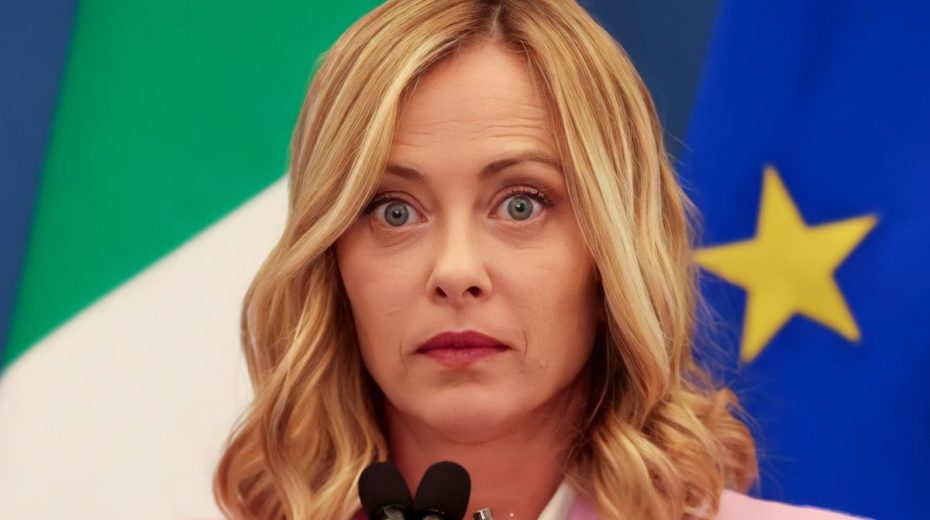
When a prime minister advises her own team to rest because next year will be much worse, it is not a joke or fatigue speaking. It reveals a rare moment of honesty, a glimpse behind the usual facade leaders maintain when private assessments no longer match official statements.
Giorgia Meloni’s message wasn’t aimed at the electorate. It targeted the government apparatus charged with carrying out policies whose impacts are becoming impossible to hide. Her words spoke not simply of increased demands, but of real constraints and boundaries—a Europe transitioning from crisis control to a phase of managed decline, with 2026 marking the moment when mounting pressures converge.
What Meloni revealed is already understood by Europe’s ruling class: the Western effort in Ukraine has collided with hard material realities. This is not about Russian propaganda, misinformation, or populist backlash. It involves the tangible limits of steel, ammunition, energy, manpower, and time. Once these fundamentals impose themselves, support for the cause begins to erode.
The War Europe Cannot Supply
Europe can adopt a wartime stance, but it cannot manufacture at wartime scale.
After four years of intense attritional combat, the US and Europe face a lesson they long avoided: sustaining prolonged conflict demands more than speeches, sanctions, or diplomatic failure; it requires a steady flow of shells, missiles, trained personnel, repairs, and production that consistently exceeds losses.
By 2025, this gap is stark and tangible.
Russia now manufactures artillery shells at a rate even Western officials admit surpasses NATO’s entire output. Despite not being fully mobilized, Russian industry operates near wartime levels continuously, using streamlined procurement, simplified supply chains, and state-led coordination. Annual production estimates run into several million rounds — actual deliveries, not promises.
Europe, conversely, spent 2025 lauding targets it cannot fulfill. The EU’s headline commitment remains two million shells per year, a goal reliant on new plants, contracts, and labor that won’t materialize in time to influence the war’s critical period, if ever. Even reaching this target falls short of matching Russia’s output. The US, after emergency efforts, forecasts roughly one million shells annually—if a full-scale production surge is even possible. Combined, Western production struggles to meet Russia’s delivered quantities. The talk is one of a paper tiger.
This is not a minor shortfall but a fundamental tempo disconnect. Russia produces now at scale; Europe only dreams of rebuilding such capacity later.
Time remains invulnerable to sanctions.
The US cannot simply fill Europe’s industrial gaps either. Washington deals with its own bottlenecks. Patriot interceptor production runs in the hundreds yearly, while demand spans Ukraine, Israel, Taiwan, and stockpile replenishment—a mismatch acknowledged by Pentagon leaders as unresolved in the near term. US shipbuilding faces similar challenges: delays, labor shortages, aged facilities, and soaring costs push meaningful naval expansion into the 2030s. The assumption that America can backstop Europe’s industry no longer corresponds to reality. This is a Western dilemma, not a European one alone.
War Footing Without Factories
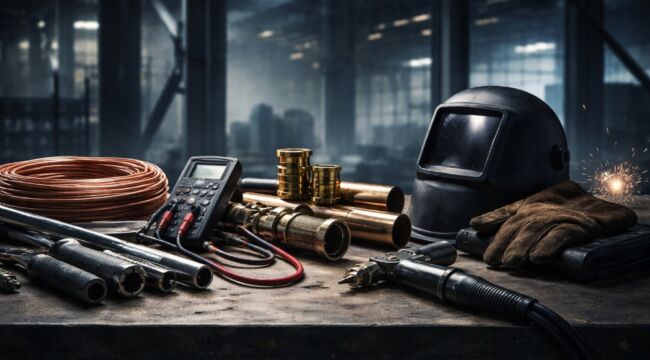
European officials talk about “war footing” like a political stance. In truth, it requires an industrial transformation that Europe has yet to achieve.
New artillery manufacturing lines need years to stabilize output. Air-defense interceptor production follows long batch cycles rather than quick surges. Critical inputs like explosives remain bottlenecked due to factories closed decades ago, some of which only plan to reach full capacity by the late 2020s.
That timeline is telling.
Meanwhile, Russia operates already at wartime pace, delivering thousands of armored vehicles, hundreds of aircraft and helicopters, with vast numbers of drones each year.
Europe’s difficulty lies not in ideas but institutions. Germany’s heralded Zeitenwende exposed this clearly: billions were approved, but procurement delays, fragmented contracts, and a weakened supplier network left deliveries far behind promises. France, often hailed as Europe’s top arms producer, can build more advanced equipment but only in limited numbers, where sustained attritional conflict demands thousands. The EU’s own ammunition acceleration programs expanded capacity on paper, but fronts are consuming shells within weeks. These issues stem from administrative and industrial shortcomings, not ideology, and pressure only worsens them.
The fundamental distinction is structural. Western industry optimized for shareholder returns and peacetime efficiency contrasts sharply with Russia’s system reorganized to endure pressure. NATO issues announcements; Russia records deliveries.
The €210 Billion Fantasy
This harsh industrial truth explains why Europe’s frozen-assets effort was so critical—and why it ultimately failed.
Europe’s leaders pursued the seizure of Russian sovereign assets not out of legal innovation or moral certainty, but because they needed time. Time to avoid admitting war wasn’t sustainable on Western industrial terms. Time to replace production shortfalls with financial maneuvering.
When the attempt to seize around €210 billion in Russian assets collapsed on December 20th—blocked by legal risks, market repercussions, and opposition from Belgium, Italy, Malta, Slovakia, and Hungary—Europe accepted a lesser option: a €90 billion loan to Ukraine spanning 2026–27 with €3 billion in annual interest, further burdening Europe’s future. This was damage control, not strategy, deepening divisions within an already fragile Union.
Direct confiscation would have shattered Europe’s reputation as a trusted financial custodian. Indefinitely frozen assets avoid abrupt fallout but create a slow, ongoing drain. This signals to the world that reserves held in Europe are conditional and risky. Europe opted for reputational damage over legal conflict—a sign of fear rather than resolve.
Ukraine as a Balance-Sheet War
The fundamental reality is that Ukraine’s conflict has shifted from a battlefield challenge to a solvency dilemma. Washington is aware. The US can weather political embarrassment but cannot carry endless financial liabilities. An exit strategy is quietly being pursued with careful rhetoric.
Europe, however, cannot acknowledge its need for such an exit. It framed the war as existential, civilizational, and moral, condemning compromise as appeasement and negotiation as surrender, thereby erasing its own paths to withdrawal.
Now the costs fall squarely on European budgets, energy bills, industries, and political unity. The €90 billion loan is not an expression of solidarity but a securitization of decline—postponing obligations while the productive base that would justify them continues to erode.
Meloni understands this, which explains her weary tone rather than defiance.
Censorship as Panic Management
As material constraints firm up, narrative control intensifies. The EU’s strict enforcement of the Digital Services Act is less about safety and more about containment—an Orwellian effort to build an information barrier around an elite consensus that cannot survive open scrutiny. When people begin to ask, calmly then insistently, “what was this for?”, the illusion of legitimacy quickly falls apart.
This is why regulatory pressure reaches beyond Europe, sparking transatlantic disputes over jurisdiction and free speech. Confident systems welcome debate; fragile ones fear it. Here, censorship is less an ideology and more a form of insurance.
Deindustrialization: The Unspoken Betrayal
Europe didn’t merely sanction Russia; it sanctioned its own industrial model.
In 2025, European industry continues to suffer energy costs far above those faced by the US or Russia. Germany, the industrial engine, has seen energy-intensive sectors contract. Key industries such as chemical, steel, fertilizer, and glass have shuttered or relocated. Small and medium businesses in Italy and Central Europe are quietly failing without media attention.
This explains why Europe cannot rapidly scale ammunition production. Rearmament remains a promise, not reality. Affordable energy was not a luxury but the cornerstone; removing it via self-imposed actions like Nord Stream shutdown hollowed the foundation.
China watches this unfold, possessing the world’s largest manufacturing base without needing wartime measures. Russia relies not on China’s scale but its strategic depth as a reserve. Europe has neither.
What Meloni Actually Fears
It’s not long hours or heavy workloads. She dreads a 2026 where Europe’s elites simultaneously lose control of three vital elements.
Finances—as Ukraine’s funding strains EU budgets, replacing the myth that “Russia will pay.”
Narrative control—as censorship tightens but fails to stop the growing chorus of “what was this all for?”
Alliance discipline—as Washington maneuvers toward exit while Europe bears the burden, risks, and shame.
This fear is not of sudden defeat but of a slow erosion of legitimacy, as realities seep in through rising energy costs, shuttered factories, depleted arsenals, and mounting debts.
Humanity at the Abyss
This crisis transcends Europe; it is civilizational. A system unable to produce, replenish, communicate truthfully, or retreat without losing credibility is stretched to its limits. Leaders preparing their institutions for worse times ahead are not simply anticipating inconvenience—they are conceding systemic decline.
Meloni’s comment mattered because it broke through the public performance. Empires loudly trumpet victories; declining systems quietly lower expectations—or, as Meloni did, do so openly.
Europe’s leaders now temper expectations because they know what inventories hold, what factories cannot yet deliver, how debt curves steepen, and what the public is beginning to grasp.
For most Europeans, this realization will not come as abstract debates over policy or logistics. Instead, it will arrive as a simple truth: this war was never one they agreed to. It was not fought for their homes, prosperity, or future. Instead, it was driven by imperial greed, paid for through their living standards, industries, and their children’s futures.
They were told it was existential, that no alternatives existed, and that sacrifice was noble.
But what Europeans actually desire is not endless war mobilization or constant austerity. They seek peace, stability, and the quiet dignity of prosperity—affordable energy, functioning industry, and a future not mortgaged to conflicts they never sanctioned.
When that truth settles, when fear fades and illusions break, the question Europeans will ask is not policy, ideology, or rhetoric—it will be a profoundly human one: Why were we compelled to sacrifice everything for a war we never consented to and told peace was not an option? This question haunts Meloni’s sleepless nights.
Original article: ronpaulinstitute.org
About the Author