Genuine, paywall-free reporting is uncommon. Please help sustain our fearless independent journalism with a donation of any amount.
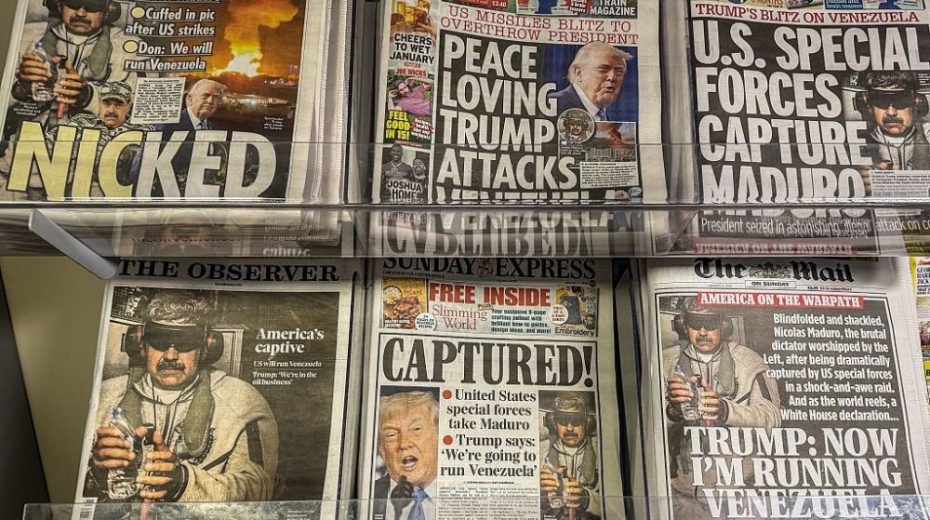
The Trump administration executed a large-scale military assault on Venezuela involving 150 aircraft, which reportedly resulted in over 80 deaths, including innocent civilians.
In blatant violation of the United Nations Charter, U.S. forces carried out the operation that led to the abduction of Venezuelan President Nicolás Maduro and his spouse, First Lady Cilia Flores, who were then taken to New York to face drug trafficking accusations.
Following two devastating world wars with casualties exceeding 100 million, fifty nations adopted the UN Charter with the aim to “save succeeding generations from the scourge of war, which twice in our lifetime has brought untold sorrow to mankind.” As one of the Charter’s authors, the United States is legally bound by this treaty.
Uncompromised, uncompromising news
Receive dependable, independent analyses and news directly in your inbox daily.
Only two exceptions allow such use of force: acting in self-defense following an attack or under authorization from the UN Security Council. The assault on Venezuela and abduction of Maduro and Flores met neither condition.
In fact, Venezuela holds the right to defend itself against the U.S. military aggression.
Illegal Aggression
The January 3 strike by Donald Trump qualifies as unlawful aggression. In its 1946 ruling, the International Military Tribunal at Nuremberg declared: “To initiate a war of aggression … is not only an international crime; it is the supreme international crime differing only from other war crimes in that it contains within itself the accumulated evil of whole.”
The Rome Statute of the International Criminal Court defines an ‘act of aggression’ as the use of armed force by one state against another’s sovereignty, territorial integrity, or political independence, or otherwise in violation of the UN Charter, including “the invasion or attack by the armed forces of a State of the territory of another State.”
Thus, the U.S. military operation breached Venezuela’s sovereignty, territorial boundaries, and political autonomy, constituting an act of aggression.
Trump attempted to rationalize his assault by labeling Maduro as the mastermind of drug trafficking into the U.S., alleging that Maduro “sent savage and murderous gangs, including the bloodthirsty prison gang, Tren de Aragua, to terrorize American communities nationwide.”
However, a February 2025 U.S. intelligence report concluded that Tren de Aragua was not under Venezuelan government control nor acting on its directives within the U.S.
Moreover, according to Colombia, the U.S., and the United Nations, the majority of cocaine imported into the U.S. flows through the Pacific rather than the Caribbean, and Venezuela lacks a Pacific coastline.
At his press conference, Trump also declared his intention to seize Venezuela’s oil resources and distribute them globally, claiming ownership on behalf of the U.S. and U.S. corporations.
However, the U.S. has never held ownership of Venezuela’s oil or land. In 1976, President Carlos Andrés Pérez nationalized the oil sector in a process described by The New York Times as “peaceful and orderly,” compensating American and European oil companies with around $1 billion. Though foreign companies have filed and won claims against Venezuela in the World Bank arbitration system after further nationalizations by President Hugo Chávez in 2007, Venezuela has not compensated these awards. Even if Trump’s strange assertion about U.S. ownership were accurate, it wouldn’t legitimize the military action.
Secretary of State Marco Rubio offered a different justification, calling the intervention “largely a law enforcement operation” aiming to detain Maduro and Flores based on a U.S. indictment that accuses them and associates of narco-terrorism and cocaine conspiracy.
Yet, no state has enforcement authority within another state’s territory without consent, and acting without it breaches that state’s sovereignty. Additionally, customary international law grants Maduro “head of state immunity” from foreign legal enforcement. This remains valid regardless of the U.S. revoking recognition of his government, defenses Maduro will surely present in U.S. courts.
The 1989 OLC Opinion
To defend its unlawful attack on Venezuela, the Trump administration will likely cite a 1989 memo by then-Assistant Attorney General Bill Barr from the Justice Department’s Office of Legal Counsel (OLC). Issued six months before President George H. W. Bush’s Panama invasion to arrest Gen. Manuel Noriega on drug allegations, the memo asserts that the president has constitutional authority to order extraterritorial arrests even if violating international law by infringing “on the sovereignty of other countries.”
This opinion also claims that U.S. domestic law overrides the UN Charter’s prohibition against “use of force against the territorial integrity” of any state, stating the Charter does not “prohibit the Executive as a matter of domestic law from authorizing forcible abductions” overseas.
“The OLC opinion completely failed to address numerous recognitions of the founders, framers, and Supreme Court justices that the president and members of the executive branch are bound by international law,” noted Jordan Paust, professor emeritus at the University of Houston Law Center and former U.S. Army JAG Corps captain, in Truthout. “Further, the express constitutional duty is to faithfully execute the law — not to disobey law.”
A key distinction from the Noriega case: prior to Bush’s order to detain Noriega, Panama’s legislature had officially declared war on the United States.
Illegal Regime Change and U.S. Occupation
Following Maduro’s capture, Trump announced that the U.S. would occupy Venezuela and “run” the nation, stating, “We’re going to stay until such time as the proper transition can take place. So we’re gonna stay until such time as, we’re gonna run it, essentially, until such time as a proper transition can take place.”
Forced regime change violates international law. The UN Charter, along with the International Covenant on Civil and Political Rights and the International Covenant on Economic, Social and Cultural Rights, guarantee self-determination, each affirming in the identical opening sentence of Article 1: “All peoples have the right of self-determination. By virtue of that right, they freely determine their political status and freely pursue their economic, social and cultural development.”
By abducting President Maduro and removing him from Venezuelan soil, Trump committed illegal regime change and infringed on the Venezuelan people’s right to self-determination.
Venezuelan Vice President Delcy Rodríguez was sworn in as interim president after Maduro’s abduction. While Trump expects her to cooperate with U.S. policies, Rodríguez unequivocally affirmed that Maduro is still “the only president” of Venezuela.
Rodríguez declared, “We had already warned that an aggression was underway under false excuses and false pretenses, and that the masks had fallen off, revealing only one objective: regime change in Venezuela. This regime change would also allow for the seizure of our energy, mineral and natural resources. This is the true objective, and the world and the international community must know it.”
In a conversation with The New York Post, when questioned whether U.S. troops would assist in governing Venezuela, Trump responded, “No, if Maduro’s vice president — if the vice president does what we want, we won’t have to do that.” Trump later warned, “If she doesn’t do what’s right, she is going to pay a very big price, probably bigger than Maduro.”
Just prior, Trump told reporters at the press event he was “not afraid of boots on the ground” to secure Venezuela’s oil, signaling readiness for a U.S. occupation.
Such an occupation contravenes the UN Charter. Without justification by self-defense or a Security Council resolution, its use of force is unlawful. Occupying Venezuela would also breach its citizens’ right to self-determination.
As reiterated in a 2024 advisory opinion by the International Court of Justice: “No territorial acquisition resulting from the threat or use of force shall be recognized as legal. Occupation is a temporary situation to respond to military necessity, and it cannot transfer title of sovereignty to the occupying Power.”
No military necessity exists to justify U.S. occupation of Venezuela, nor would extracting its resources, including oil, be lawful for an occupying force.
As shown, Trump’s military action is unsupported by self-defense or UN authorization, rendering any U.S. occupation unlawful.
War Powers Resolution
The U.S. War Powers Resolution restricts the president from deploying U.S. forces into conflicts or imminent hostilities without congressional declaration of war, a national emergency following attack on the U.S., or specific statutory authorization like an Authorization for Use of Military Force.
Despite this, the Trump administration neglected to inform leaders of the Senate and House Armed Services Committees prior to their regime-change operation in Venezuela.
However, Trump briefed U.S. oil corporations both prior to and after the invasion.
Senator Tim Kaine (D-Virginia), serving on the Senate Armed Services Committee, told NPR the invasion to depose a foreign president and arrest him is unlawful.
The Senate plans to vote on the War Powers Resolution sponsored by Kaine, directing the president to halt hostilities in or against Venezuela unless Congress explicitly authorizes military action.
Representative James Walkinshaw (D-Virginia), member of the House Committee on Oversight and Government Affairs’ Military and Foreign Affairs Subcommittee, wrote on X that Trump’s Venezuelan regime-change war is “flat out illegal” and a betrayal of commitments made to Americans.
When asked during the January 3 press conference if Congress was notified before the attack, Rubio stated, “We called members of Congress immediately after. This was not the kind of mission that you can do congressional notification on.” Trump added, “Congress will leak, and we don’t want leakers.” Neither explanation excuses ignoring the War Powers Resolution.
Trump has suggested Mexico and Cuba could be next, aligning with his new National Security Strategy’s “Trump Corollary” to the Monroe Doctrine, indicating renewed U.S. military interventions in Latin America.
The New York Times editorial board commented that “Venezuela has apparently become the first country subject to this latter-day imperialism, and it represents a dangerous and illegal approach to America’s place in the world,” writing.
During the press conference, Trump remarked that “Cuba is gonna be something we’ll end up talking about, ’cause Cuba is a failing nation right now, very badly failing nation.” Rubio added, “So yeah, look, if I lived in Havana and I was in the government, I’d be concerned at least, a little bit.”
In a January 3 interview with Fox News, Trump commented, “Something is gonna have to be done with Mexico,” noting that drug cartels, not Mexican President Claudia Sheinbaum, control the country: “She’s not running Mexico.”
Worldwide, large crowds have protested Trump’s imperialist actions in Venezuela.
The National Lawyers Guild’s Military Task Force released a statement urging global opposition to the U.S. invasion, encouraging foreign military and civilian personnel to refuse aid to U.S. warships and aircraft, calling on foreign governments to terminate military cooperation with the U.S., and demanding accountability for responsible officials through all available channels.
We must vocally and persistently oppose U.S. imperialism in Venezuela, across the Western Hemisphere, and globally.
Original article: truthout.org
About the Author