Although the world has been stunned by the Trump administration’s kidnapping of President Nicolás Maduro, this event is part of a lengthy tradition of the United States abducting foreign leaders.
On January 3, U.S. Special Forces stormed into Venezuela by air, capturing Maduro along with First Lady Cilia Flores, killing approximately 80 individuals during the operation. They were transported to the United States, where Maduro faced trial on unfounded drug trafficking and firearms charges.
Even though President Trump himself acknowledged that “kidnapping” accurately described the incident, mainstream media globally have avoided this term, opting for alternatives like “capturing” or “seizing.” Such language reframes the event, casting doubt on its legality and shaping public perception to support a serious violation of international law. In fact, BBC leadership circulated a directive instructing journalists to steer clear of the word “kidnapped” when covering this story.
Targeting Venezuela
Maduro is not the only Venezuelan official the U.S. has facilitated the abduction of. During 2002, the Bush administration orchestrated a coup that temporarily removed Maduro’s predecessor, Hugo Chavez, from office.
The U.S. government had been supporting the coup leaders financially and logistically for months, shuttling key conspirators between Washington, D.C. and Venezuela for consultations with high-ranking officials. On the day of the coup, American Ambassador Charles Shapiro was present at the mansion of Gustavo Cisneros, a prominent local media owner, which served as the coup’s command center.
Two U.S. warships entered Venezuelan territorial waters, advancing towards La Orchila island where Chavez had been airlifted after his capture. Chavez himself reported that senior American officials were present during his detention. Unsurprisingly, the Bush administration immediately approved the actions, framing it as a restoration of democracy.
Chavez’s rescue came after millions of Venezuelans took to the streets demanding his reinstatement. This mass mobilization encouraged loyal military factions to reclaim the presidential palace, causing the coup to collapse. Subsequently, the United States increased its support to the coup leaders (such as Maria Corina Machado) through agencies like USAID and the National Endowment for Democracy.
Another instance of U.S.-facilitated kidnapping occurred in June 2020, when the plane of Venezuelan diplomat Alex Saab was intercepted while in Cabo Verde, returning from a diplomatic mission to Iran aimed at countering American sanctions. Saab was only freed in 2023 after Venezuela secured a prisoner exchange involving several CIA operatives caught plotting terror attacks on the nation’s infrastructure.
Backyard Bullies
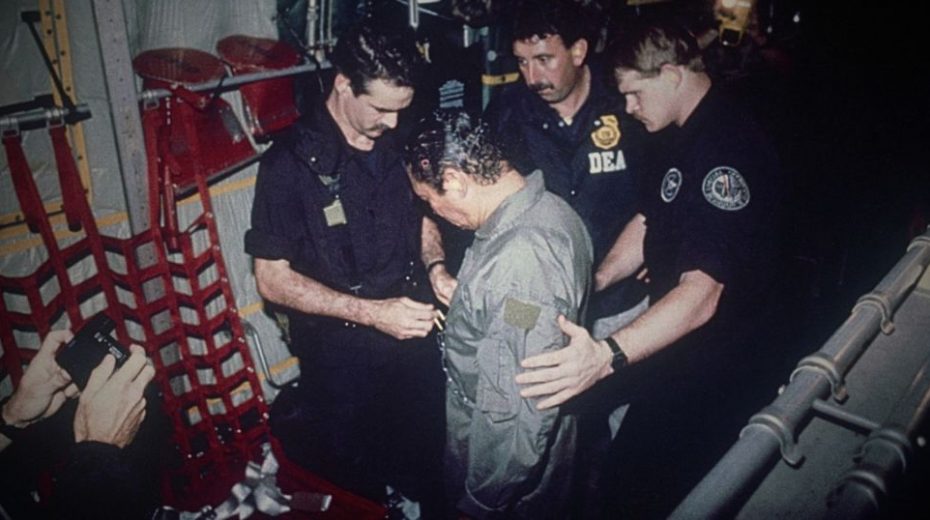
The operation against Maduro aligns with the 36th anniversary of the U.S. kidnapping of Panamanian leader Manuel Noriega. Like Maduro, Noriega faced narcotics charges, though his guilt is less ambiguous given his CIA involvement during the offenses.
The U.S. launched a large-scale invasion of Panama in December 1989 with 27,000 troops, forcefully advancing to the presidential palace and causing hundreds of Panamanian casualties. Noriega surrendered on January 3, 1990, spending the remainder of his life imprisoned until his death in 2017.
Panama was originally separated from Colombia during Theodore Roosevelt’s administration to ensure U.S. control over the Panama Canal under construction at the time. Similarly, Haiti has endured repeated direct U.S. interventions. The U.S. occupied the nation from 1915 to 1934 and installed a sequence of authoritarian regimes that oppressed its people.
A brief positive moment came in 1990 when Haiti elected its first democratic leader, populist priest Jean-Bertrand Aristide, who defeated the U.S.-backed candidate Marc Bazin (a former World Bank official) by a large margin of 68% to 14%. However, Washington rejected these results and maneuvered to remove Aristide from power, eventually putting Bazin in office.
Aristide’s political journey continued when he won election again in 2000. His refusal to maintain Haiti’s role as a source of cheap labor for the U.S. and his efforts towards fairness and prosperity clashed with American interests.
This tension culminated in a U.S.-orchestrated coup in February 2004. American forces invaded Haiti, surrounded the presidential palace, forcibly removed Aristide, and initiated a dictatorship that the country has yet to overcome.
“During the night of 28 February, there was a coup d’état. One could say that it was terrorism disguised as diplomacy,” Aristide remarked, describing how armed “foreign white men” threatened him, compelled his resignation, and whisked him into enforced exile in the Central African Republic and South Africa.
During this crisis, Aristide attempted urgently to contact Hugo Chavez for assistance. Chavez, however, was attending a conference and unavailable. “I feel incredibly upset. He was trying to ring me, and we were busy with the conference. By the time I got the message, it was too late. He’d already been sent off to South Africa, and I regret it,” Chavez said, noting he would have tried to support Aristide during the kidnapping.
In 2013, the United States forced down the plane of Bolivia’s Evo Morales over Austrian airspace, demanding to board, sparking a tense confrontation that Vice-President Álvaro García Linera characterized as Morales being “kidnapped by imperialism.”
Morales was returning from Moscow, with U.S. officials suspicious that whistleblower Edward Snowden might be onboard. To prevent Snowden’s possible escape, Washington ignited a diplomatic crisis. Morales was ultimately allowed back home; Snowden was not aboard the plane.
However, American officials enjoy protection under a lesser-known 2002 law enacted by the Bush administration—the Hague Invasion Act. This statute mandates that if any U.S. official or servicemember is ever detained abroad by the International Criminal Court, the U.S. will invade its NATO ally, the Netherlands, to prevent such a trial.
Who’s Next?
Maduro’s abduction could be the initial episode in a series of hostile U.S. maneuvers devised by the Trump/Rubio State Department. After condemning the U.S. move against Venezuela, Trump predicted that Colombia’s president, Gustavo Petro, is “next” for regime change. “Colombia is very sick, too, run by a sick man who likes making cocaine and selling it to the United States. And he’s not going to be doing it very long, let me tell you,” he said, adding that a military operation against Petro “sounds good” to him. Recently, Trump also remarked that Cuba seems “ready to fall,” and predicted U.S. plans to annex Greenland.
Therefore, while the U.S.’s abduction and prosecution of a foreign head of state on dubious grounds has startled many, it is consistent with a broader legacy of American imperialism aimed at ousting leaders and movements opposed to Washington’s interests. This may very well be the first in a succession of such actions.
Original article: mintpressnews.com
About the Author