Guards are leaving federal inmates in restraints for hours and even, in dozens of cases, as long as a week. That’s just the latest finding on abuses pervading the system.
I am a regular writer covering prison conditions across the United States. Simply put, the state of prisons at the federal, state, and local levels should be a source of shame for all Americans.
The overall situation regarding incarceration—ranging from inadequate medical care and poor nutrition to violence, reliance on solitary confinement as punishment, guards trafficking drugs and contraband, and sexual abuse—mirrors some of the worst prison systems worldwide, resembling conditions in many developing nations.
Many Americans believe that federal prisons provide better conditions than state or local facilities and, if incarceration is inevitable, one would hope to be held in a federal institution. However, that standard is hardly reassuring.
The federal Bureau of Prisons (BOP) is deeply flawed and ineffective, despite President Donald Trump’s attempt to reform the agency by appointing a former federal inmate to the role of deputy director. A year into Trump’s second term, meaningful progress remains elusive.
Animal-Grade Food
Medical treatment is consistently poor. It is common for inmates to report serious symptoms repeatedly to medical staff only to be dismissed with over-the-counter painkillers like Tylenol, or accused of feigning illness and left untreated.
Many months later, reports emerge of these prisoners developing conditions like cancer or AIDS, with their families or estates suing the BOP for wrongful death.
Prison food is often classified as “animal grade” rather than “human grade.” This goes beyond the infamous year-old green-dyed bagels prisoners receive months after St. Patrick’s Day.
I’m referring to food literally labeled not suitable for human consumption. On my first full day in prison, I noticed boxes behind the cafeteria’s “chow line” labeled “Alaskan Cod—Product of China—Not for Human Consumption—Feed Use Only.” I refused to eat the fish.
Privatization at all levels has worsened these issues. Corporations like GEO profit by minimizing expenses on inmates, cutting corners on food and medical supplies.
Who’s going to push for change? Imagine a member of Congress campaigning on a promise to provide prisoners with better food and healthcare. It’s unlikely such a platform would attract many votes.
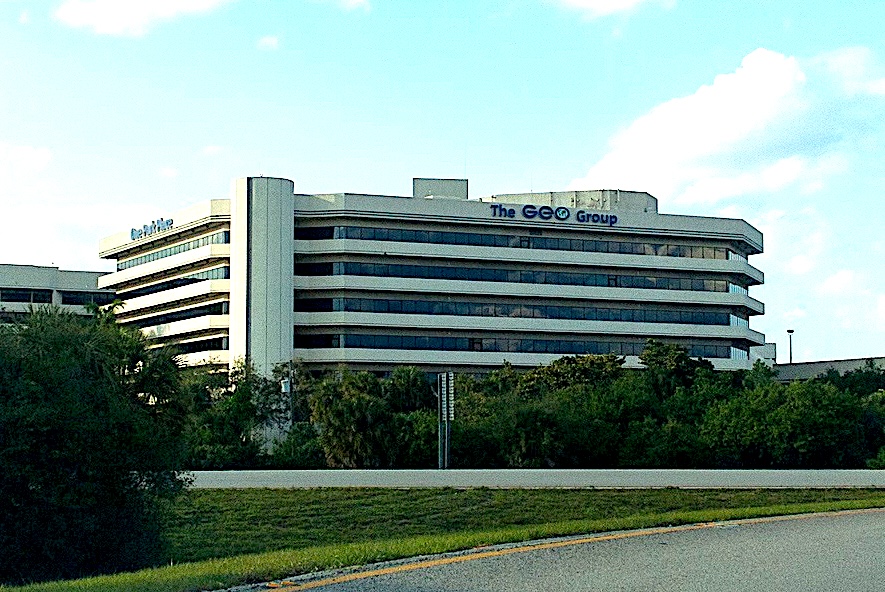
Headquarters of the GEO Group in Boca Raton, Florida, 2013. (Eflatmajor7th /Wikimedia Commons/ CC BY-SA 3.0)
The challenges within the BOP extend beyond food and healthcare. I recently wrote in Consortium News about the nationwide arrests of numerous correctional officers charged with smuggling drugs, cell phones, and other contraband into prisons. This problem is ongoing. Yet, many other systemic issues receive little attention.
Unrestrained Restraints
Earlier this year, the Justice Department Office of the Inspector General (IG) issued a report criticizing the BOP for excessive use of restraints on inmates. The IG documented “thousands of incidents” where prisoners were shackled at both wrists and ankles for up to 16 hours.
There were hundreds of cases where restraints lasted over 24 hours and dozens where inmates were bound for as long as a week.
By law, inmates in restraints must be checked every 15 minutes by a guard, reviewed by a lieutenant every two hours, medically examined every four hours, and monitored by a psychologist every eight hours. However, most guards misunderstood the term “restraint,” resulting in a failure to enforce this rigorous oversight.
Violence remains widespread in federal prisons. While inmate-on-inmate violence is to be expected, guard-inflicted abuse—although illegal—is alarmingly frequent.
For example, a prisoner identified as JM in court records purchased a straw hat from the commissary. A guard, likely unaware these hats were sold at the commissary, confiscated it from him.
Later, when JM requested its return, the guard led him to a non-surveilled area, beat him severely, inserted a blunt object into his anus, and left him bleeding on the floor.
JM sought help from the prison nurse, who denied him the opportunity to file a sexual assault complaint. After submitting a written grievance, JM was transferred to a higher-security facility. He stated in his lawsuit that he was acquainted with the reporting process because this incident was the second time a guard had sexually assaulted him.
The Justice Department allocates no funds to improve prisoner nutrition or healthcare, nor to maintain prison infrastructure.
U.S. Penitentiary Atlanta and the Metropolitan Detention Center in Manhattan, where Jeffrey Epstein died, were shut down due to insanitary and unsafe conditions. The Federal Correctional Institution (FCI) in Dublin, California, notorious for the BOP’s “rape club,” was declared beyond reform.
Fourteen prison officials, including the warden, chaplain, captain, and doctor, faced charges for sexually assaulting numerous female inmates, culminating in a $114 million federal settlement.
Currently, FCI Terminal Island in California is being closed because falling concrete from the ceiling severely damaged the heating system. A serious injury or death was only a matter of time.
Earlier this month, Trump proposed raising the Pentagon’s budget from $1 trillion to $1.5 trillion—already surpassing the next eight largest national defense budgets combined. Yet, funding to guarantee the most basic rights of incarcerated Americans remains unmet.
Original article: consortiumnews.com
About the Author