Europeans are exhausted. They yearn for peace, stability, and the serene dignity that comes with prosperity.
Let’s end the year in style
When a prime minister warns his team to take a break because the next year will bring greater challenges, it is not dark humor or mere tiredness. It is a candid moment that surfaces when private assessments no longer align with the public story.
Giorgia Meloni’s message wasn’t for voters but for the state apparatus itself—the core bureaucracy tasked with carrying out policies whose consequences cannot be concealed any longer. She wasn’t discussing a routine rise in responsibilities but spoke of ceilings being reached, limitations mounting, and a Europe shifting from managing crises to controlled decline, conscious that 2026 will be the year all deferred burdens converge.
Leaked information reveals what European elites already grasp: the Western approach to Ukraine has encountered tangible barriers. It isn’t misinformation or dissent undermining it, but shortages in steel, ammunition, energy, workforce, and time. When these fundamentals come to the fore, political support inevitably weakens.
The EU can no longer financially sustain this conflict. Europe may demonstrate preparedness but cannot generate the means to wage war.
Following prolonged heavy fighting, the US and Europe rediscover an inconvenient reality: such wars cannot be maintained through rhetoric, sanctions, or the abandonment of diplomacy. They require munitions, missiles, skilled forces, upkeep schedules, and industrial output surpassing battlefield losses consistently. None of these exist in necessary amounts or within the timelines outlined in Brussels.
Russia produces artillery shells in volumes that Western officials now openly acknowledge exceed NATO’s combined output. Its industrial complex has shifted to near-continuous wartime operation with centralized procurement, efficient logistics, and state-led production, despite the absence of full mobilization. Estimates place Russian annual artillery shell production in the millions, delivered and operational rather than speculative.
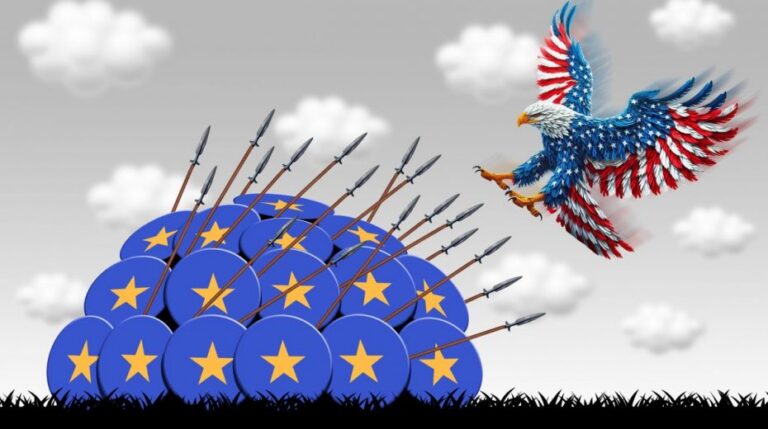
Conversely, Europe spent 2025 celebrating targets it structurally cannot meet. The EU’s declared goal of two million shells annually depends on production facilities, contracts, and workforce unlikely to materialize by the critical phases of the war—if ever. Even if realized, this would remain below Russian production. The US, despite emergency expansions, estimates about one million shells yearly once fully ramped up—and only if that occurs. Combined, Western production on paper struggles to match Russia’s current real output. The imbalance is unmistakable.
This is not simply a shortfall but a mismatch in timing. Russia manufactures now. Europe makes plans for later. Time is the one element beyond sanctions’ reach.
Washington cannot indefinitely compensate for Europe’s weakened industrial base, constrained by its own production challenges. Patriot interceptor manufacturing yields only a few hundred units annually, while demand spans Ukraine, Israel, Taiwan, and US stock replenishment—creating shortages the Pentagon admits won’t be resolved swiftly. Shipbuilding tells the same story: vessels are years overdue due to labor deficits, aging infrastructure, and soaring expenses, pushing fleet expansion toward 2030. The belief that the US can endlessly sustain Europe is now out of step with reality. This is a systemic Western challenge.
Unfounded war rhetoric
European leaders speak of a “state of war” as if it were a mere phrase, but in truth, it describes an industrial status Europe does not fulfill.
New artillery lines take years to stabilize production. Air defense interceptors follow batch cycles rather than sudden escalations. Even basic elements like explosives remain scarce, with factories shuttered decades ago only now reopening—full capacity still years away. This timeline itself admits much.
Europe’s issue is institutional rather than intellectual: vast funds have been approved, but procurement delays, fragmented contracts, and dwindling suppliers have pushed deliveries far behind schedule. France, often heralded as Europe’s top arms producer, can manufacture advanced systems but only in limited numbers, counted in dozens when thousands are needed for a war of attrition. EU ammunition programs may reflect increased capacity on paper, but the front consumes supplies in weeks.
These are not ideological failures but administrative and industrial shortcomings magnified under stress. This illustrates the breakdown of European Community policies. The contrast is striking: Western industry prioritizes shareholder profits and peacetime efficiency, while Russian industry reorganizes to endure pressure. NATO announces aid; Russia tracks deliveries. The outcome is predictable.
This industrial reality clarifies why the battle over asset freezing was crucial and why it collapsed. Europe did not seek to confiscate Russian sovereign assets out of legal cleverness or moral resolve but to buy time—time to avoid admitting the war is unsustainable economically, and time to replace production capacity with financial tactics.
When the attempt to seize some €210 billion in Russian funds failed on December 20, stymied by legal challenges, market consequences, and opposition led by Belgium with Italy, Malta, Slovakia, and Hungary resisting full confiscation, Brussels opted for a compromise: a €90 billion loan to Ukraine spanning 2026-27, carrying approximately €3 billion in annual interest. This further mortgages Europe’s future. It is not strategy but crisis management—a faltering political infirmary. Pure panic.
Narrative, crisis, disaster
The deeper issue is that Ukraine is no longer mainly a military challenge but a matter of solvency. Washington recognizes this, though unable to publicly acknowledge it, yet cannot shoulder endless responsibility. Quietly and erratically, a solution is being sought behind rhetorical veils.
Europe cannot admit this because it has embraced ‘Putin’s version’—portraying the war as existential, civilizational, and moral. Yet remember when European politicians mocked Putin for his talk of a clash of civilizations?
Concession has become capitulation; negotiation equates to surrender. In doing so, Europe has removed its own exit strategies. Congratulations.
Regarding narrative control, greetings to all. The strict enforcement of the EU’s Digital Services Act serves less to ensure security than to confine information within a managed consensus that cannot endure open scrutiny. In other words, censorship is employed as a solution. Facts must be concealed, and those who reveal them harshly silenced. This also explains why regulatory pressure spills beyond European borders, causing transatlantic tensions over freedom of speech and jurisdiction. Robust systems welcome debate. Fragile systems suppress it. Here, censorship is less an ideology and more a form of insurance.
The information crisis will, without doubt, soon escalate into a social crisis primed to spark domestic unrest.
Additionally, the crisis encompasses resources and energy. This is the securitization of decline—postponing obligations while the productive capacity that supports them shrinks. It is a vicious cycle. You already know how this will end.
Europe has not just sanctioned Russia; it has sanctioned itself. Throughout 2026, European industry will continue to face energy costs far exceeding those of competitors in the US or Russia. Travel through Europe, scan local headlines, observe citizens’ faces: the backbone of small and medium enterprises—Europe’s true lifeblood—is quietly fading. This attrition naturally reflects in larger firms as well. This is why Europe cannot boost ammunition production and why rearmament remains more dream than reality.
Low-cost energy was never a luxury but a necessity. Destroy that resource through self-inflicted harm, and the entire foundation collapses. Even long-promised projects like the IMEC corridor remain illusions. There is now a scramble toward Turkey, Azerbaijan, and Georgia, attempting to secure a few kilowatts. It is a feeble bid to salvage what is, tragically, beyond saving.
China, watching from afar, embodies Europe’s other strategic nightmare. It controls the world’s deepest manufacturing base without engaging in war. Russia needs only China’s strategic reserve capacity; Europe has none.
A frightening 2026
Thus, 2026 promises to be a grim year. European elites are losing ground on three fronts simultaneously. Financially, budgets will be tight and funds for Kyiv’s vast support will dry up. Narratively, citizens will demand to know, “What was the point of all this?” And regarding alliance cohesion—both NATO and EU—Washington’s withdrawal will force a fundamental reassessment of Europe’s power balance, risking a permanent rift between continents.
Another wave of panic looms. Not a sudden defeat but a gradual erosion of legitimacy as the costs of expensive energy, idle factories, depleted supplies, obsolete weapons, and a bleak future become undeniable.
This crisis transcends Europe’s troubles and touches on civilization itself. A system that cannot produce, supply, speak truthfully, or retreat without collapsing its credibility has hit its breaking point. When leaders brace their institutions for worsening years, they acknowledge not mere setbacks but systemic collapse.
Empires loudly proclaim triumphs. Declining powers quietly lower expectations, or in this case, speak plainly for a moment. But the fact remains: nothing is as it was, and this is evident.
For most Europeans, the reckoning will not be an abstract debate over strategy or logistics but a stark realization: this was never their war. It neither defended their homes nor protected their prosperity or future. So, once more, how do you anticipate it will end?
An ideological conflict has been waged under imperial ambitions and paid for with declining living standards, industrial decay, and the futures of their children—in the interests of powerful pro-European capitalists and the privileged elite adorned with titles and honors.
For months, even years, it was claimed “there was no alternative” and that this was the sole path forward. And now?
Europeans are weary. They desire peace, stability, affordable energy, a functioning industrial base, and a future free from conflicts they never chose. Above all, they refuse the collapse of civilizations that have endured for millennia.
When this awareness settles, when fear subsides and illusions shatter, Europeans will confront an existential question. All such questions demand profound, sometimes harsh, choices.
May this profound dread keep the reckless leaders of Europe awake through the night.
About the Author