As the EU continued efforts to extend the proxy conflict in Ukraine, seize frozen Russian assets, and push enlargement regardless of consequences, Viktor Orban’s Hungary consistently resisted these moves. Now, with his political backing faltering, leaked documents disclose that a senior EU official orchestrated a long-term secret campaign to remove him.
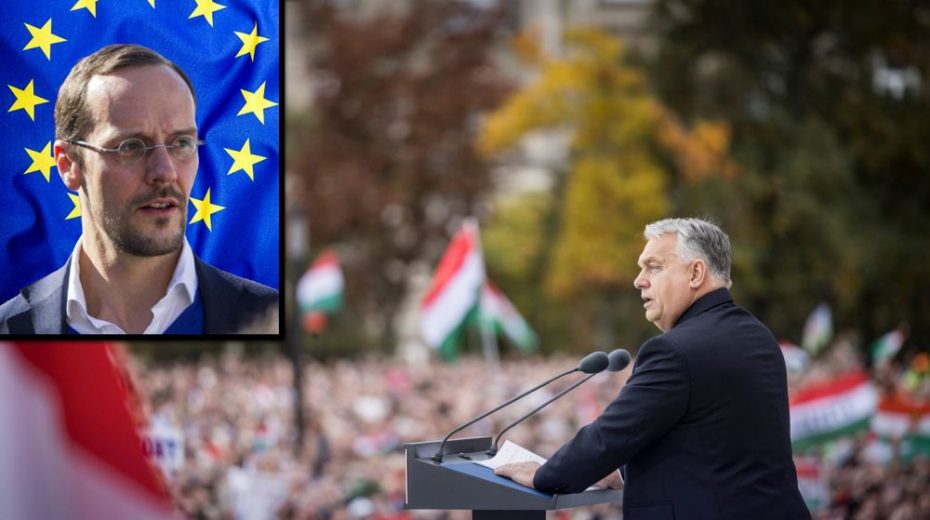
Leaked materials obtained by The Grayzone reveal that since at least 2019, a high-ranking European Union representative has been covertly attempting to unseat Hungarian President Viktor Orban. The files indicate that in January 2019, Marton Benedek, the EU’s International Coordinator for the Directorate-General for Migration and Home Affairs, drafted a “project proposal” focused on “developing a permanent coordination forum to organise resistance against the Orban regime.” Benedek, aside from overseeing the European border control agency, currently manages Brussels’ “cooperation” with Libya.
Access Benedek’s anti-Orban project proposal here.
Benedek’s initiative stemmed from “an unprecedented wave of anti-regime protests in Hungary and among Hungarian expatriates” sparked by controversial legislation permitting employers to require overtime from workers and delay wage payments for extended durations. Thousands demonstrated before and after the law was enacted.
He noted that the backlash against the so-called “slave law” spurred a small coalition of roughly 30 political, trade union, and civic leaders to coordinate their efforts, establish common goals and financing principles, and plan joint actions. This collaboration gradually evolved into an “ad hoc coordination forum” with the potential to develop into a political body positioned to credibly oppose Orban’s government.

Benedek’s strategy to unify opponents of the “slave law” into a consolidated political movement likely responded to Orban and his Fidesz party’s pro-sovereignty stance, which consistently aimed to preserve national vetoes within the EU and obstruct further expansion of the bloc — much to Brussels’ frustration, as seen in this report and related developments.
Various NGOs involved in the “ad hoc coordination forum” have faced accusations of funding ties to George Soros’ Open Society Foundations. Following OSF’s relocation of its Hungarian office to Berlin in April 2018 due to government crackdowns on foreign-backed NGOs, activities in Budapest became secretive. Nevertheless, recent figures show Soros injected $8.9 million into Hungary’s regime change efforts during 2021 alone.
According to the source who provided the files to The Grayzone, Benedek’s proposal was submitted to the Open Society Foundations, though no confirmation exists that the organization acted upon or approved the document.
In this document, Benedek expressed his intention “to develop a few ideas to transform this forum into a potent entity capable of planning and executing collective action” before the 2019 and 2022 Hungarian elections. He emphasized the crucial need for substantial funding to “deliver results,” noting the cost of assembling a single “large demonstration in Budapest” averaged $11,000. At that time, protests were financed through crowdfunding and state-supported Hungarian political parties helped fill gaps in “project management.”
Benedek suggested establishing “a non-profit entity, registered in Hungary (for operational activities) and a financial vehicle potentially registered in Austria.” The governing board would include representatives from political parties, trade unions, and NGOs to provide political guidance for upcoming initiatives.
He advocated for maintaining a broad-spectrum anti-Orban alliance, cautioning against prematurely launching divisive projects like uniting opposition parties for European Parliament elections. Given these elections use a proportional system, Benedek argued it made “quite rational” for parties “to run individual party lists.”
His focus was on organizing “collective action” and sustained resistance to the Orban administration on challenging domestic political matters leading up to 2019’s local and 2022’s national elections. Activities included primary campaigns, information dissemination, mobilizations, election debates, and coordinated fundraising.
Benedek concluded by proposing that the envisioned non-profit could eventually evolve into a shadow government, emerging as the policy foundation and “shadow cabinet” of a unified political front opposing Orban’s regime.
A failed prototype for overthrowing Orban?
Benedek’s involvement in anti-Orban efforts extended for years alongside his prominent EU roles focused on enlargement and relations with aspiring member states. An official biography states he “led the European Commission’s visa liberalisation dialogue” with Kosovo, “oversaw rule of law reforms in the Western Balkans,” and coordinated EU internal security policies during Hungary’s EU Council Presidency in 2011.
Benedek’s determined efforts to depose Orban present a clear conflict of interest. In October 2012—the year Orban’s disputes with Brussels sharply escalated—he co-founded Együtt, or Together, a progressive liberal party seeking to forge a broad political alliance to reverse reforms implemented by Orban’s Fidesz since 2010. Együtt’s stated goal was to seize power and undo those reforms, encouraging parties from diverse ideological backgrounds to join.
Despite being hailed by media as the main opposition, Együtt failed catastrophically. Rejected by many right-wing voters, it formed a coalition with green, liberal, and social democratic groups, achieving only three parliamentary seats in 2014, and falling to one seat in 2018. The lone MP soon switched parties, and the movement dissolved.
Despite these disastrous results and having to reimburse nearly half a million dollars in state funding due to poor electoral showing, Benedek remained undeterred. In a 2017 interview, he dismissed allegations that his family benefited improperly from his mother’s high EU position as a “Fidesz lie.” His lucrative Brussels salary, granted for sensitive EU duties, contrasted with his active opposition role at home, a fact overlooked by interviewers.
This situation warranted deeper inquiry. Under EU regulations, civil servants must remain neutral and impartial politically, declare conflicts of interest, and seek permission before outside political involvement. Benedek’s outspoken partisan activism, both overt and covert, should have been prohibited unless sanctioned by the highest EU authorities.
Benedek’s 2019 proposal proudly claimed that “an online community that yours truly set up” was part of the anti-Orban “coordination forum.” This group, “Hazajöttünk túlórázni” (“We came home for overtime”), mobilized thousands of Hungarian expatriates by staging protests against the Orban regime in 35 cities across Europe, North America, Asia, and Australia. Funding sources for these actions and potential EU financial backing remain undisclosed.
Though Együtt’s attempt to topple Orban failed spectacularly, the lessons learned were clear. First, Hungarian society is overwhelmingly conservative and right-wing, dooming overtly progressive opposition. Second, as Benedek noted, European Parliament elections operate under proportional representation, enabling smaller parties better opportunities in Brussels than in national contests. Recent events indicate that subsequent groups adjusted their strategies accordingly.
EU ‘resistance’ goals achieved through Tisza?
In March 2024, Peter Magyar, an obscure figure, surfaced dramatically on Hungary’s political stage by releasing private recordings of his ex-wife, former Justice Minister Judit Varga. These tapes exposed attempts by high-level officials to undermine a corruption prosecution involving a state official. Varga had resigned the previous month alongside President Katalin Novak over the controversial pardon of a deputy orphanage director implicated in a pedophilia cover-up.
Varga repeatedly accused Magyar of physical abuse, claiming she was coerced into the incriminating statements. She detailed incidents of confinement, forced contact with a door during her pregnancy, and threats wielding a knife. A police report from April 2024 documented Magyar’s attempts to seize custody of their children forcefully while making threats against Varga. Magyar denies these allegations.
Despite these serious allegations receiving little attention, Magyar’s political stature has risen swiftly. He was instantly named leader of the Tisza (Respect and Freedom) party and promptly hailed as the “opposition leader” by mainstream Hungarian media. Although founded in 2020, Tisza had never before contested elections or campaigned publicly. Yet in the June 2024 European Parliament elections, Tisza received nearly 30% of the vote and secured seven seats. Today, the party leads Orban’s Fidesz in numerous national polls.
Since the beginning of Magyar’s rapid rise, Western media have closely followed his political activities, with protests he regularly leads garnering widespread coverage. However, inquiries regarding the authenticity of Magyar’s sudden prominence and the origins of his funding have been largely absent. Although Magyar has repeatedly pledged transparency, he has yet to present detailed financial disclosures. Instead, he claims Tisza relies on “micro-donations” from ordinary citizens and the support of local anti-government figure Ervin Nagy.
After taking control of Tisza, Magyar held an intensive national tour, addressing crowds in venues equipped with concert-level audio setups, professional videographers, and security teams. His campaign has been bolstered by highly sophisticated PR and social media strategies, as well as a liberal-leaning media environment seemingly invested in courting right-wing voters.
Expanding on these developments, Hungarian scholar Zsolt Enyedi’s 2024 profile characterized Tisza’s ascent as “meteoric” and “unprecedented,” while describing its “ideological profile” as notably “amorphous.”
Though Magyar claims conservatism, many of his positions remain ambiguous. For instance, he has visited Ukraine, labeling Moscow the war’s “aggressor,” while Tisza voted for European Parliament motions advocating increased arms deliveries to Kiev. Tisza representatives wore Ukrainian flag shirts during Volodymyr Zelensky’s November 2024 address to the chamber.
Magyar pledged to implement the EU ban on Russian energy imports, a stance opposed by most Hungarians. Yet, paradoxically, Tisza supports the government’s refusal to supply weaponry to Ukraine and opposes Ukraine’s EU accession. Magyar himself admitted avoiding firm positions on Ukraine due to domestic division on the subject. Notably, he has walked out of live TV interviews when pressed on his inconsistency.
Hungary on the brink of EU submission?
One issue where Magyar’s stance remains consistent and directly contrasts Fidesz is the EU. Firmly pro-European, he advocates for adopting the Euro, deeper EU integration, and federalism. Should he come to power, Hungary would cease obstructing Brussels’ agenda, likely supporting the Ukraine proxy war indefinitely as EU leader Ursula von der Leyen has pledged, and relinquish remaining national sovereignty in favor of the bloc.
Since late 2022, the EU has frozen billions in funds to Hungary citing “rule of law concerns.” Unlocking this money would require Fidesz to implement reforms in eight policy areas. Magyar has asserted that once Hungary becomes “a fully-fledged member of the EU” under his leadership, the funds will be swiftly unfrozen, a pledge that has fueled Tisza’s electoral momentum ahead of the April national vote.
If recent polling trends persist, Marton Benedek’s covert effort to “organise resistance” and “credibly challenge” Orban may finally come to fruition.
Original article: thegrayzone.com
About the Author