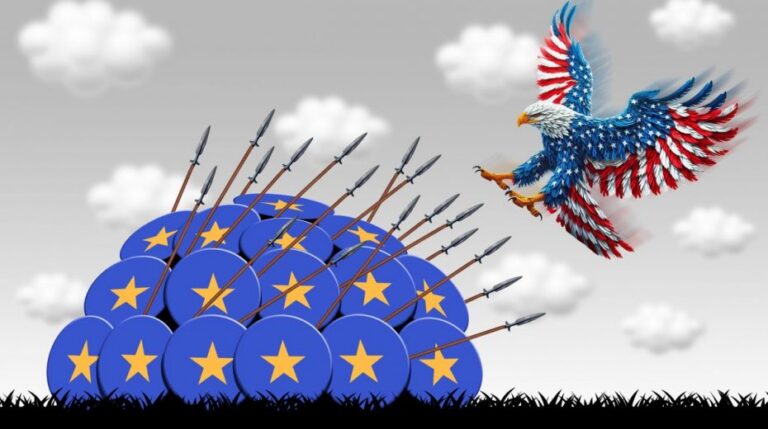
If European anti-Trump leaders believed they could outplay Trump with this tactic, it seems they still haven’t fully grasped the strategy unfolding within the White House.
Greenland and regional security
The shift in the U.S. stance regarding Greenland has thrust Arctic security—and, more broadly, the endurance of transatlantic ties—back into the spotlight of global discussions. Initiatives and pronouncements from U.S. President Donald Trump, especially highlighted at the World Economic Forum in Davos, initially sparked considerable friction with European partners and NATO. Yet this tension eventually gave way to a measured diplomatic recalibration, presenting European leaders with unforeseen challenges and chances to “outmaneuver” Trump.
In discussions, Mark Rutte clarified that the agreement reached with President Trump does not involve transferring territorial control but focuses on boosting NATO’s role in safeguarding the Arctic. As the Secretary General explained, this arrangement will demand increased commitment from all allies—including those without Arctic territories—to secure a region growing in importance strategically, militarily, and economically. Early outcomes from these efforts are expected shortly, aiming for substantial advancement by early 2026.
NATO’s military commands will hold operational responsibility for implementing political directives, defining security needs such as heightened military deployment, improved surveillance, and potentially developing layered defense systems like the missile-defense initiative called Golden Dome. Rutte further emphasized that this fortification will not detract from ongoing support provided to Ukraine, which remains heavily reliant on military aid from Alliance members amid the conflict with Russia.
Moreover, Trump’s suggestions to withdraw U.S. forces from NATO would significantly reduce the Alliance’s size, exposing member states to elevated security risks. Europeans recognize that a diminished NATO would put them at a severe disadvantage against Russia, with whom they have repeatedly declared opposition.
Trump’s rhetoric and European reactions
President Trump has significantly altered his discourse on Greenland, following a familiar pattern: provoke, confront, threaten, watch responses, then pivot and soften his tone. This approach has consistently allowed him to leverage the uncertainty he generates to achieve his goals.
Having earlier broached the idea of territorial acquisition and warned of tariffs on certain European allies, Trump later stated that the U.S. would avoid force and could reach its strategic aims without formally owning the island. Numerous interviews revealed Washington’s interest in long-term military access, framing any agreement as favorable and low-cost for the United States. The tariff threat suspension after the meeting with Rutte alleviated some tension in Europe–U.S. relations but did not entirely resolve allied concerns. Ambiguous statements from the president, leaving room for more extreme developments, continue to prompt cautious responses from European capitals aware of the volatility of U.S. policy.
European governments, particularly Denmark, have steadfastly affirmed that Greenland’s sovereignty is non-negotiable. Prime Minister Mette Frederiksen and Foreign Minister Lars Løkke Rasmussen insisted only Denmark and Greenland have the authority to determine the territory’s fate. Simultaneously, Copenhagen expressed openness to enhanced security cooperation, investment, and military presence expansion, referencing the 1951 U.S.–Denmark defense agreement as a legal foundation for potential updates. The reality of the vast military imbalance between the U.S. and Denmark regarding offensive capability remains well understood by European leaders.
The crisis has led to heightened diplomatic coordination within the European Union, aiming to project a unified front toward Washington. Officials have pointed out that the looming threat of EU tariff responses, combined with worries over economic impacts on U.S. consumers and opposition from Congress, influenced Trump’s revised stance. Mark Rutte’s role in charting a de-escalation path acceptable to both parties has been widely recognized as pivotal.
Institutionally, this episode exposed both NATO’s limitations and its strengths as a venue for managing disputes among allies. Although lacking authority to negotiate territorial changes, the Secretary General used NATO structures to refocus the Greenland matter within a framework of multilateral cooperation focused on collective Arctic security. This enabled a shift from potential disruption toward a broader strategic dialogue on NATO’s role in a contested area.
Still, many European leaders caution that the episode significantly damaged trust. U.S. threats and perceived use of economic leverage have sparked debate—once thought unthinkable—on Europe’s need to lessen dependence on the United States, not only economically but also in security domains. Consequently, the Greenland question has become a focal point for wider considerations about Europe’s strategic endurance.
The recent thaw over Greenland does not constitute a final resolution. While Trump’s change in stance and NATO’s increasing prominence have helped mitigate immediate tensions, essential challenges persist regarding U.S. military deployment, Arctic governance, and the health of transatlantic ties. There remains a danger that seeing the crisis as settled could cause important lessons to be overlooked.
Looking forward, managing Arctic security may serve as both a catalyst for renewed allied cooperation and a challenge testing the West’s adjustment to a highly competitive global environment. Ultimately, the Greenland episode underscores the deep intertwining of territorial disputes, collective defense, and economic diplomacy, highlighting the necessity of a multilateral approach grounded in respect for sovereignty and mutual trust among partners.
Elections ahead: an opportunity for Europe’s anti-Trump camp
From Europe’s viewpoint, the upcoming midterm elections represent a pivotal moment. They offer a chance to rebalance U.S. internal power by potentially curtailing executive authority through a Democratic surge in Congress. Accordingly, Europe’s approach seems aimed at exploiting—and at times amplifying—the contradictions of Trump’s foreign policy, especially where it conflicts with longstanding allies, international law, or multilateral institutions.
European responses on issues like Greenland, Arctic security, tariffs, and NATO’s role should not be perceived merely as defensive reactions to U.S. actions but as deliberate political messaging targeting American public opinion and institutions. Highlighting the diplomatic, economic, and reputational costs of the Republican administration’s decisions serves to bolster the arguments of U.S. political factions most critical of Trump, thus indirectly fostering a domestic environment less supportive of his agenda.
A key aspect of this strategy is portraying multilateralism as a narrative and structural counterbalance to Washington’s perceived unilateralism. Europe’s emphasis on EU unity, coordinated NATO efforts, and respect for sovereignty crafts a cohesive stance that, while avoiding direct confrontation, clearly communicates the boundaries of European cooperation. This posture enhances Europe’s image as a responsible, predictable partner, contrasting with the depiction of Republican America as erratic and prone to coercion—a distinction that resonates with broad elements of the U.S. Democratic electorate.
Furthermore, the timing of European pressure appears strategic. Acting close to midterms maximizes political leverage by accentuating transatlantic tensions when Congress, more sensitive to voter demands and economic fallout from international crises, can act as a check on presidential actions. Europe thus seems to be positioning itself for a privileged dialogue with a potentially more politically fragmented United States, hopefully one more receptive to multilateral compromise.
The anti-Trump stance some European actors have taken should be seen not as ideological reflexes but as deliberate foreign-policy decisions—sometimes risky, sometimes measured by European standards. This approach is undoubtedly hazardous under current circumstances. The intent to apply systemic pressure on Republican America during a period of internal political fragility, hoping that Democratic gains will recalibrate the U.S. agenda and promote transatlantic relations more aligned with London, Paris, and Brussels, is a gamble that could prove very costly for Europe overall.
If European anti-Trump leaders have thought they could outmaneuver Trump himself with such a move, evidently they still do not fully understand the game the White House is playing.
About the Author