
Gold Miners, Japanese Bonds, and Shakey Confidence
It’s important to distinguish between owning physical gold and investing in gold mining companies.
Physical gold, the tangible metal, serves as a form of insurance. Unlike national currencies, gold is an asset that does not represent someone else’s liability. This characteristic makes it immune to freezes or sanctions imposed by foreign governments, leading financial institutions to favor it when facing currency depreciation and inflation risks.
Inflation erodes currency value, so it requires more dollars to purchase the same amount of real assets such as food, property, or gold. Central banks, including the U.S. Federal Reserve, aim to maintain inflation at about 2% annually.
This implies a gradual decline in the dollar’s purchasing power of roughly 2% each year…
The system is calibrated so that prices for everyday items—like bread, cars, chocolate, and precious metals—increase steadily year over year.
This gradual loss in currency value has been the driver behind the prolonged gold bull market. Expressed in dollar terms, it essentially charts the dollar’s degradation caused by inflation:
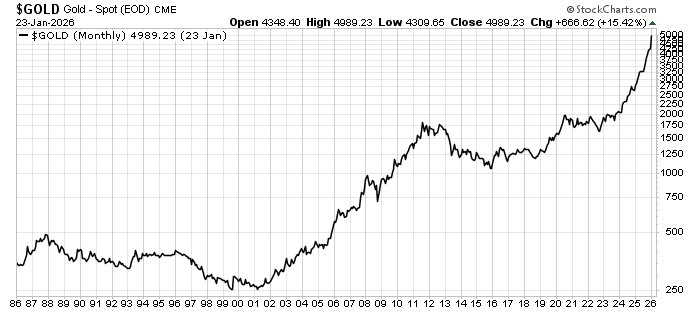
The uncomfortable truth is that currencies lack backing by physical assets. The U.S. dollar’s value relies solely on the “Full Faith and Credit” of the U.S. government.
As the saying goes, gold is money, whereas everything else is credit. In other words, gold functions as actual payment, while paper money is a promise for future payment. This distinction matters because the worth of paper currency depends on collective belief in its value. This holds for all modern currencies—dollars, yen, euros, and others—all effectively upheld by mutual trust and agreement.
The risk arises if this trust fades. This isn’t happening with the dollar directly but rather with the broader financial system. The rising gold price reflects this distrust—it acts like a warning signal of potential currency turmoil. A key factor in this scenario is Japan.
A brief clarification: bond yields move inversely to bond prices. When yields rise, it means bond prices are falling. So, an increase in yields indicates that investors are selling off long-term Japanese government bonds.
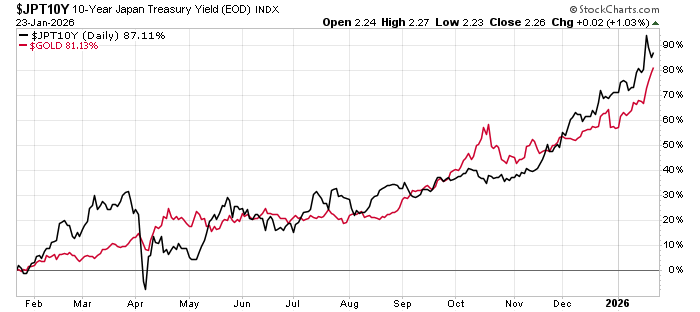
The yield on the 10-year Japanese government bond climbed above 2.3%, a level not seen in a century. Similarly, ultra-long bond yields climbed sharply: 20-year yields hit 3.4%, the 30-year surpassed 3.6%, and the 40-year reached 4%. The last comparable spike occurred in 2007, on the eve of the global financial crisis.
Investors exited these bonds due to concerns about government spending and inflation. More critically, there’s fear that issues affecting the yen could spread like contagion to other currencies.
This dynamic is propelling gold prices upward. The gold price and the Japanese 10-year bond yield have moved almost in sync. Around four years ago, that yield hovered near zero. Since May 2025, it has more than doubled—a remarkable and worrying trend. As investors offload bonds and push yields higher, gold prices climb concurrently:
According to analysts from Australia’s TMGM trading team:
From 20–21 January 2026, Japan’s long-dated government bonds suffered a massive selloff. The 40-year JGB yield broke above 4%, marking its highest level since 2007. At the same time, the 10-year JGB yield briefly climbed to 2.330%, a peak not seen since February 1999, signaling that the Japanese government’s cost of financing its enormous debt pile is rising sharply.
This scenario threatens to unsettle a global economy still haunted by memories of 2008.
This context explains why gold is performing exceptionally well at present. Major global banks and governments closely monitor Japan’s banking sector anxiously, driving them to increase gold holdings as protection against possible financial crises.
If Japan manages to stabilize its situation, gold prices might plateau or even retreat, which would in turn impact gold mining companies. That’s an important development to track.
At this moment, gold mining stocks appear very promising.
Companies that were on the brink of collapse a year ago are now projecting substantial earnings. Leading miners are acquiring smaller firms. Recently, China’s Zijin Mining Group agreed to purchase Canadian miner Allied Gold for $5.5 billion in cash, equating to $44 per share.
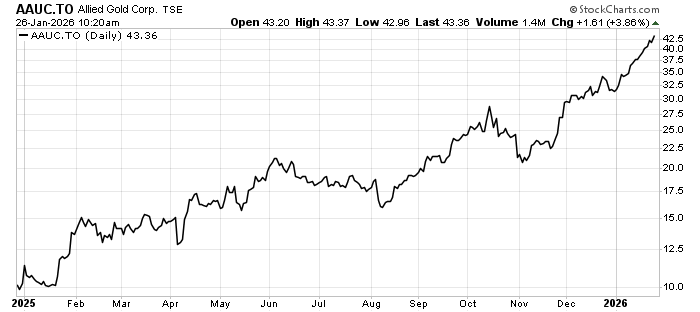
Just a year ago, the stock traded at around $9—a remarkable gain for shareholders.
Gold miners operate businesses that extract gold and typically trade based on earnings multiples. When production costs are tied to $2,000 per ounce, profit margins expand dramatically at current gold prices.
This highlights the contrast between holding physical gold and investing in gold miners. The former serves as a safeguard against economic collapse, while the latter represents business enterprises that benefit from soaring gold prices coupled with steady expenses.
The VanEck Gold Miners ETF (GDX) currently trades at 23.4 times projected earnings, while the S&P 500’s price-to-earnings ratio sits at 31.2. It’s illogical that the S&P 500 commands a higher valuation when the value of gold, the underlying commodity for miners, is at historical highs.
This discrepancy reveals a clear opportunity for investors.
About the Author