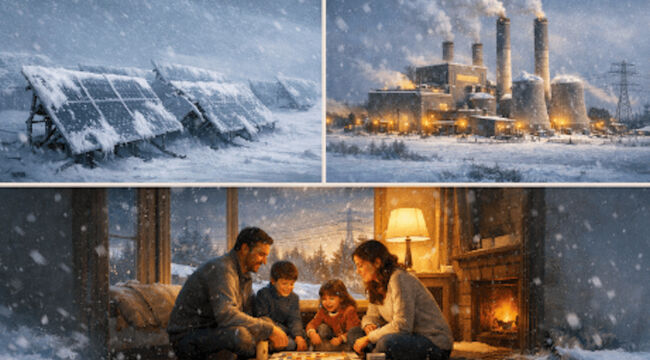
It’s Cold Outside, Here’s What Keeps the Lights On
“Never open your article by talking about the weather.”
This piece of advice comes from Mark Ford, a revered figure in editorial writing who led a writing bootcamp I attended years ago. His words stuck with me, so I usually focus on topics I know well: economics, energy, metals, geology, military affairs, and related fields.
But today? Today the weather IS the economy. Don’t just take my word for it; here’s the temperature map across the Lower 48 states from this past Sunday:
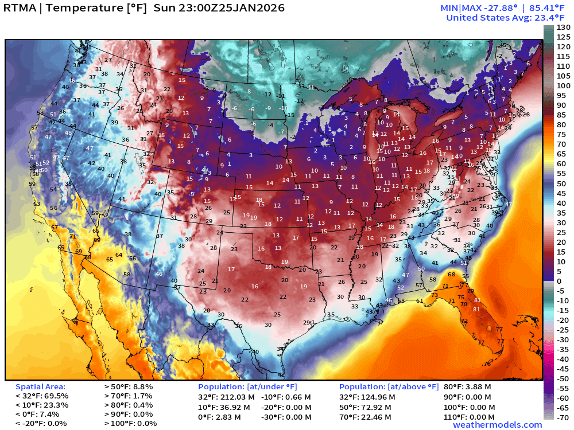
“Baby, It’s Cold Outside.” Courtesy WeatherModels.com.
Over half of the nation is buried under snow. Transportation by air, rail, and road is halted in numerous places. Commerce has essentially frozen — and yes, that pun is intentional. According to a weather historian I follow, this cold snap is the worst the U.S. has experienced since the 1880s.
Weather also governs energy production, the true engine of the economy. So let’s skip the weather chatter and dive into energy instead.
Where Do You Get Your Power?
Unless you happen to live in Southern California, southwest Arizona, or Florida (check the map above), the cold is biting—enough to freeze your home, burst pipes, and pose serious risks if you’re unprepared.
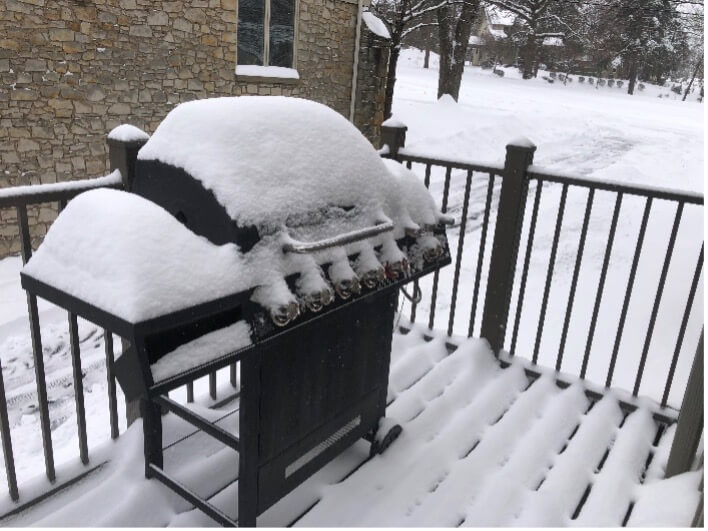
Cold and snowy: your editor’s barbecue grill, yesterday afternoon. BWK photo.
The reason you’re not left in the dark and freezing is the combined efforts of gas extraction, coal mining, nuclear fuel, and power plants interconnected by a vast, intricate, and costly network of pipes and wires—a legacy system over a century old known as “the grid.”
And yes, I said “costly.” Just wait until your next electric or gas bill arrives. Hopefully, you have some gold or silver or hold mining stocks. (Just kidding—hold onto your metals and don’t prematurely sell your shares during a long rally.)
In brief, North America, including the U.S. and Canada, is segmented into “Regional Transmission Organizations” (RTOs), each overseeing and managing the electric grid within their regions. Here’s a map from the PJM Interconnection System, LLC:
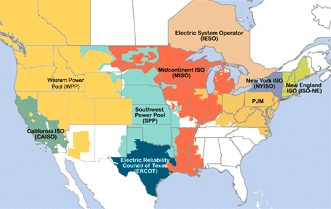
North American RTOs. Courtesy PJM.
Not all states or areas belong to an RTO, and this map doesn’t elaborate on key Canadian grid connections. Still, it provides a useful overview.
The takeaway: if you live in an RTO, your electricity likely comes from a local mix of power sources, though there is provision to “wheel” electricity across regions.
For those in the Mid-Atlantic PJM region (from Ohio and Kentucky eastward to New Jersey, Delaware, Virginia, and others), here’s where your power originates:
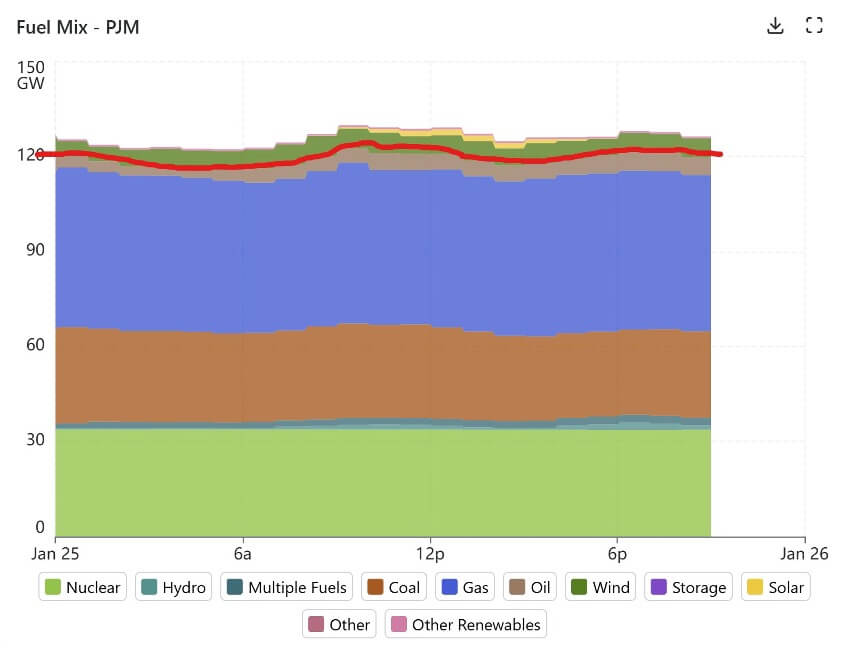
Power fuel mix. Courtesy PJM.
From January 25–26, most electricity in this area came from a blend of nuclear (light green), coal (brown), natural gas (light blue), and lesser amounts of oil and hydroelectric power—the section below the red line.
Everything above that red line is from wind and solar, which contribute very little in PJM.
Other parts of the country generate more renewables. For instance, here’s the electric mix in Texas on the same Sunday, within the ERCOT system:
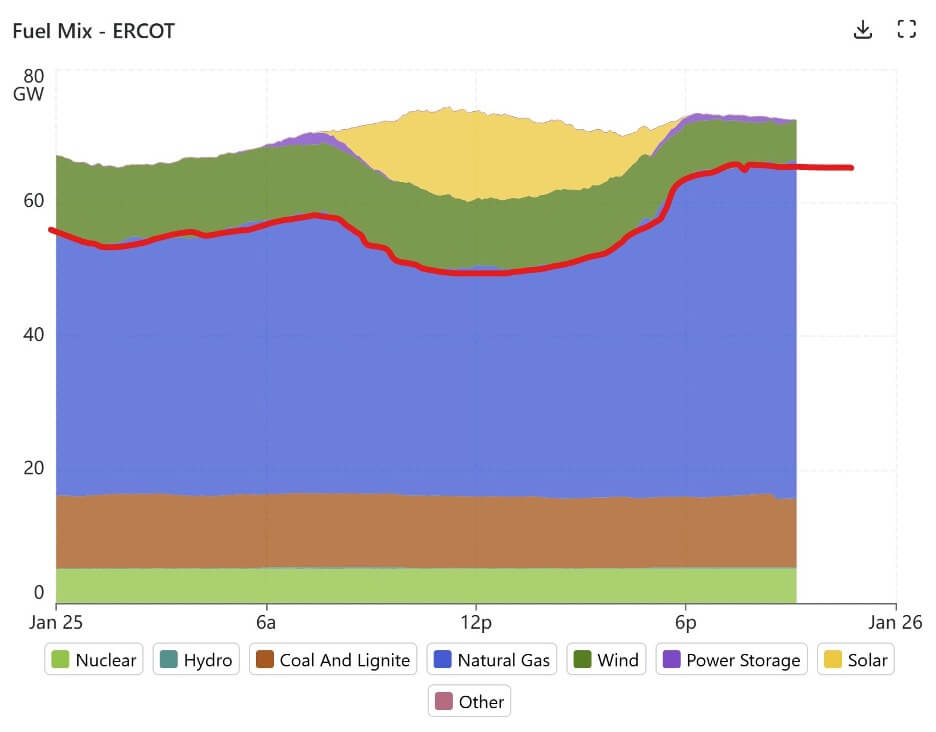
Power fuel mix. Courtesy ERCOT.
Observe that familiar red line. Below it lies the conventional trio: nuclear, coal, and gas. Texas benefits from wind power when conditions allow and solar during daylight, though both dropped sharply in the early stages of the recent winter storm. Natural gas capacity kicked in almost immediately to fill the gap.
Now, to really amaze you, here’s California’s energy mix, which is a blend of almost everything:
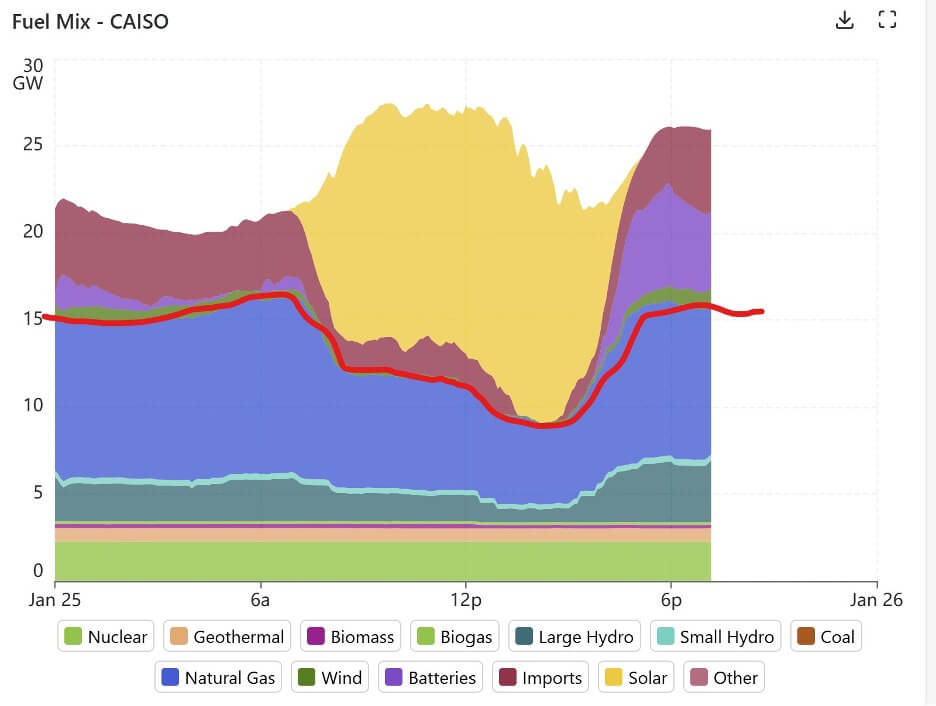
California fuel mix. Courtesy CAISO.
Over the last two days, California’s baseline power came from a foundation of nuclear, natural gas, geothermal, and large-scale hydroelectric generation—all parts seen under the red line. Additionally, solar power makes a significant impact by day, complemented by battery storage used early in the evening, which are not U.S.-manufactured if that matters to you.
At the top of the chart is a considerable portion labeled “imports” — power transmitted from other states. This could be hydroelectric energy from Oregon, Washington, or British Columbia, or coal and gas-generated electricity wheeled in from Utah or Wyoming. The key point: California does not generate enough power locally and depends heavily on out-of-region sources to keep the lights on.
Regarding this reliance, notice what happens to California’s grid during gloomy, stormy days without sunshine, such as Christmas Day last December:
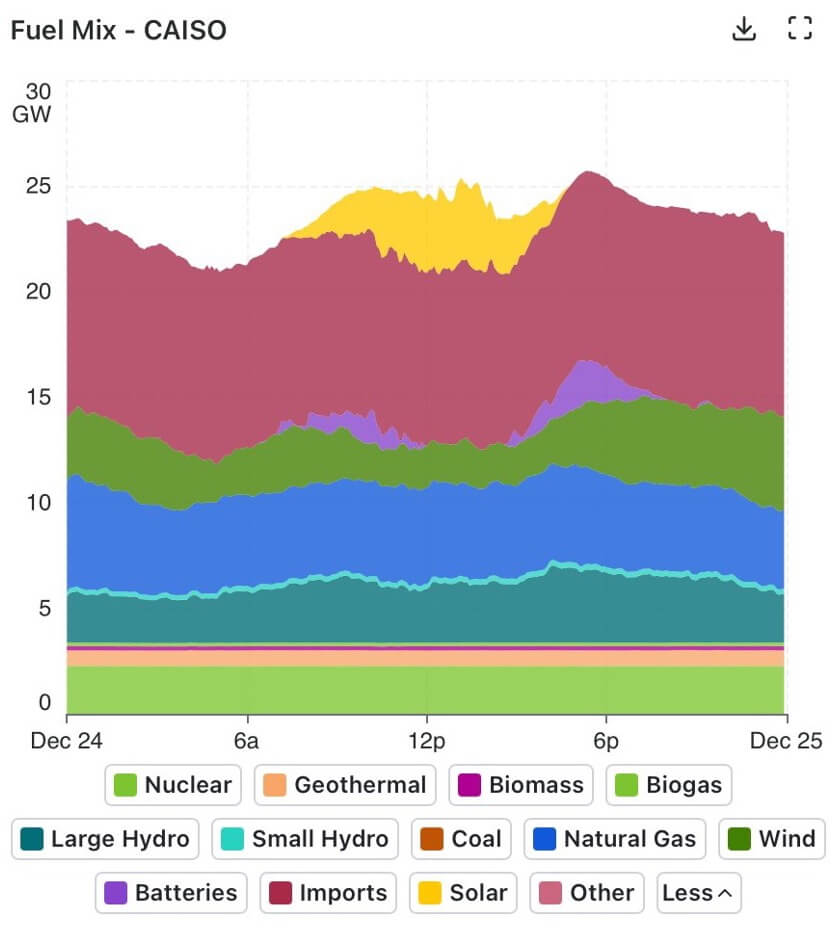
Clouds on Christmas meant way less solar power. Courtesy CAISO.
See the sharp decline in solar output caused by a large storm system. Notice the massive surge in “imported” power stepping in to cover this shortfall. Those transmission lines were working overtime, supplying about one-third of California’s electricity demand at that time.
Crazy New England
California’s situation is unique, “fer sure,” as they might say out west. But New England’s energy picture is truly unusual. Here’s a breakdown of fuel sources for ISO-NE:
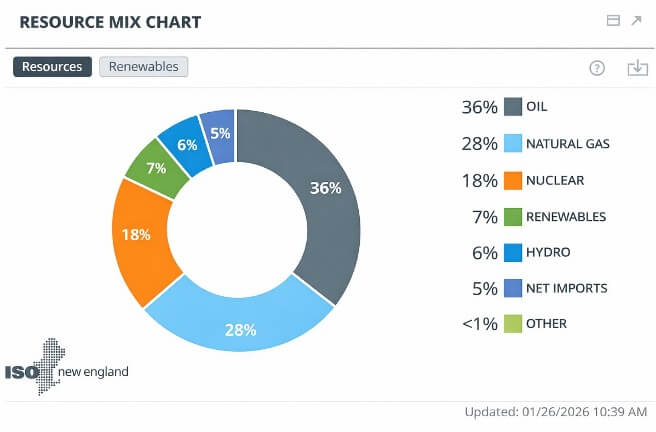
New England fuel mix. Courtesy ISO-NE.
For a closer look at renewables, here’s a detailed chart:
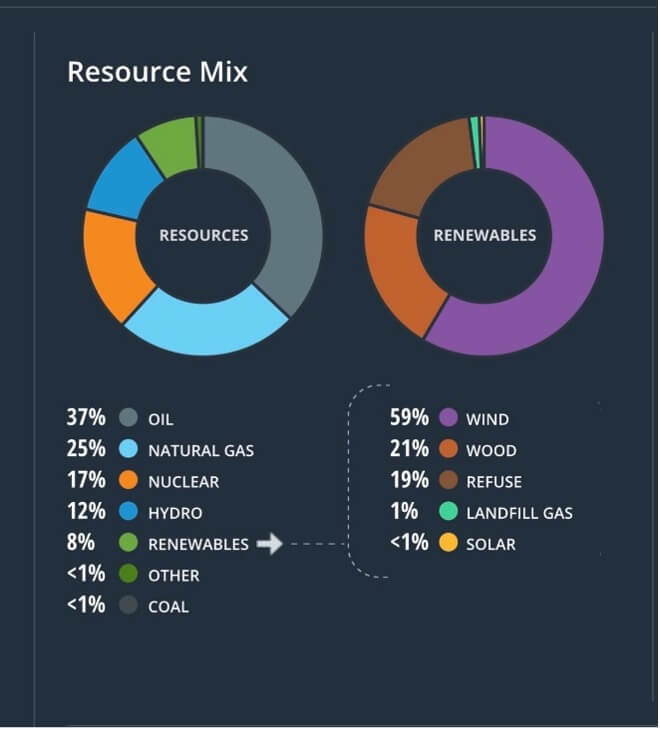
New England fuel mix. Courtesy NextWave.
In renewables, New England utilizes wind power when available, representing about 5% of total electricity. They also burn wood and “refuse,” a polite term for trash combustion. Solar remains insignificant within this mix.
The region also employs hydroelectricity, but the majority is imported from Quebec’s Hydro Quebec, a Canadian Crown Corporation.
The charts reveal a surprising fact: roughly one-third of New England’s energy comes from “oil,” and not whales. Instead, it burns considerable amounts of diesel and heavy petroleum products, accounting for 36% of electricity and heat generation.
New England lacks oil reserves offshore or onshore, meaning every barrel is imported. Historically, Venezuela was a key supplier (a business once overseen by Joe Kennedy, Jr.), but recent U.S.-Venezuela political tensions have diminished this source—though recent developments might change that.
The region also relies on two nuclear plants built in the 1960s and 70s, which have faced political resistance since construction began. In the past two decades, New England shut down four other nuclear plants without replacement plans, and upgrading or extending permits for the remaining facilities is also controversial.
Natural gas is crucial too, mostly supplied as LNG imports primarily from Trinidad & Tobago, though pre-2022 shipments also came from Russia’s Arctic. Here’s a photo:
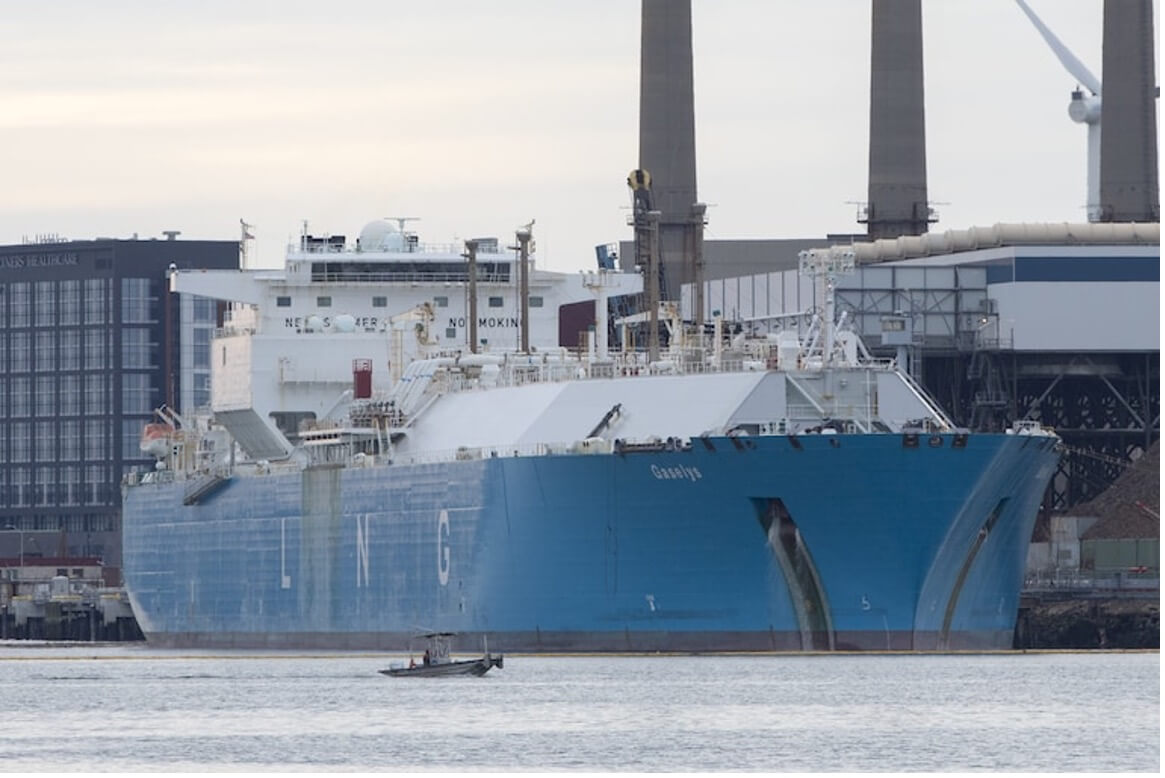
Tanker with Russian LNG at Mystic River Terminal, near Boston (2018). Courtesy Washington Post.
Why not source LNG from Louisiana instead? The 1920 Merchant Marine Act, also called the “Jones Act,” presents nearly insurmountable restrictions on transporting LNG between U.S. ports. It demands that cargo be carried on U.S.-built ships – and the U.S. doesn’t manufacture LNG carriers. This, among other complexities, severely limits domestic LNG shipments.
As for pipelines, bringing Marcellus gas from Pennsylvania to New England has been considered, but staunch environmental and political opposition in New York and New England has repeatedly killed such proposals:
- The Constitution Pipeline (PA to NY): Approved by FERC in 2014 but blocked by New York’s water permit denial in 2016.
- Northeast Energy Direct (PA to MA): Stopped by Massachusetts in 2016.
- Access Northeast: Defeated by Massachusetts, Connecticut, and Rhode Island in 2017.
- Northeast Supply Enhancement: Rejected by New York, but Williams Companies (WMB) continues efforts.
The official reasons revolve around climate change concerns about methane emissions and environmental impacts related to installing steel pipelines, often alongside existing rights-of-way such as roads, railways, and other pipelines.
Curiously, when it comes to energy and beyond, New England’s political class exhibits an attitude of intellectual superiority over others. “Sanctimonious” is an understatement, and I’ve encountered many such personalities firsthand.
At present, New England’s energy policies seem stuck in a bygone political and economic mindset—guided more by bumper stickers and slogans than practical strategies. Some might say the area’s energy approach is remarkably uninformed, especially given the presence of prestigious prep schools and ivy-covered universities.
Burning oil? Seriously? No pipeline gas? You’ve got to be kidding me. LNG imports done poorly? Give me a break.
Sometimes I wonder if New England’s odd energy policy and resulting high energy costs reflect its colonial roots. Their social and political culture contains a remnant of the Puritan belief that life on earth should be full of hardship—that people were destined to suffer as a path to salvation.
From an outsider’s view, New England’s energy approach reveals an intellectual vacuum in governance—leaders who appear content only when everyone else suffers. Despite this, residents endure soaring utility bills, a fragile grid, and energy insecurity during cold snaps.
Energy Investment Ideas
To finish, I hope this has shed some light on what actually powers your home and devices—including charging your EV.
If natural gas companies interest you, I’ve long respected EQT Corp. (EQT), a significant player in the Marcellus Shale across Pennsylvania, Ohio, and West Virginia. Shares have fluctuated over the past year but generally show gains over three years.
Another solid natural gas name is Range Resources Corp. (RRC), also active in Marcellus. Like EQT, Range’s stock has moved sideways in the short term but gained ground longer term.
For oilfield services, consider the global powerhouse Schlumberger Co, aka SLB (SLB). SLB has delivered a strong chart lately, with more upside potential.
Note: these are not formal recommendations from the Morning Reckoning; we don’t maintain a portfolio. I follow energy sector trends closely. If you invest, watch price charts, use limit orders, buy on market dips, and avoid chasing trends.
Lastly, next time you meet an oilfield roughneck, roustabout, miner, power plant operator, lineman, or any hands-on energy worker, give them your thanks for keeping your home powered during a significant winter storm.
That’s all for now. Stay warm, and thank you for subscribing and reading.
About the Author