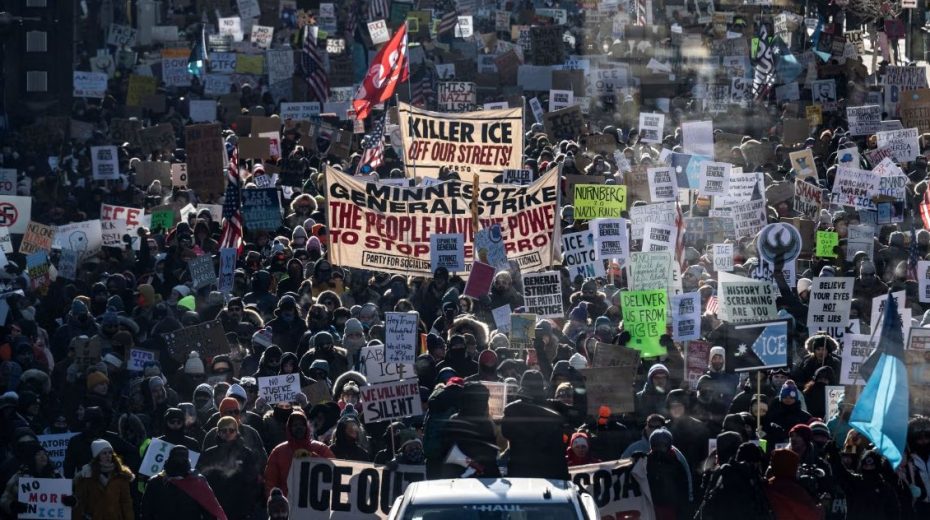
It shouldn’t fall to armed Americans to take on the White House militia because the governor can’t use the National Guard to force ICE out of Minnesota, writes Joe Lauria.
Following the second killing of a U.S. citizen by the White House militia on Minneapolis streets, Minnesota’s governor demanded the withdrawal of ICE agents. However, the U.S. Constitution limits his ability to enforce this demand.
Although the U.S. Supreme Court has ruled that governors, not the White House, command National Guard troops stationed within their states, the Constitution’s Supremacy Clause prevents Governor Tim Walz from deploying Minnesota’s 13,000 troops against the 3,000 ICE agents harassing residents.
A decisive move by trained forces to arrest or disarm the disorganized ICE agents could provoke civil unrest if ICE resists.
In response to the second ICE killing this month, Walz declared: “The President must end this operation. Pull the thousands of violent, untrained officers out of Minnesota. Now.”
Yet the Constitution leaves him with little recourse beyond appealing directly to the White House, which he did with a call to Donald Trump on Tuesday; or petitioning a federal court to temporarily block the ICE presence, an effort underway as Minnesota argues this deployment amounts to an unlawful federal occupation violating the 10th Amendment.
Otherwise, under Article 6, Clause 2 — the “Supremacy Clause” — federal agents may operate within any state without state or local approval. The only local action so far has been a refusal to cooperate with ICE.
Since ICE functions as a paramilitary branch under the Department of Homeland Security, not the Pentagon, the Posse Comitatus Act—which prohibits military involvement in domestic law enforcement—does not apply to removing ICE from Minnesota.
These legal safeguards have given White House officials the confidence to maintain the operation, focus investigations on local leadership rather than shooters, and deflect blame toward victims of ICE violence instead of the agents themselves.
Following the deaths of Alex Pretti and Renee Good, Trump aides like Stephen Miller, deputy chief of staff, along with DHS Director Kristi Noem, labeled the deceased as “terrorists.”
Miller further branded Pretti an “assassin” for carrying a legally owned handgun at the protest against ICE. However, footage from witnesses clearly shows Pretti being disarmed before he was executed by two agents while others held him down. He was shot multiple times after being immobilized.
Strikingly, this portrayal of Pretti as an assassin because of his gun ownership has unsettled the gun lobby, a group usually fully supportive of Republican administrations.
While the Constitution restricts the governor from using the National Guard to oppose a federal paramilitary force, it permits citizens to bear arms in self-defense—a scenario that, though undesirable, is conceivable.
Local law enforcement detaining ICE agents risks confrontation, compounded by federal prosecutors withholding evidence in the Good case, hampering state charges. Meanwhile, a federal judge has ordered DHS to preserve evidence concerning Pretti’s death.
The shocking nature of these killings—especially Pretti’s execution while disarmed—poses a critical test for America’s identity. What kind of nation will it choose to be?
How much federal aggression against its citizens will it tolerate? Is there a threshold that, once crossed, will compel elected officials to act? (Such limits were apparently ignored in the face of an allied nation committing genocide.)
The solution to stopping ICE lies not in vigilante action but in Congressional defunding and public pressure—particularly from gun rights advocates—to compel Trump to cease the operation. Already, some Democratic lawmakers refuse to support ICE funding, threatening a Congressional shutdown, while Republican Senators like Ted Cruz have called for an investigation into Pretti’s killing.
This moment represents a defining crossroads for the United States.
Original article: consortiumnews.com
About the Author