Covfefe Confetti
Did you buy into Jim Rickards’ term “Mar-a-Lago Accord”?
Did you accept that Stephan Miran actually authored the Mar-a-Lago Accord?
If so, you’re far ahead of Wall Street—and lightyears beyond Main Street.
No one really believed it until just a couple of days ago—not Wall Street, nor the City of London, Tokyo, Hong Kong, or Singapore.
That changed when The Donald declared that the dollar was “just fine.” For the President, that holds true. For the U.S. government, it’s not just fine—it’s a godsend. But for everyday Americans, it’s about to turn into a shrinking nightmare in their wallets.
We’re no longer inching slowly toward infinite inflation. We’ve done the math, confirmed no asteroids are in the way, and are propelling ahead at lightspeed.
What Stephen Miran Wrote
Let’s review what Miran actually documented, as this is where the foundation lies (bold emphasis mine):
The desire to reform the global trading system and put American industry on fairer ground vis-à-vis the rest of the world has been a consistent theme for President Trump for decades. We may be on the cusp of generational change in the international trade and financial systems.
The root of the economic imbalances lies in persistent dollar overvaluation that prevents the balancing of international trade, and this overvaluation is driven by inelastic demand for reserve assets. As global GDP grows, it becomes increasingly burdensome for the United States to finance the provision of reserve assets and the defense umbrella, as the manufacturing and tradeable sectors bear the brunt of the costs.
Simply put: the dollar is too strong. It’s damaging American manufacturing. And the government is intentionally weakening it to correct trade imbalances.
This isn’t a conspiracy anymore. It’s not even theoretical. This is explicit government policy.
BlackRock Will Run The Fed
Rick Rieder, BlackRock’s CIO of Global Fixed Income, is now the frontrunner to be the next Federal Reserve Chair. To understand what this means for your finances, listen to what he shared on CNBC.
Rieder describes this as “the best investing environment ever.” Maybe not for Main Street, but anyone aware of the upcoming changes? Absolutely!
He isn’t concerned about aggressive rate cuts; in fact, he supports a 100 basis point drop. His argument? Interest rates no longer effectively control inflation, and he might have a valid point.
However, you know what high rates damage? Housing markets, low-income borrowers, and most importantly to Rieder: “The cost to the government. We have too much debt in this country.”
There it is. The term “fiscal dominance” was just spoken aloud.
Rieder concedes that high rates add “an extra 100 basis points” in costs on the government’s outrageous $38.7 trillion debt, and he doesn’t see it as “worth it.” He wants lower rates to ease the government’s borrowing expense, regardless of inflation repercussions.
When the CNBC host pointed out, “if the White House is listening to what you’re saying right now, they’re all standing up yelling yes, yes, this is the story we’ve been trying to tell,” Rieder agreed without hesitation. He doubled down, asserting inflation volatility is “incredibly low” and that productivity improvements will control prices even as rates fall. Let’s hope he’s right.
Rieder is poised to lead the Federal Reserve. Someone advocating rate cuts to help the government finance its spending, even if your grocery bill keeps rising.
But there’s more. Look at what occurred in the markets this week.
Don’t Call Us…
My colleague and Paradigm Press options specialist Nick Riso shared a striking development on our editorial board. On Monday, January 26, 2026, the MIAX Options Exchange took the extraordinary step of making a dozen series of iShares Silver Trust (SLV) call options “non-tradable.”
Here are the specific strikes that were blocked:
- February calls at $160, $165, $170, $175, $180, and $185
- Late February calls at those same figures
For context, silver was trading at $119 at 6:13 ET this morning while I write this.
These calls aren’t gambling slips. They’re high-strike calls that would pay off massively if silver soared in a scenario where the dollar weakens—the exact scenario Miran embedded in official policy.
You can’t buy protection if the insurer refuses to offer it. And right now, the options market is withdrawing the safety net from the savvy investors. If you wanted to position yourself to benefit from a major silver spike amid dollar depreciation, those high-strike calls would be the perfect tool.
Now, that route is closed.
This timing is no coincidence. The Mar-a-Lago Accord is evolving from pipe dream into reality. A BlackRock executive prioritizing government debt costs over price stability is set to lead the central bank. Meanwhile, exchanges are sealing off the escape routes.
No, This Time Isn’t Different
The story of currency devaluation repeats across history. Governments claim they’re managing a “strategic adjustment.” Their agents, bureaucrats, and academics assure everyone “this time the impact will be limited.” Meanwhile, ordinary folks holding cash watch its purchasing power vanish.
Rieder’s argument is alluring: technological productivity gains can offset the inflation from rate cuts. The authorities can deliberately weaken the dollar without causing rampant inflation. The government can lower its debt burdens without destroying savers.
It’s a narrative told before, recently too—in nations like Argentina and Turkey.
The formula never changes. The government prioritizes its own borrowing needs. The central bank complies. The currency deteriorates. And those holding it suffer the consequences.
Stephen Miran authored the playbook for intentional dollar devaluation. Rick Rieder advocates rate cuts to reduce government debt costs. The options markets are locking down hedges against the inevitable. And the President beams with satisfaction.
Wrap Up
You were meant to dismiss the Mar-a-Lago Accord as a conspiracy theory. Yet, Jim Rickards predicted it, Stephan Miran documented it. The dollar was “overvalued” and must decline to aid American manufacturing.
You were supposed to believe the Fed acts independently. After Arthur Burns, that should’ve been obvious otherwise. Now, BlackRock’s Rick Rieder openly campaigns for rate cuts to ease government borrowing. He performed well on CNBC and might have cemented his path to Fed leadership.
You were supposed to have access to hedges. But the options exchanges just made high-strike silver calls impossible to buy before the true dollar devaluation arrives.
All the components are aligned. The policy is laid out. The people are chosen. The exits are closed.
When the President says the dollar is “just fine,” he’s telling the truth—for the government’s financial convenience, a weakening dollar is more than fine. It’s ideal.
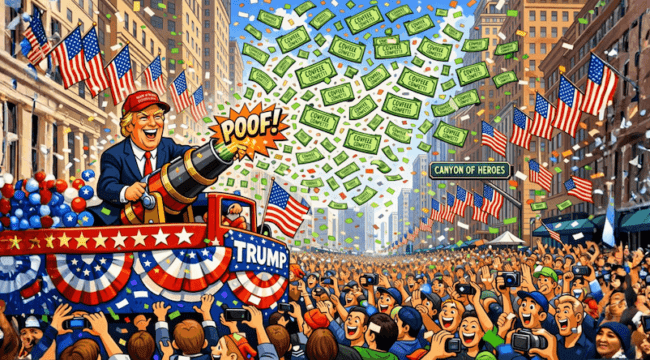
But by the time Main Street grasps this reality, it will be too late to act. They’ll find themselves with nothing but Covfefe Confetti in their wallets.
About the Author