America’s foreign policy elites don’t seem to care much about the people they kill.
President Donald Trump portrays himself as a peacemaker, claiming his war settlements warrant a Nobel Peace Prize. This comes after a year marked by reckless military interventions, unpredictable tariffs, and strange, expensive foreign demands, all touted as efforts to “make America great again.”
Yet, the administration’s intense, often strained rationalizations rarely hold up. Take Trump’s short and forceful campaign in Venezuela, justified as saving hundreds of thousands of American lives by his own account. However, Caracas neither produces fentanyl nor sends drug-laden vessels to the U.S., and does not make Washington’s Dirty Dozen drug list. When Venezuelan President Nicolas Maduro was captured, Trump openly praised seizing the oil—apparently planning to control its sale exclusively. Drug enforcement mattered little compared to his supposed goal of promoting democracy, a notion seemingly irrelevant even after opposition leader María Corina Machado presented him her Nobel medal.
Attorney General Pam Bondi attempted to justify the military action by asserting the need to detain a foreign defendant “to face justice,” as explained here. Yet, a botched extradition effort does not provide legal grounds for an invasion. The Constitution does not permit the president to wage war on another country for such a reason.
War inevitably incurs a grave cost. In Venezuela’s case, dozens reportedly lost their lives. However, this seemed to draw little attention in Washington. The New York Times noted:
The Defense Department said it was conducting an assessment of the damage resulting from the attack. “We are currently not aware of any civilian casualties,” the Defense Department said in an email. “Every strike was precisely planned to achieve operational objectives and at no point were civilians intentionally targeted.”
While the Venezuelan government, controlled by Chavista loyalists, may exaggerate figures for propaganda, the U.S. military’s overwhelming force is a key factor in its frequent tactical successes. The lack of robust resistance implies significant casualties likely occurred.
The Times confirmed at least two civilian fatalities from U.S. strikes that affected an apartment complex. It reported:
At 2 a.m. last Saturday, inside his sky blue apartment building in Catia La Mar, a city on Venezuela’s northern coast, Wilfredo González said he was jolted awake by the sound of whistles and explosions. He had just managed to stand when the shock wave from a blast knocked him back to the ground. “They are bombing us,” he recalled. After it was over, his relatives rushed to find survivors amid the debris in his unit. Mr. González, 61, said he found his 80-year-old aunt, Rosa Elena González, pinned under a washing machine. “She was saying, ‘I can’t breathe, I can’t breathe,’” Mr. González said, adding that she died shortly afterward at a hospital.
Furthermore, many security forces reportedly perished. According to the Times:
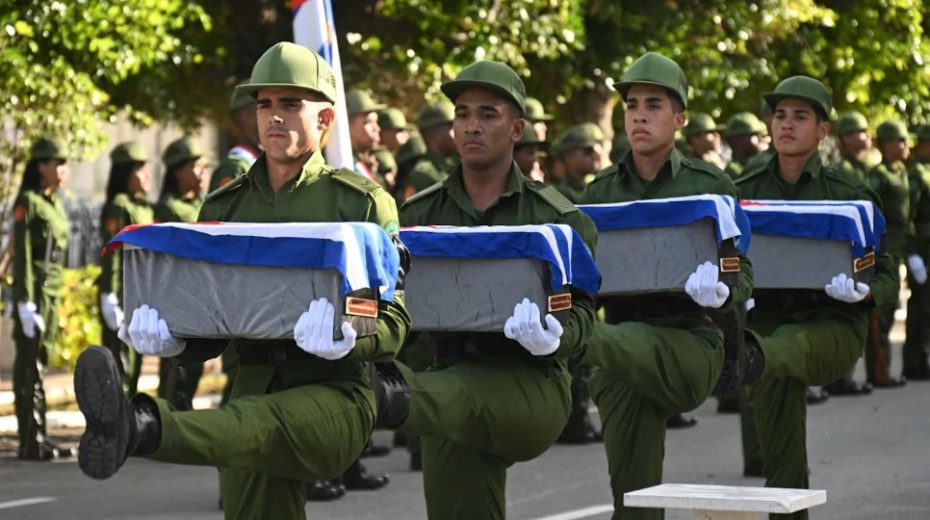
Diosdado Cabello, Venezuela’s interior minister, said that 100 people had been killed, and at least as many wounded. The majority of those killed appear to have been members of the military. The Cuban government said 32 of those killed were Cuban citizens—members of the country’s armed forces or its interior ministry, on a mission in the country at Venezuela’s request. The Venezuelan government published obituaries for 23 service members who it said had been killed in the raid.
These were fathers, brothers, and sons. For example, the Washington Post covered the story of 74-year-old Salvador Rodríguez, whose
son, the boy who’d always asked for Rodríguez’s blessings, who’d helped him through the anguish of his wife’s passing, had been taken from him, too—killed in an explosion during the mission by U.S. forces to capture Venezuelan President Nicolás Maduro. “I have his cédula right here,” he said, pulling out the seared identification card of José Salvador Rodríguez, 32, who had served as a member of the Venezuelan military. “It was burned by the explosion.”
So why did Washington kill the younger Rodríguez and many others? The U.S. and Venezuela are not formally at war. The administration emphasized the raid was a law enforcement action, not a military engagement. In warfare, soldiers often fall, and civilians may be casualties too. Yet, as Charli Carpenter from the University of Massachusetts pointed out, “For law enforcement operations, the bar is much higher.” Launching an international invasion to detain a suspect recalls the notorious federal assault on the David Koresh compound in Waco and the Philadelphia Police Department’s bombing of a civilian neighborhood in its MOVE operation. (President George H.W. Bush’s invasion of Panama cited drugs only tangentially.)
Still, many U.S. officials likely regard such deaths as inconsequential or, in the case of Venezuelan and Cuban military and security personnel, even advantageous. While few would mourn despotic regime leaders responsible for harsh repression, there was no justification to kill them, much less rank-and-file servicemen defending their countries and leaders. Particularly when the operation seemed focused on appropriating Venezuela’s oil.
Carelessly shedding foreign lives for national gain will backfire politically. Though “so’s your mother” is a poor excuse for aggression, atrocities, and oppression by any regime, it effectively silences U.S. moral rhetoric. If the Donroe Doctrine implies Washington can wage war to seize resources and control neighboring states, then it forfeits complaints when Russia, China, or regional actors like Israel, Saudi Arabia, the UAE, or Iran enact similar policies in their perceived spheres.
This pattern isn’t unique to Trump or even unprecedentedly severe. President George W. Bush caused the deaths of hundreds of thousands through his illegal invasion of Iraq. President Barack Obama sponsored a prolonged, violent regime change in Libya, igniting years of recurring conflict, while supporting the Saudi and Emirati slaughter in Yemen. President Joe Biden has supported Israel’s destruction of Gaza and its brutal occupation of the West Bank, a stance continued from the Trump era.
These casualties are likely to weaken the administration’s Venezuela policy. Few experts in Latin America expect that Trump’s approach, focused on leadership removal, will bring stability, U.S. dominance, or the emergence of a liberal democratic state. The Times reported that Venezuelan
government officials have accused the United States of killing innocent civilians, and they honored the servicemen who died as martyrs in the struggle against the “cowardly” U.S. attack. “The imperialists know they have committed a terrible crime, that they have murdered civilians,” Mr. Cabello said, adding that the United States has “generated an anti-American sentiment” for having “murdered a group of Venezuelans who had nothing to do with this.”
Notably, Cabello remains influential, actively resisting Trump’s plans despite also being indicted in the U.S. on drug charges. This undermines the administration’s declared war on drugs. The Times added:
The world is often brutal, forcing difficult decisions, but the U.S. president lacks the moral and legal right to roam the globe imposing his will and causing death indiscriminately. Anyone claiming to advance peace should halt the reckless infliction of suffering abroad—even in Venezuela.
Original article: theamericanconservative.com
About the Author