Mining Co. “Finds” $3 Billion in the Trash
On August 24, 2006, I accompanied Dr. Steve Sjuggerud on a trip to Tennessee. He invited me to join him in visiting a zinc smelter, of all places.
For those unfamiliar with Dr. Steve, he stands as one of the most successful newsletter writers and investors in history. He left Stansberry Research to enjoy surfing, investing, and living a fulfilling life.
His destination was Clarkesville, Tennessee, drawn by a unique company, Zinifex. His analysis indicated Zinifex would generate $2.5 billion in profits that year, despite a market cap slightly above $5 billion.
In other words, the stock was valued at roughly twice its earnings—a remarkably low valuation and a market oversight. Discovering such opportunities was exactly Dr. Steve’s specialty.
I went along and uncovered the reason behind the Clarksville refinery’s strong profitability: it was extracting additional value by re-mining old tailings ponds for germanium.
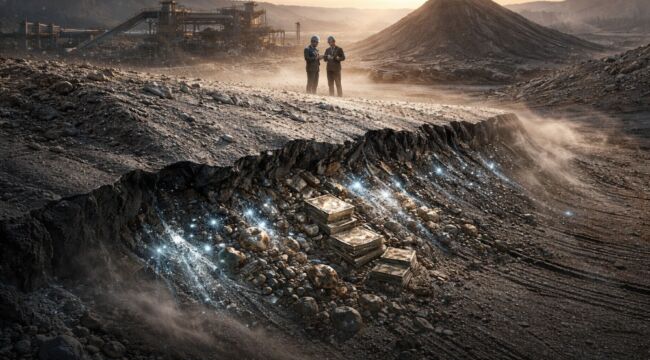
Tailings ponds are essentially mining and smelting waste dumps, where residual material rejected during metal extraction is stored. Established in the late 1970s, this smelter is the only primary zinc smelter left in the U.S. The zinc ore contains various accompanying metals like cadmium, thallium, indium, and germanium.
Back then (2006), the price of germanium surged from about $360 per kilogram to $660 per kilogram. The waste ponds were rich in metals, and the company realized it could boost zinc profits by recovering germanium.
Today, germanium commands over $7,000 per kilogram—a 960% increase since my visit.
Nearly 20 years later, the Clarksville smelter is under new ownership. Korea Zinc Co. acquired it in December and has ambitious plans, including utilizing those very tailings.
Korea Zinc reports possessing 600,000 metric tons of material currently valued at more than $3 billion. These tailings contain zinc, copper, lead, silver, and germanium, and the company estimates there are six to seven years’ worth of material stored there.
The firm intends to pour $7.4 billion into transforming the old smelter into a key minerals complex. This initiative aligns with the broader U.S. push for critical metals independence. According to the company’s press release:
- Korea Zinc and the U.S. Government, through the Department of War and the Department of Commerce, have concluded an initial, conditional commitment – including U.S. federal and private investment – that will support a domestic critical minerals project with an expected $6.6 billion of capital expenditures. The agreement will support Korea Zinc’s plans to expand operations, including the building of a 650,000 m² smelting facility in Tennessee.
- The Tennessee project aims to create an integrated smelter producing both base metals as well as critical and strategic minerals, with phased commercial operations targeted for 2029.
- 11 out of 13 nonferrous metal products that the U.S. Smelter will produce are designated as “critical minerals” by the U.S. Government. This conditional commitment strengthens the critical minerals supply chain for the U.S., South Korea, and other allied countries, ensuring a consistent, steady supply of key elements and minerals.
This represents a significant breakthrough for the American critical metals sector, as few smelters currently operate in the U.S. Historically, smelters were seen as “dirty.” Yet in 2006, the smelter complex looked less industrial than any other I had encountered.
Nevertheless, decades of anti-mining sentiment created complex barriers to establishing new smelters. Securing permits alone would normally take years. That is no longer the case. The company claims it can reach production within just two years.
I might need to catch another flight to Nashville for a follow-up visit to this project.
Korea Zinc’s shares have more than doubled in the last six months. Unfortunately, the stock is not listed on U.S. exchanges.
Still, this trend of re-mining is expected to spread globally. We’ll keep an eye out for actionable re-mining opportunities and share any noteworthy discoveries.
About the Author