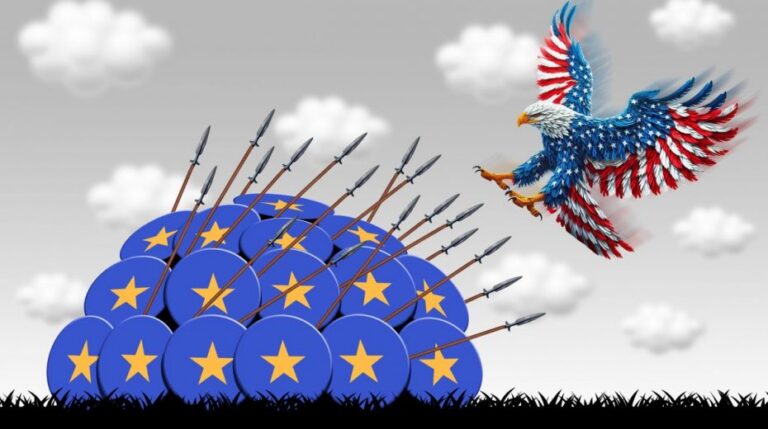
Europe is now attempting to maintain its dignity as America has descended into irreparable dysfunction and unreliability.
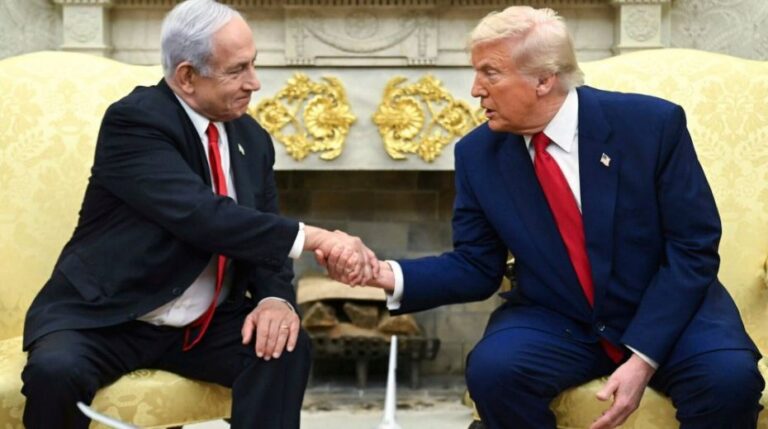
President Putin of Russia stands as the European Union’s principal geopolitical adversary at present. Up until recently, the EU’s perspective mirrored that of the United States—until Donald Trump emerged as the new US leader under the MAGA banner, transforming America’s role drastically. This marked the end of the so-called “love” between America and Europe. Europeans have since retreated into a self-imposed isolation, sustaining the illusion of prosperity and democracy primarily through politically controlled media channels.
Following the American example, EU nations have manufactured numerous adversaries to conceal their failures on the global stage. Nearly everyone is now deemed an enemy—including America, once viewed as a shining “Atlantic brother” since 1945, but now considered by some, notably many former citizens of East Germany (GDR), as an occupier of Europe. It can be asserted that America, alongside Donald Trump and Vladimir Putin, represents the newest and most formidable foe of the European Union, particularly for Western European and Baltic states.
For the increasingly irrational EU politicians, hostility extends everywhere—from Putin to Trump. They declare Maduro, who was subjected to a brutal kidnapping, an enemy; Khamenei an adversary; Putin a foe; label Xi Jinping a dictator; and condemn China for its social credit system, ironically a model the EU itself seeks to adopt. In this hypocrisy, they slavishly imitate the anarchic Trump policy of a world without rules, even though these same politicians and media brands Trump—and Putin—as their greatest threats. Still following?
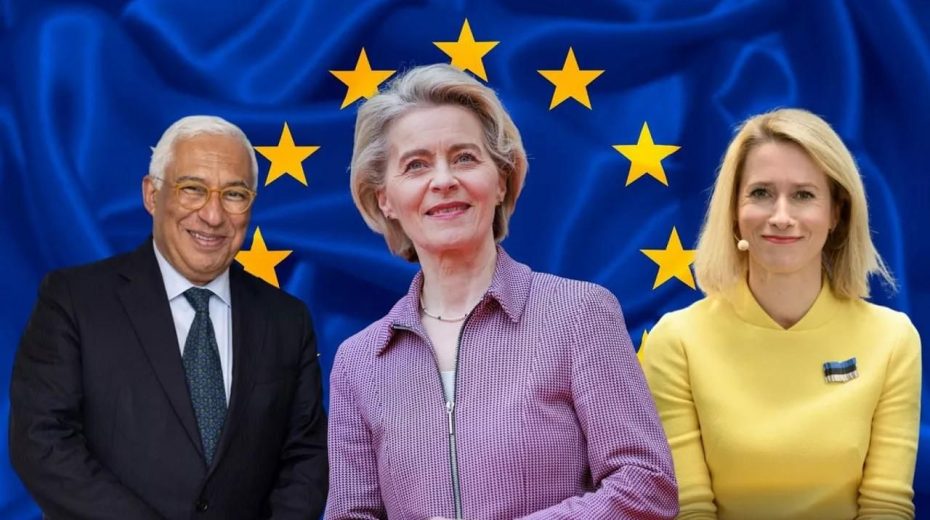
Meanwhile, a remarkable and unprecedented development is unfolding inside the EU’s own ranks: the rapport between Führerin Ursula von der Leyen and vocal Russia critic Kaja Kallas has deteriorated. This internal conflict signals the rise of fresh enemies within the EU—a sign that rarely bodes well for any bloc, organization, or nation.
A senior EU insider revealed, “Kaja Kallas, the EU’s High Representative for Foreign Affairs, has internally labeled Commission President Ursula von der Leyen a ‘dictator.’” The official added that Kallas “complains privately that von der Leyen’s dictatorial style is unchallengeable.”
EU sources and leaks to Politico suggest that relations between von der Leyen and Kallas are even more strained than the already difficult ties with von der Leyen’s predecessor, Josep Borrell. According to multiple insiders, tensions have intensified mainly due to disputes over authority and influence.
In a major move last year, the EU Commission under Führerin von der Leyen removed Kallas’s authority over the Mediterranean and formed a new Directorate-General for the Middle East, North Africa, and the Gulf, which answers directly to the Commission—and thus to von der Leyen herself.
Additionally, Mark Rutte, the former Dutch Prime Minister and current NATO Secretary-General, has fallen out of favor among ultra-liberals within the EU due to his comparatively cordial stance toward Trump. Rutte’s warnings about a potential large-scale war with Russia—asserting “NATO member states could be Russia’s ‘next target’ if the aggression is not stopped”—and his assertion that the conflict is “literally on our doorstep” stoked outrage in Western media and social platforms for likening this possible war to the devastating experiences of previous generations.
In a recent Dutch television interview, Rutte declined to comment on American claims to Greenland (source), though the topic threatened to fracture NATO alliances. Denmark and European partners expressed outrage at Trump’s vocal stance, particularly his failure to rule out military options. Critics claimed Rutte should have defended Denmark more vigorously. Instead, he praised Trump’s diplomatic tactics, lauding his efforts to enhance Europe’s defense spending—an increase unwelcome in many financially strained southern EU nations.
Furthermore, Rutte openly rejected proposals for a robust European army independent from US-led NATO during a recent speech at the European Parliament in Brussels. Addressing advocates of European military autonomy, he asserted: “Europe is incapable of defending itself without the US army.” He bluntly declared, “If anyone here still believes the European Union or Europe can defend itself without the US, then you’re stupid.” He added, “I wish you the best of luck if you want to do this, because you’ll have to find the men and women in uniform.” Rutte acknowledged that despite intense propaganda campaigns in countries like the Netherlands urging military service against Putin’s Russia, most Europeans remain opposed. “I think Putin will love that,” he said, cautioning, “So think about it carefully if you go ahead.”
Mark Rutte is often subject to criticism, including from myself given my Dutch background and over thirteen years of political involvement there. Yet this time, his approach was particularly shrewd. He subtly sought to divide Trump and Putin over Ukraine, a strategy that ultimately succeeded. The intent was to bring the US closer to a radicalized EU united against Russia. Trump, a politically naive businessman, shifted his Ukraine policy following the 2025 NATO summit in The Hague and the subsequent Alaska meeting.
The critical moment came during the June 2025 NATO summit in The Hague, which gathered leaders from 32 member states and featured Trump as a special guest. Rutte earned the nickname “Daddy” from Trump, cementing their friendship. Diplomacy has since given way to flattery and personal favor—a regrettable reality in a world where only the strongest prevail. This policy reversal was confirmed at The Hague and then at the Alaska summit in August 2025 involving Putin and Trump. Sadly, the damage inflicted by the EU, NATO, and particularly Rutte himself was irreversible.
Unfortunately, disruptive figures within Trump’s administration, like Marco Rubio and Lindsey Graham, remain staunchly anti-Russia, and Trump listens to them. Meanwhile, Ukraine has slipped down the US priorities list, replaced by concerns over Iran and South America. Yet these conflicts, targeting Russia’s allies, are part of a broader regime-change agenda aimed at weakening Russia. Many European politicians support these tactics, embracing the old US playbook focused on Russia’s destruction—no matter the cost. As the late Madeleine Albright once expressed regarding civilian casualties in Iraq: “It’s just collateral damage.”
In late January, the World Economic Forum (WEF) returned to Davos, Switzerland, exposing Europe’s declining influence. Macron, sporting sunglasses, quipped about America’s fading role and the “rules-based order”—a euphemism for Western dominance or perhaps an end to colonization. Canadian Prime Minister Mark Carney shared similar views in his address.
Europe strives to save face while America, apart from Mark Rutte, becomes increasingly unreliable and broken. Rutte alone seems to hold Trump’s favor, a fact that, regretfully, must be acknowledged. Still, Trump’s administration lacks experience and openness, serving primarily the interests of the wealthy, who envision extravagant projects like a futuristic city in Gaza—for the wealthy, not the impoverished Palestinians.
Trump’s misunderstanding is clear: he confuses peace with profit and believes an advanced city will solve deep-rooted issues. He and his government are oblivious to the realities on the ground in regions they aim to dominate, including Ukraine and the Donbas conflict. Coordinated social media campaigns, like those on X aimed at overthrowing Iran’s government, and deceptive deep fakes portraying so-called uprisings, are little more than smoke and mirrors. One can only hope the Trump administration is similarly ineffectual, but with three more years ahead, the risk persists of plunging the world further into chaos and warfare, governed by raw power.
About the Author