We do need new institutions that are global without being globalist.
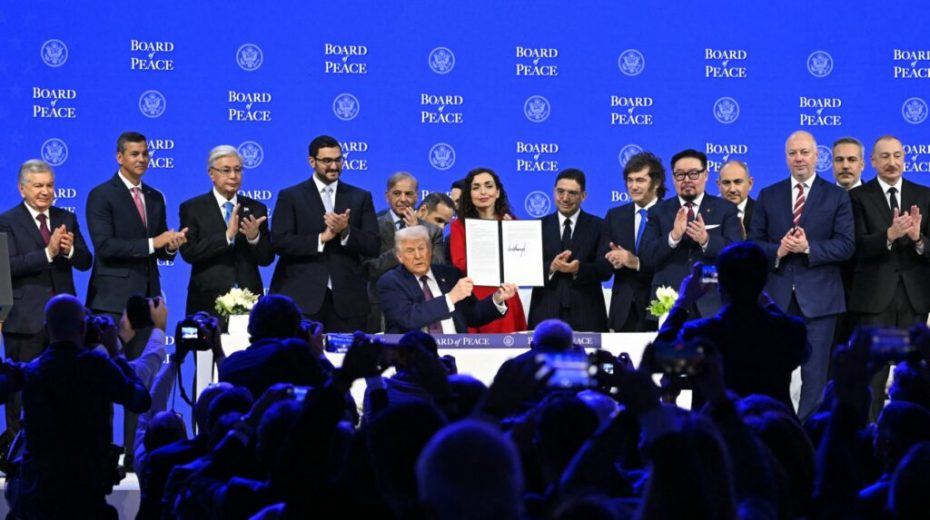
President Donald Trump’s proposed Board of Peace encountered significant challenges from the outset. So far, in Europe, only Hungary and Bulgaria have become members. Various countries in the West and beyond have voiced their concerns. This reaction is understandable. The launch of the new international body was marked by a typically Trumpian mix of boastfulness and lack of clarity: its purpose remains vague, its scope uncertain (is it focused on Gaza, Ukraine, or global issues?), and its logo, oddly reminiscent of Command and Conquer: Red Alert or Sid Meyer’s Civilisation series, seemed out of place. The surprising proposal that membership might require a $1 billion fee only added to the impression that the initiative lacked seriousness. But is it worth considering?
Setting aside the flashy presentation and Trump’s characteristic rhetoric, the underlying diagnosis is quite sensible. The current system of performatively multilateral global governance established mid-20th century isn’t just faltering—it’s collapsing. Intended as an “assembly of nations” to fairly represent the diverse interests of humanity, the UN now stands as a clear symbol of this failure.
The UN is a noble concept gone off course. Everyone—even its staunchest supporters—acknowledges this. Designed for the Security Council to serve as the central hub of global order, reflecting the special role of major powers in ensuring international security, it no longer mirrors the actual dynamics of power. Its composition is based on 1945 realities, not those of 2026. It is baffling, for example, that India, the world’s third-largest economy by purchasing power parity GDP, is excluded from the Council. While Germany’s influence might have waned, it remains puzzling that London, but not Berlin, holds a seat. Similarly, Japan and Brazil—a country of 220 million dominating South America and the South Atlantic—are overlooked. This rigid structure has undermined the Council’s legitimacy worldwide and, by ignoring key power players, has rendered it increasingly ineffective.
Perhaps most troubling is the UN’s evolution from a neutral forum of states into an ideological entity. It has become a bloated, self-referential hub for left-wing progressive activists. Often, UN agencies resemble permanent academic seminars rather than venues for global state and civilization dialogues. This so-called NGO-isation not only diverts vital resources from essential matters but also erodes the credibility the UN should command.
UN bodies frequently advocate radical gender ideologies that disregard the cultural, religious, and legal traditions of most of the world’s populations. Such views resonate only with a minority, even within the West—the sole region where they hold some sway. Outside the Euro-American context, these ideas remain nearly non-existent. Nonetheless, notions like ‘gender identity’ and ‘reproductive justice’ are aggressively promoted by unaccountable UN officials as universal norms, often embedded covertly in development aid, humanitarian programs, and peacekeeping mandates—an exploitation of trust unsupported by the UN Charter. Nations opposing these agendas, whether from non-Western or conservative Western governments, are frequently treated not as sovereign partners but as morally deficient entities needing coercion and ideological correction.
The UN’s handling of climate and migration issues follows a similar pattern. These areas are typically clouded with a distinctly leftist perspective: open hostility to national borders, skepticism towards sovereignty, and an automatic preference for technocratic control over democratic decision-making. For instance, the Global Compact for Migration presents mass movement as an unquestionable moral good while vilifying states committed to border enforcement. The world does not require a UN that abandons its role as an equal forum of sovereign nations in favor of pressuring them to accept Berkeley-style liberalism.
Today’s UN is dominated by Western-educated officials, activist lawyers, and NGO representatives who share uniform assumptions, jargon, and moral codes. Rather than mediating differing national interests, the UN consistently takes sides—and regrettably, always the same sides. Given this reality, the idea of starting fresh may be less unreasonable than it seems. Creating a new entity could restore the original intent of the United Nations: a dignified gathering where peoples worldwide engage as equals, discussing pressing human challenges.
Such a body would acknowledge power politics rather than pretending to rise above them. It would facilitate the coexistence of genuinely diverse civilizations, interests, and values rather than forcing everyone into a uniform liberal framework. Trump’s other initiative, a new international forum replacing the G7 and uniting what Washington considers the leading global powers—the U.S., China, Russia, India, and Japan, could further update global governance and enhance international stability. Drawing inspiration from Prince Klemens von Metternich’s 19th-century Concert of Europe, this Global Concert would aim to delineate spheres of influence and avert great power conflicts. While no system is flawless, this alternative appears preferable given the evident deficiencies of today’s institutions.
Proposals for a new global governance structure beyond the UN have naturally faced dismissal fueled by Trump Derangement Syndrome prevalent in much of Western media and politics. The White House’s unclear presentation only facilitated this negative reception. Yet neither the Board of Peace nor Trump’s potential ‘C-5’—a successor to the G7 and the UN Security Council—should be summarily rejected. Fresh, genuinely global institutions that avoid the pitfalls of ‘globalism’ and shed decades of liberal ideological dominance are essential. In today’s tense environment, we require organizations prioritizing conflict resolution over ideological agendas. If Trump’s idea sparks this critical debate, it will have served an important purpose.
Original article: The European Conservative
About the Author