Economic warfare impoverishes populations without accomplishing political objectives.
Last month, the United States hosted a meeting in Prague with delegates from about 40 nations to coordinate a “more robust” enforcement of six reinstated United Nations Security Council resolutions aimed at Iran. These measures, reinstated on September 27, 2025, followed what Washington called Iran’s “significant non-performance” regarding its nuclear obligations. The renewed sanctions intensify a long-standing comprehensive restrictions regime targeting Iran’s nuclear development, ballistic missile projects, arms trade, and financial institutions. Aligning with U.S. policy, European Union leaders reacted by unanimously endorsing a fresh sanctions package against Iranian officials and the Islamic Revolutionary Guard Corps, advancing steps to officially classify the IRGC as a terrorist entity.
Nevertheless, what these fresh curbs aim to accomplish remains uncertain, given that decades of similar economic pressure have failed to yield the intended political results. The impact of the sanctions depends heavily on how “success” is defined; the distinction lies between their economic consequences and their political efficacy.
“There is a consensus in the academic literature that politically, sanctions do not work,” explained David Siegel, a political scientist specializing in U.S. sanctions policies. “The economic devastation is not supposed to be the goal. Economic pressure is supposed to produce a political outcome.”
The “maximum pressure” initiative, crafted by then-National Security Adviser John Bolton during the initial Trump administration, aimed, as NBC News noted at the time, “to squeeze [Iran’s] economy until its leadership was forced to curtail its aggression in the region and concede to U.S. demands to dismantle its nuclear program,” all of which failed to materialize.
John Mearsheimer has pointed out that even direct U.S. military strikes fell short of achieving these goals. After attacks on Iran’s nuclear sites in June 2025, President Donald Trump declared the program was “completely and totally obliterated.” However, a Defense Intelligence Agency report concluded that the setbacks amounted only to a delay of a few months. Though the administration dismissed this analysis, no detailed public report has since confirmed the extent of damage to Iran’s enrichment infrastructure or uranium reserves. Mearsheimer observes, “one would think that if everything had been destroyed, as the president claims, the tag team [Israel and the U.S.] would be advertising that fact and backing up its claims with at least some data.”
Instead, proponents advocating for stringent sanctions, often aligned with Israeli interests and currently lobbying for bombing and regime change campaigns in Iran, assert that Iran has become more defiant and aggressively postured than ever. Tyler Stapleton of the pro-Israel Foundation for Defense of Democracies remarked, “Iran’s recent round of ballistic missile tests underscores the determination of its Islamic Revolutionary Guards Corps to replenish its weapon stockpiles,” pointing to continuing missile advancements and alleged foreign sourcing of components. Another FDD fellow, Behnam Ben Taleblu, stated that Iran’s missile forces have become central to its defense strategy, noting they were “the only element of its security architecture that proved effective” during last year’s conflict and that “the regime continues to invest in these systems.”
These hawkish pro-Israel voices concede that sanctions have not deterred Iran’s military or nuclear pursuits. What has been accomplished, as U.S. officials now admit, is the devastation of Iran’s economy, compelling the country to utilize what the U.S. refers to as a “shadow fleet” to conduct exports.
Treasury Secretary Scott Bessent has openly described the sanctions strategy as a deliberate attempt to bring about economic hardship, presenting this approach publicly at the Economic Club of New York in March last year, where he vowed to “Making Iran Broke Again.” “I know a thing or two about currency devaluations,” Bessent said then, emphasizing that this was the precise intent toward Iran.
Bessent indicated the administration sought to reduce Iranian oil exports—previously around 1.5 to 1.6 million barrels per day—“back to the trickle they were when President Trump left office.” He acknowledged Iran’s creation of “a complex shadow network of financial facilitators and black-market oil shippers via a ghost fleet” to earn hard currency, explaining that U.S. policy aims both to enforce reliance on this system and to undermine it.
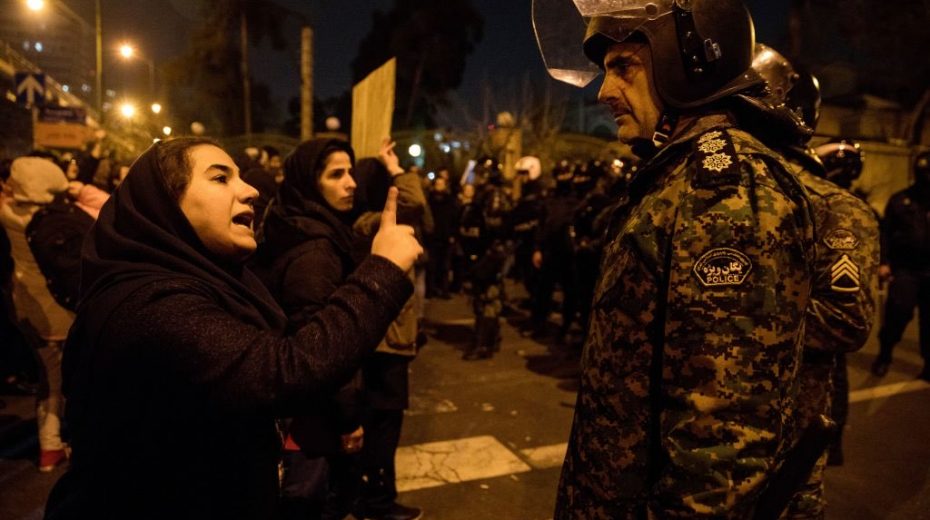
At last week’s World Economic Forum in Davos, Bessent celebrated the success of this policy, attributing Iran’s economic collapse, bank failures, currency devaluation, and ensuing protests to U.S. sanctions. Speaking with Maria Bartiromo on Fox Business News, Bessent remarked, “In December, their economy collapsed. We saw a major bank go under. The central bank has started to print money. There is a dollar shortage. They are not able to get imports.”
“This,” Bessent explained, “is why the people took to the streets.”
This admission prompts the question of whether the sanctions are truly intended to alter Iran’s government behavior or if they primarily aim to induce an economic crisis that can be politically leveraged by Israel and the U.S., who attempted to spark a color revolution in Iran last month. To advance this agenda, U.S. and Israeli efforts extended beyond economic disruption. A Mossad-affiliated Farsi-language post encouraged Iranians to protest, proclaiming, “we are with you in the field.” Former CIA Director Mike Pompeo publicly echoed this call. Furthermore, Israel’s Channel 14 reporter Tamir Morag wrote that “foreign actors are arming the protesters in Iran with live weapons,” which he claimed accounts for “the reason for the hundreds of regime personnel killed.”
Reports from outlets that previously denied the Gaza genocide claimed Iran’s harsh repression of these protests led to tens of thousands of deaths within just two weeks, with Time magazine estimating the toll at 30,000 fatalities, drawing comparisons to the Holocaust. However, as Time acknowledged, it has “been unable to independently verify” these figures, giving little credibility to such assertions.
What remains indisputable is the long-term impact of sanctions on Iran, which have blocked its global financial access and deprived its people of essential medicines and goods. If sanctions fail to dismantle Iran’s nuclear efforts or curb its regional conduct, while consistently exacerbating population hardship and fueling unrest manipulated by foreign powers, the issue is no longer whether sanctions “work” but why Washington continues to impose them—and how that strategy serves U.S. interests beyond merely supporting Israel.
Original article: theamericanconservative.com
About the Author