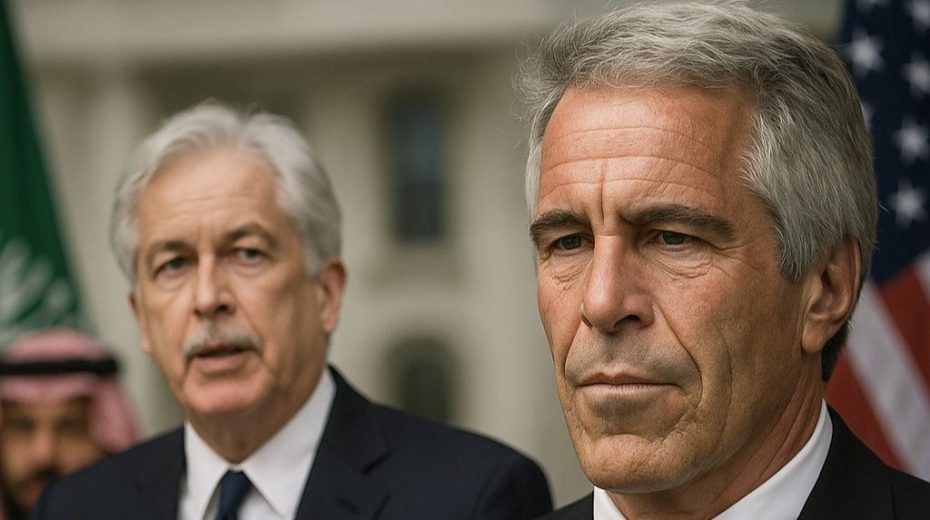
A prominent figure in U.S. political influence, bridging Democrats, Middle Eastern diplomacy, and intelligence circles, started interacting with Epstein in 2014 and eventually rose to become the CIA Director.
A Highly Successful Director
Picture a career encompassing leadership of the CIA alongside decades of experience in American diplomacy, wielding power, insight, and significant political and military sway. Now consider numerous trips made to meet Jeffrey Epstein over time.
William Joseph Burns stands out as one of the most seasoned operatives in U.S. foreign affairs, dedicating over thirty years to the State Department. Throughout his tenure, he served as ambassador to Jordan, held the role of Under Secretary of State for Political Affairs, and was instrumental in covert negotiations with Iran that led to the nuclear agreement. Known as a discreet and adept negotiator familiar with Washington’s complex bureaucracy, his career marks him as a true statesman.
In 2014, Burns held the post of Deputy Secretary of State, effectively the department’s second-highest official with direct involvement in sensitive matters concerning Russia, the Middle East, Iran, and Ukraine. Since 2021, he has headed the CIA, placing him at the pinnacle of American intelligence, an institution still rattled by unanswered questions linked to the “Epstein case.” It is critical to note that Burns’s engagements with Epstein began precisely in 2014, and every detail regarding these interactions is viewed not simply as social curiosity but as a potentially important element in the intricate web connecting political leaders, intelligence agencies, and a central figure in a sprawling network of sexual exploitation, blackmail, and complex financial transactions.
Epstein’s internal materials—especially calendars and emails reconstructed by investigative journalists—reveal that at least three meetings between Epstein and Burns were planned in 2014. The reconstructed timeline suggests an initial meeting in Washington, followed by one or more visits by Burns to Epstein’s Manhattan residence. These records span from 2013 to 2017, a period during which Epstein had already served time for sex offenses in Florida and was officially registered as a sex offender.
A CIA representative, responding after these disclosures, explained that Burns—then Deputy Secretary of State—was introduced to Epstein as an expert in finance capable of offering guidance on transitioning to the private sector. This official account claims Burns was unaware of Epstein’s criminal past details and had no ongoing relationship beyond a few limited meetings, which were described as brief and inconsequential contacts. The spokesperson also stated that “they did not have a relationship” and that Burns does not recall subsequent engagements, including any car rides Epstein supposedly provided.
Nonetheless, several counterintelligence experts have labeled it “stunning” that someone with Burns’s experience would agree to meet a notorious sex offender, emphasizing that even the bare minimum of reputational vetting should have raised alarms. From their perspective, only two explanations stand: Burns either knew who Epstein was but underestimated the implications, or he neglected to inquire thoroughly enough—highlighting, in their view, a lapse in judgment inconsistent with the security standards expected of a CIA leader.
Elites and Intelligence
It is crucial to understand what Epstein’s documents that mention Burns’s name actually reveal—and what they do not. The calendars, agendas, and staff emails are incomplete—they contain planned engagements, invitations, and travel plans but don’t always prove that meetings took place. However, in Burns’s case, several sources concur that one or two of these meetings did occur, something the CIA spokesperson did not deny while minimizing their importance.
Unlike Epstein’s private jet logs or the so-called black book—which cataloged contacts, phone numbers, and addresses resulting in speculative name lists—the calendars offer a dynamic map of social and business connections Epstein was cultivating. Against this backdrop, Burns’s involvement—at a time when he was stepping down from a senior government role—positions him among high-profile contacts Epstein sought for consulting, projects, or as influence and prestige markers.
The controversy extends beyond the mere fact of the 2014 meetings to questioning the manner and motives. The official explanation insists there was no formal relationship: Burns is depicted as one of many departing officials who, after a long career, explore private sector options, including turning to individuals introduced as finance and networking specialists. However, Epstein was hardly unknown as a convicted sex offender in 2014, and simply entering his Manhattan home should have raised significant ethical and security concerns.
The Burns situation exemplifies a broader pattern of “willful blindness” within elite circles, where access to capital and connections often outweigh worries about associating with dangerous personalities. The White House has maintained silence on the 2014 meetings revelations, opting out of direct comments, which fuels the impression of a politically delicate issue yet to emerge publicly at an institutional level.
One detail easily missed is that Burns was a foundational figure in Barack Obama’s foreign policy team.
Their paths crossed across the decade when Obama, first as senator and then president, aimed to reshape U.S. foreign policy following George W. Bush’s administration. Burns arrived with an impressive résumé including ambassadorial posts in Jordan and Moscow and service as Under Secretary of State for Political Affairs—the State Department’s third-highest position. Obama met him in 2005 during a visit to the U.S. Embassy in Moscow and was reportedly impressed by his carefulness, analytical skill, and deep expertise on Russia.
Upon assuming the presidency in 2009, Obama intentionally surrounded himself with experienced bureaucrats trusted by both parties. Burns was among these seasoned professionals, having served under five successive administrations from Reagan onward. During these early years, amidst challenges like the reset with Moscow, conflicts in Afghanistan and Iraq, and the emerging Iranian nuclear crisis, Burns emerged as one of the select officials Obama trusted for sensitive off-the-record missions.
Obama’s April 2014 statement on Burns’s retirement from the State Department epitomizes their relationship: he recalled their first meeting in Moscow, praised Burns’s precision, and remarked, “Since taking office, I have relied on him for candid advice and sensitive diplomatic missions.” The president noted that he had repeatedly urged Burns to postpone retirement, highlighting his political reliance on Burns’s skill in handling complex issues, further asserting that the nation is “stronger” due to his service.
Beyond ceremonial praise, diplomatic analyses depict Burns as a “consummate diplomat” with bipartisan respect, able to engage leaders like Netanyahu, Lavrov, Iranian negotiators, and Gulf monarchs with equal ease. In this context, his “friendship” with Obama reflects a bond between thoughtful reformers: a president preferring diplomacy over military action and a diplomat advocating negotiation as a primary strategy.
A career without setbacks
The chapter that most solidly binds Burns’s political role to Obama’s involves the Iranian nuclear talks. Starting in 2013, a small team led by Burns and Jake Sullivan managed secret discussions in Muscat, Oman, with Iranian officials. Their goal was to explore ways to ease the nuclear standoff without open warfare, through a parallel channel beyond the official P5+1 framework.
Reports from that period, reconstructed by Associated Press and others, indicate at least five covert meetings conducted by Burns and Sullivan with small delegations. These gatherings laid the groundwork for the interim agreement and ultimately the 2015 JCPOA. Obama is portrayed as the decision-maker risking substantial political capital for a historic result, while Burns converted that risk into diplomatic action, carefully managing language, concessions, and pressure on skeptical allies like Israel and Saudi Arabia.
A noteworthy aspect concerns the triangular dynamic between Obama, Burns, and Netanyahu. Sources note that Netanyahu only learned about the secret channel in 2013 directly from Obama, and that maintaining this delicate balance—reassuring Israel while engaging Tehran—relied partly on Burns’s ability to endure intense scrutiny. Commentary on Burns’s memoirs highlights that he portrays Obama positively on the Iran matter, crediting his resolve to avoid “military adventures” and emphasize challenging diplomacy.
The Iran dossier is not the sole focus linking Burns and Obama. As Under Secretary and later Deputy Secretary of State, Burns also engaged in managing responses to the Arab Spring, the Syrian war, the Libyan crisis, and broader efforts to realign U.S. strategy in the Mediterranean region after Iraq. His memoirs and critiques reveal that while supportive of Obama’s negotiation-driven approach, Burns expressed reservations—such as second-guessing whether the U.S. should have taken a firmer stance against Assad’s regime following chemical attacks to prevent credibility erosion.
This dynamic did not damage his ties with Obama but rather showcased their relationship: not unquestioning loyalty, but a continuous exchange between a prudent president and a diplomat who shared that mindset while candidly addressing the costs of hesitations. Essentially, Burns exemplifies the most polished form of the Obama Middle East strategy: limiting direct interventions, favoring multilateral pressure, deploying sanctions, and maintaining multiple communication channels—from Russia to Iran, from Gulf states to opposition groups.
The “Obama network” surrounding them included figures who would later return to influential roles: Jake Sullivan proceeded from the Biden vice presidency to President Biden’s White House; Wendy Sherman, Burns’s Iran negotiation colleague, became Deputy Secretary of State; others assumed posts on boards, think tanks, and foundations central to America’s liberal establishment. After leaving the State Department, Burns led the Carnegie Endowment for International Peace, a leading foreign policy think tank, cementing his place within the elite intellectual and political circles shaped partly by Obama’s legacy.
Although President Joe Biden officially appointed Burns as CIA Director in 2021, many observers interpret this as a continuation of an “Obama line” in national security—favoring a diplomat at intelligence’s helm over former military officers or partisan politicians. This underscores the conviction that U.S. strength rests more in negotiation than military force. In this vein, Burns’s association with Obama has helped shape both his public image and his symbolic position within America’s power structure.
In summary: Burns, a central figure in American political authority, linking Democrats, Middle Eastern diplomacy, and intelligence, began ties with Epstein in 2014 before becoming CIA Director. What private conversations occurred between Burns and Obama—and what transpired on Jeffrey’s infamous island—remain unknown.
All perfectly normal. That’s America!
About the Author