Germany Wants Its Gold Back (Again)
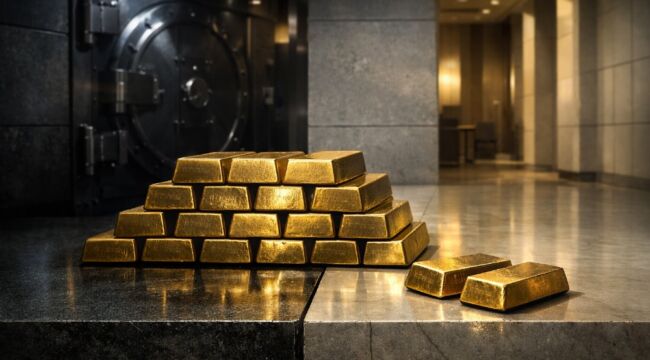
Germany holds the world’s second-largest gold reserves, totaling 3,350 tons.
The United States ranks first with 8,133 tons.
China officially claims to possess 2,300 tons, yet it’s widely acknowledged that they have been covertly accumulating gold for decades, potentially exceeding even the U.S. in total holdings.
Returning to Germany, the nation stores 37% of its gold in the vault of the New York Federal Reserve located in Manhattan. This stash is currently worth around $170 billion.
Why would Germany place such a huge amount of gold in New York? During the 1970s, fears loomed that the USSR might launch 20,000 tanks through the Fulda gap into West Germany.
Hence, the gold was kept in the U.S. for protection.
Since that time, German demands to repatriate their gold have surfaced intermittently, meeting with limited success.
In 2012, Germany’s central bank’s effort to at least inspect their gold holdings was covered by the German news outlet Der Spiegel in a report.
Finally, in 2007, “following numerous enquiries,” Bundesbank staff members were allowed to see the facility, but they reportedly only made it to the anteroom of the German reserves.
In fact, auditors from the Bundesbank made a second visit in May 2011. This time one of the nine compartments was also opened, in which the German gold bars are densely stacked. A few were pulled out and weighed. But this part of the report has been blacked out — out of consideration for the Federal Reserve Bank of New York.
“I would like more transparency on the issue,” says Bundesbank board member Thiele. The Americans are very sensitive, though, when it comes to security procedures in their gold storage facilities. In their second major depository, the legendary Fort Knox, practically no one in recent decades has been allowed to view the gold reserves.
Back in 2007, actually seeing any gold was off-limits. Years later, they gained access to only one out of nine compartments.
Moreover, certain sections of the inspection report were redacted, casting doubt on the whole process.
The Spiegel article from 2012 further explains:
Such intense secrecy fuels legends. Many conspiracy theorists have suspected for decades that the German gold has long since disappeared. Others believe that it has been lent out. They contend that there are only promissory notes of little worth stored in the bank’s vaults.
In the wake of these controversies, Germany was able to repatriate a portion of its gold, withdrawing 300 tons from the U.S. by 2016.
Still, the New York Federal Reserve holds 37% of Germany’s reserves, prompting renewed calls for full repatriation.
Germany’s Latest Attempt
Recently, German experts have once more urged the return of their gold. According to The Guardian:
Emanuel Mönch, a leading economist and former head of research at Germany’s federal bank, the Bundesbank, called for the gold to be brought home, saying it was too “risky” for it to be kept in the US under the current administration.
“Given the current geopolitical situation, it seems risky to store so much gold in the US,” he told the financial newspaper Handelsblatt. “In the interest of greater strategic independence from the US, the Bundesbank would therefore be well advised to consider repatriating the gold.”
Some have tried to attribute this issue to Trump, but it actually has a long history spanning decades.
Others are demanding regular gold audits:
Markus Ferber, a member of the European Parliament for the CDU, told Bild that he also insists on German officials being allowed to personally inspect the country’s U.S.-based bullion.
“I demand regular checks of Germany’s gold reserves,” he said. “Official representatives of the Bundesbank must personally count the bars and document their results.”
Despite these demands, Joachim Nagel, head of Germany’s central bank, remains firm for now, stating, “We have a trustworthy and reliable partner in the Fed in New York for the storage of our gold holdings.”
The renewed calls for repatriation or at least thorough audits are significant.
The last time Germany pushed to access their gold, they succeeded in bringing a portion back from the New York vaults.
Conspiracy Theories
Recall last year when President Trump and Elon Musk discussed auditing America’s gold reserves?
What became of those plans? Presumably, other priorities took over.
A longstanding group of gold enthusiasts has suspected that governments globally might have secretly sold or leased their bullion. They suggest vaults may contain little more than paper notes.
Could certain clandestine groups have secretly disposed of national gold reserves? It’s within the realm of possibility.
This veil of secrecy and lack of independent verifications only deepen such suspicions. Denying a sovereign country access to examine its own gold seems rather unusual.
Yet, current proof is circumstantial, leaving us with more questions than definitive answers.
Growing Mistrust
With diplomatic strains worsening between the U.S. and Europe, these tensions could soon escalate.
President Trump’s suggestion to acquire parts of Greenland sparked concern among some Germans.
Could this trigger Germany’s leaders and central bank to demand full repatriation of their gold? Possibly not immediately, but if alliances between NATO partners continue to weaken, the situation might change.
A revelation that national gold reserves have been sold would cause significant upheaval.
It would become one of the century’s most startling scandals—a theft on an unimaginable scale.
Our own Jim Rickards has covered this topic extensively, asserting that at least America’s gold remains intact, which is somewhat reassuring.
Still, it’s not impossible that some amount of foreign gold has vanished over the past five decades.
The temptation to lend out gold to generate revenue would be considerable.
Then again, a flood of gold onto the market would be hard to conceal and would undoubtedly create a noticeable impact. So, the truth remains unclear.
We will continue to watch this story as it develops.
About the Author