The GDI calls itself “independent”—but if it depends on funding from governments and public institutions like the European Commission, what kind of independence is that?
Just before Christmas, the U.S. State Department imposed visa restrictions on five individuals labeled as agents of a “global censorship-industrial complex” aiming to curtail Americans’ free speech. Leading the sanctions was Thierry Breton, former EU internal market commissioner, known for pushing the EU’s Digital Services Act (DSA) during his Commission tenure. Additionally, directors from three groups accused of censorship—HateAid, the Global Disinformation Index, and the Center for Countering Digital Hate—were also penalized.
As outlined in my recent portrait of HateAid, this German entity operates as a trusted flagger within the DSA framework, meaning online platforms and search engines must prioritize its notifications about allegedly illegal or harmful digital content. This trusted status is granted by EU member states, in this case, Germany.
However, another group sanctioned by the U.S., while not officially a ‘trusted flagger,’ has played a significant role in the EU’s long-standing efforts to oversee online speech regulation, predating the DSA. Importantly, it has notable, though opaque, connections to Germany. This organization is the Global Disinformation Index (GDI), whose executive director, Clare Melford, was also sanctioned.
Though previously scrutinized by right-wing U.S. media and politicians, GDI gained widespread attention in April 2024 when UnHerd revealed it had been placed on the group’s ‘dynamic exclusion list,’ resulting in lost advertising revenue. GDI’s declared mission is to ‘defund disinformation’ by blacklisting entities allegedly spreading false information.
While often described as a British organization due to its London office and Melford’s nationality, GDI’s European Commission CORDIS entry clarifies that it operates as a German entity headquartered in Berlin, receiving EU funds accordingly.
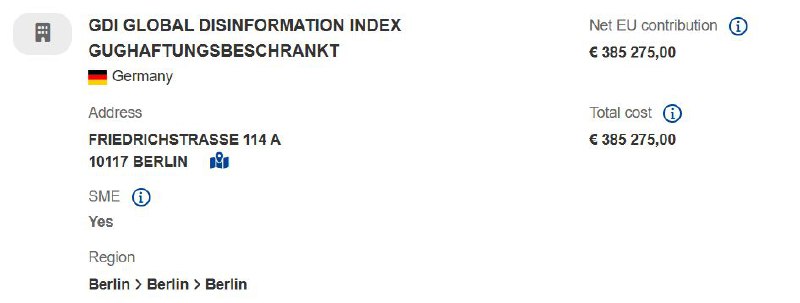
Furthermore, GDI has also been supported by the German government, at least during the last period when it disclosed its financial backers.
When UnHerd publicized concerns about GDI in 2024, highlighting its funding from the UK’s Foreign, Commonwealth and Development Office (FCDO), it emerged that the FCDO had already stopped supporting the group. Similarly, the U.S. State Department withdrew its funding following controversies with conservative American media. As detailed in UnHerd’s follow-up report, references to FCDO and Disinfo Cloud—a defunct platform once funded by the U.S. State Department—were promptly removed from GDI’s website funding list. However, the EU and Germany’s Auswärtiges Amt remain, as captured in the archived page dated 19 April 2024.
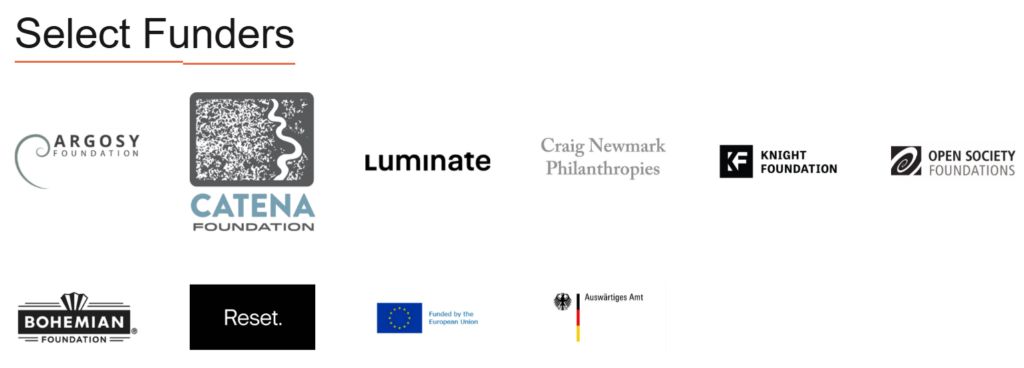
Since then, the entire funding list has vanished from GDI’s website. Notably, the German Foreign Office in Berlin’s ‘Mitte’ district is only a few minutes away by car from GDI’s Berlin Mitte location at Friedrichstrasse 114.
The European Commission launched its initial formal approach against alleged online ‘disinformation’ in 2018 with its Code of Practice on Disinformation, a supposed industry self-regulatory code involving major digital platforms and search engines. That same year, GDI was established.
By June 2022, just before the DSA was adopted, the Code of Practice was strengthened, and the EU-funded European Digital Media Observatory (EDMO) was appointed to a Permanent Task Force on Disinformation connected to it. Clare Melford holds a position on EDMO’s advisory board. Last year, the Code of Practice was upgraded to a Code of Conduct, allowing platforms to demonstrate DSA compliance through participation in the Code.
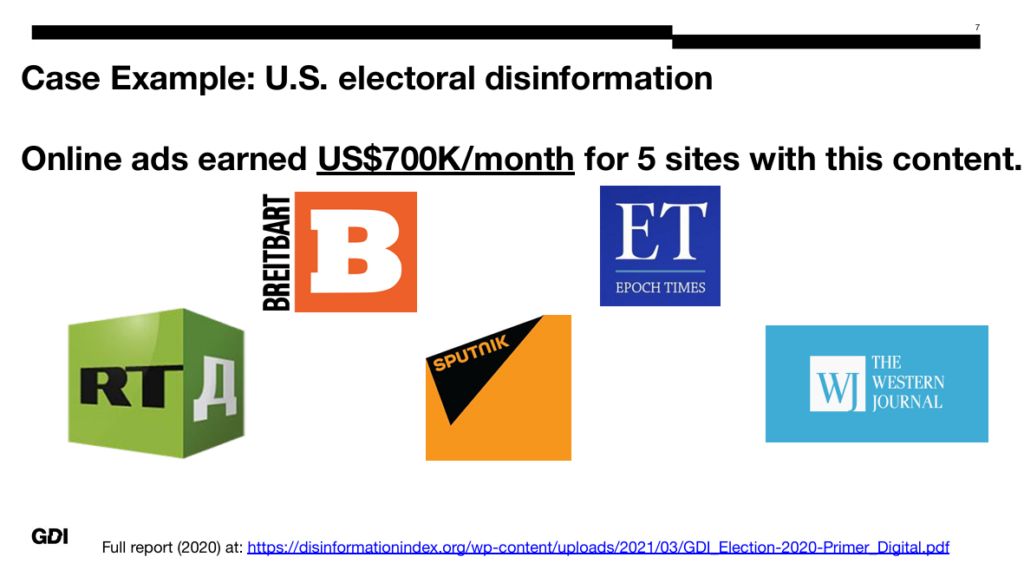
In a 2021 European Parliament presentation titled “Monetizing Disinformation in the EU,” Melford identified Russian outlets RT and Sputnik as disinformation sources, alongside U.S. media such as Breitbart, The Epoch Times, and The Western Journal (see visual below). The following year, EU Commission President Ursula von der Leyen banned RT and Sputnik broadcasts and enforced this ban across online platforms.
Initially, GDI received considerable funding from the British government. Yet, their EU lobby register submissions reveal clear enthusiasm to serve the emerging EU censorship framework. For example, data from May 2022 stated,
We are working globally but see a clear and unique opportunity at the EU level to advance the code of practice on disinformation to defund sites. We are keen to leverage our knowledge of this topic for meeting the EU’s commitment to this issue.
The same submissions also mention “the weekly evidence we compile and share with EU contacts,” particularly on “ads funding disinformation (on COVID-19 conspiracies, for example).”
Lobbyfacts.eu collected information on numerous meetings GDI held with European Commission officials between 2020 and 2022, including with commissioners most involved in the Code of Practice and DSA development: Thierry Breton (Internal Market), Margrethe Vestager (Europe Fit for Digital Age), and Věra Jourová (Values and Transparency).
Interestingly, the May 2022 data still showed a significant grant close to €1.5 million from the FCDO. However, as British financial support dwindled (its final FCDO contribution came in 2023), GDI began naming Disinformation Index Inc.—its American branch—as its primary donor. The latest register information is available here.
This means GDI lists itself as its biggest funder. ‘Disinformation Index Inc.’ is an American affiliate of GDI, and as we will see, this murky transparency is consistent across both branches, leaving much of GDI’s financial backing unclear.
The current register entry states, “The Global Disinformation Index is tracking and supporting EU commitments to combat disinformation as outlined in the EU Code of Conduct on Disinformation and the Digital Services Act.” Lobbyfacts.eu has also documented an additional five meetings with European Commission staff, including one as recent as last week with Executive Vice President Henna Virkkunen, the Commission’s current DSA lead.
In 2022, after controversy arose over GDI’s blacklisting of conservative U.S. outlets, its American branch released tax documents to the DC news outlet The Washington Examiner. These filings, however, concealed donor identities and even redacted the names of its own officers.
“I don’t think I’ve ever seen a 990 that excludes the names of officers and directors,” a nonprofit law attorney told The Washington Examiner then, “And I’ve looked at hundreds.”
Meanwhile, the German government’s response to a parliamentary inquiry (page 82) reveals that in 2023, precisely as British support was winding down, the German Foreign Office began funding GDI through its U.S. branch. “AA” stands for the Auswärtiges Amt, and “Disinformation Index Foundation” refers to the American arm of GDI. That year, the AA contributed a modest €48,000.

As noted above, GDI aims to cut funding for alleged online disinformation by targeting advertising revenue streams. This demonetization initiative aligns with both the 2022 reinforced Code of Practice and the DSA. Yet, ironically, ad income is often what sustains free-access websites and their editorial independence. While GDI claims to be “independent”—that is, not influenced by the media it assesses—its reliance on government and public institution financing like the European Commission calls that independence into question. Instead of a neutral watchdog, it might simply be a watchdog on a leash.
Why has GDI become so secretive about its backers since the FCDO funding stopped? Who ultimately bankrolls these defunders?
Original article: europeanconservative.com
About the Author