The larger objective involves marginalizing Russia and Iran within global energy markets while establishing a forward military stance along their borders.
U.S. Vice President JD Vance’s recent trip to Armenia and Azerbaijan was hailed as unprecedented, marking the first occasion a sitting American vice president or president has visited these South Caucasus countries.
Reports described the visit as the United States “planting its flag” in a strategically significant region bordering southern Russia, long tied closely to Moscow. Both Armenia and Azerbaijan are former Soviet states and lie adjacent to Iran’s northern boundary.
Vance framed his journey as a continuation of the “peace process” initiated under President Donald Trump last summer, when the two nations’ leaders signed a historic peace agreement to resolve the longstanding Nagorno-Karabakh conflict. Trump famously claims he deserves a Nobel Peace Prize for this diplomatic success.
Notably, Vance met separately with Armenian and Azerbaijani officials in their capitals rather than convening a joint summit. This raised questions about whether peace was truly the main focus of his mission.
A key element of the U.S.-brokered agreement is the so-called Trump Route for Peace and Prosperity (TRIPP), a U.S.-controlled security corridor granting Azerbaijan access to its exclave Nakhchivan via southern Armenia. Nakhchivan is contiguous with Türkiye to the west.
In both Yerevan and Baku, Vance praised TRIPP as a pact of peace and economic development generously offered by the United States to the South Caucasus. Beneath this diplomatic language lies a stark strategic move by the U.S. to weaken Russian and Iranian influence.
This “peace corridor” serves as a new commercial route linking Asia and Europe that aligns with the geopolitical aims of the U.S. and NATO. It enables the transfer of Caspian oil and gas reserves to NATO ally Türkiye and onward to Europe, circumventing Russia and Iran.
Russian Foreign Minister Sergey Lavrov recently criticized the U.S. strategy, accusing Washington of aggressively trying to dominate global energy supplies and deliberately excluding rivals such as Russia and Iran. Recent U.S. actions against Venezuela and stronger pressure on countries to halt energy trade with Russia and Iran fit this broader geopolitical contest. The Caucasus move represents a bold expansion of this strategy.
The agenda extends beyond energy market dominance to include a security offensive.
During his two-day trip, Vance finalized agreements for U.S. military equipment deliveries to Armenia and Azerbaijan. This marks Washington’s first military cooperation with these countries, which have traditionally depended on Russia for defense needs.
While the initially announced military aid—$11 million in surveillance drones for Armenia and an unspecified number of naval patrol boats for Azerbaijan to safeguard Caspian Sea interests—is relatively modest and non-lethal, the opening of this supply line is strategically significant.
This development could transform the South Caucasus into a U.S. and NATO military foothold strategically positioned on Russia’s southern perimeter and Iran’s northern frontier.
As highlighted in Killing Democracy, “Armenia and Azerbaijan have emerged as a new opportunity for the United States and its Western allies to menace Russia.” (Chapter 15, page 275.)
This scenario was anticipated in a 2019 RAND Corporation analysis entitled “Overextending and Unbalancing Russia,” which recommended leveraging Ukraine, Moldova, Georgia, Armenia, and Azerbaijan to destabilize Moscow—years before the conflict in Ukraine began.
Securing influence in the South Caucasus represents a threat to Russia’s national security comparable to Ukraine’s potential NATO membership, the core reason behind the ongoing proxy warfare in Ukraine since 2022. Meanwhile, Armenia and Azerbaijan are now potentially entering “strategic partnerships” with the U.S. that could lead to a substantial military presence.
For Washington’s foreign policy circles, the conflict in Ukraine has created a chance to penetrate Russia’s vulnerabilities while Moscow remains occupied militarily.
A Foreign Affairs article published last year optimistically declared, “Russia Is Losing Its Near Abroad,” and advised how “America and Its European Allies Can Help Erode Moscow’s Declining Influence” by strengthening their role in the South Caucasus.
Armenian Prime Minister Nikol Pashinyan has distanced his nation from the CSTO security bloc led by Russia and is pursuing closer ties with the European Union and NATO—a foreign policy direction that has angered many Armenians wanting to maintain strong ties with Russia.
In contrast, Azerbaijan, governed for two decades by President Ilham Aliyev, has maintained a consistently close relationship with Türkiye and favors deeper connections with NATO.
U.S. interest in the Caucasus is not new and predates Trump, who later claimed credit for brokering peace between former adversaries. Even under the Biden administration, Washington has encouraged Pashinyan to make border-related concessions to Azerbaijan. Pashinyan complied, provoking outrage among Armenians who view his actions as abandoning Nagorno-Karabakh—an area where some 100,000 Armenians were displaced after Azerbaijan, backed by Türkiye’s military assistance, took control in 2023.
While Armenia is a less valuable prize, it remains a necessary component in Washington’s plan to tap into Azerbaijan’s substantial Caspian energy reserves. Armenia’s role secures the “peace corridor” facilitating access between Azerbaijan and Türkiye.
A revealing incident that exposed Armenia’s subservient role was Vance’s blunder during a genocide commemoration in Yerevan.
After laying a wreath at the Armenian Genocide memorial with his wife, Vance quickly removed any reference to “genocide” from his official social media posts. This was due to Turkey and Azerbaijan’s vehement denial of the Ottoman-era genocide of over 1.5 million Armenians between 1915 and 1917.
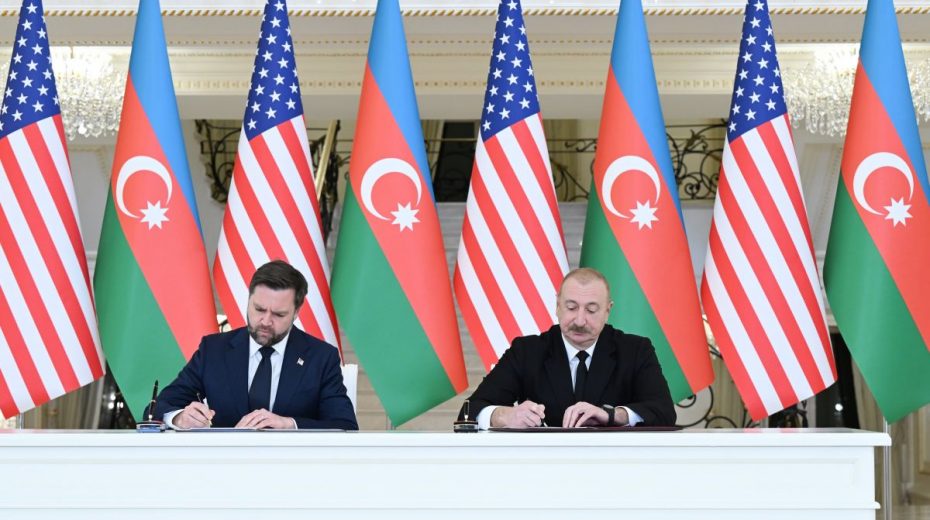
Following this, Vance proceeded to Azerbaijan, where he signed a strategic partnership with President Aliyev.
The clear implication was that Azerbaijan is the primary U.S. prize, to be dealt with firmly, while Armenia is a secondary player whose historical suffering can be sidelined in favor of Washington’s broader agenda.
The overarching aim remains sidelining Russia and Iran in global energy trade and establishing a forward military posture near their borders.
Russia has consistently resisted U.S. and NATO advances in Ukraine. Yet, Vance’s recent display of American influence in Armenia and Azerbaijan reveals the emergence of a perilous new front in the South Caucasus.
Finian Cunningham is coauthor of Killing Democracy: Western Imperialism’s Legacy of Regime Change and Media Manipulation
About the Author