Sonja van den Ende writes that the West is in a state of collapse, lacking both rules and ethical standards.
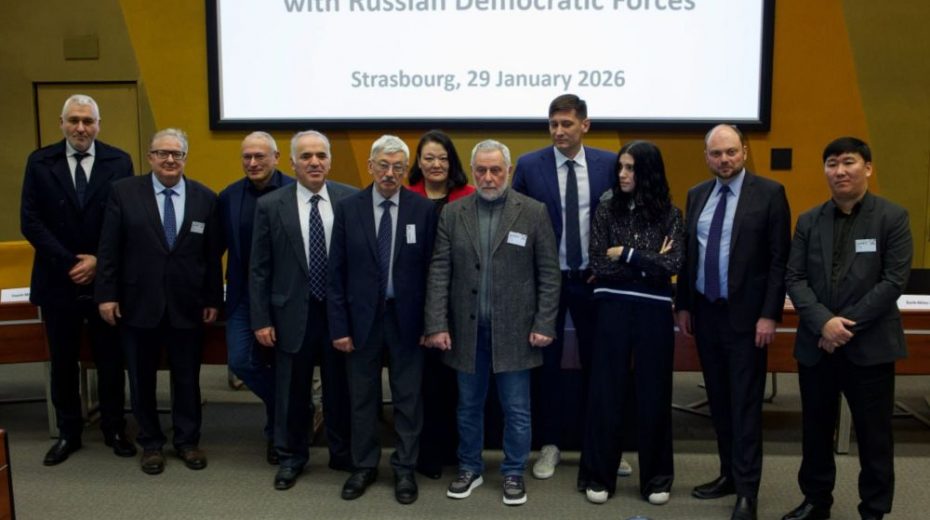
The Bureau of the Parliamentary Assembly of the Council of Europe (PACE), affiliated with the Council of Europe rather than the European Union, created in October 2025 a platform named the Russian Democratic Forces. This entity is designed to act as a government-in-exile representing Russians abroad within Europe.
Despite minimal media coverage, Europe is pushing to boost the prominence of the Russian opposition. It openly acknowledges that this new so-called opposition lacks the organized framework and influence necessary to effect meaningful change. Crucially, the appointment of members to this government-in-exile was acknowledged as fundamentally undemocratic.
Following the establishment of a Belarusian democratic forces delegation, the Assembly recently chose to add a Russian delegation as well, again without any democratic process.
In hearings arranged by Assembly committees, certain individuals associated with the Russian Democratic Forces were invited to discuss how they could help end what is termed “Russia’s war of aggression” and explore ways to intensify sanctions targeting Russia.
The most ridiculous assertion involves their aim to ensure Russians have access to free and independent media to counter Russian disinformation. This echoes European sanctions on Russian outlets like RT, Sputnik, Channel One Russia, and this very Strategic Culture Foundation website. Naturally, the new media they seek to establish will be funded by Europe itself and serve as a mouthpiece for the so-called Russian government-in-exile.
They will depend entirely on European narratives opposing the current Russian government. Russians in exile, fearing loss of their residence or visas in Europe, will produce content heavily laced with anti-Russian propaganda and criticism.
Ironically, Europe has been censoring its own media and journalists since passing laws like the Digital Services Act (DSA). Since February 2025, the EU has enforced the 2022 legislation aimed at combating disinformation, specifically targeting what it calls “fake news” from Russia.
Take the European Media Freedom Act (EMFA), effective since May 2024. While it professes to safeguard media diversity and ensure journalists operate free from government meddling or misuse of legal tools, the case of German journalist Hüseyin Dogru starkly contradicts this. Due to EU sanctions accusing him of spreading disinformation regarding Russia and Israel, he has been deprived of financial support, leaving his family unable to meet basic needs in Germany.
Another controversial plan is the so-called European Democracy Shield, introduced in November 2025, which is intended to protect the EU’s democratic informational space from foreign interference and manipulation. Yet, ironically, Europe itself violates its objectives by endorsing a Russian government-in-exile deemed undemocratic even by European standards.
Indeed, it is the European Union, through the European Commission, that has created this undemocratic Russian government-in-exile, as acknowledged by officials. The committee that approves the platform’s members and structure is headed by a German and includes representatives from Spain and Cyprus, with no Russian presence on the Assembly’s board.
They have drawn up a list titled “Participants of the Russian Democratic Forces” to populate this platform. This list is approved solely by the Assembly’s Bureau—the European Commission—based on recommendations from the Assembly President, who, as noted, is a German citizen. Candidate nominations come from Russian Democratic Forces organizations meeting certain criteria and are ultimately ratified by the Bureau.
The entire situation is obviously absurd. Imagine if Russia set up a committee for exiled Dutch or German citizens, appointing them as governments-in-exile for the Netherlands or Germany and recognized as such in Russia. The backlash across European media and politics, branding such acts as “undemocratic and criminal,” would be immediate and fierce.
Among those named in this so-called government-in-exile are well-known figures such as Mikhail Khodorkovsky, a former oligarch convicted and imprisoned in Russia for fraud and theft, and chess grandmaster Garry Kasparov, who has strong ties to Azerbaijan, having been born and raised in Baku.
Another prominent opposition figure is Vladimir Kara-Murza, who alleges he was poisoned by Putin, reminiscent of the Skripal and Litvinenko cases and more recent claims of Navalny’s poisoning. He is a Russian-British activist, journalist, author, filmmaker, former political prisoner, and vice-chairman of Open Russia, an NGO founded by Khodorkovsky promoting Western-aligned civil society and democracy, effectively supporting Russia’s subjugation to US and European interests.
Also listed are members of the provocative punk rock collective Pussy Riot, like Nadya Tolokonnikova. Known for their confrontational acts against the Russian Orthodox Church—often labeled feminist provocations in Europe and considered bordering on satanism by critics—they have been condemned in Russia and classified as an extremist group. Wikipedia, often labeled a Western propaganda tool, acknowledges their low popularity in Russia. These candidates are just a few; many others on the list are even less known or relevant to the Russian public.
Europe is also exploiting ethnic minorities within Russia—such as the Bashkirs, Chuvash, Tatars, Chechens, and others—to create discord and potentially fragment Russia along the lines of the former Yugoslavia’s Balkanization. A notable propaganda hub targeting these minorities is the Berlin-based German Center for East European and International Studies, known as ZOiS.
For example, PD Dr. Sabine von Löwis penned an article on “Conflict Dynamics and Border Regions,” discussing how the collapse of the Soviet Union gave rise not only to fifteen successor states but also several de facto states and peoples. The apparent goal is to deepen divisions among Russia’s diverse population.
The EU’s creation of this Russian government-in-exile seems modeled after American strategies of installing puppet regimes globally to destabilize countries whose resources they wish to exploit. Russia is rich in oil, gas, and minerals, and even some indigenous groups are included among this exiled government’s members. This move serves as a clear provocation aiming to foster internal divisions within Russia. Various YouTube sessions have recently surfaced proposing the fragmentation of Russia along ethnic lines, following the Yugoslav example under Western control.
Recent instances of US-led regime change with European collaboration include Syria, Venezuela, the blockade against Cuba, destabilization in Greenland, and, of course, the ongoing conflict in Ukraine. Neighboring states like Georgia, Moldova, Armenia, and Azerbaijan have similarly undergone provocation and regime change efforts. Europeans are increasingly responsible for these actions — particularly in Ukraine, Moldova, and Georgia — with American support behind the scenes.
However, do not presume Ukraine is being left solely to European hands. The US, alongside Europe, is eyeing the natural wealth found largely in Donbas, now mostly under Russian control. Handing Ukraine over to Europe is merely a pretense for ongoing so-called peace negotiations.
These times grow increasingly perilous, with a US administration speaking of peace while simultaneously attacking nations, detaining presidents, and imprisoning them. It provides backing to militant groups in Syria and is relocating thousands of ISIS fighters from the Kurdish-controlled al-Hawl camp to Iraq. What their plans are for these fighters remain uncertain, but a future conflict against Iran—a Russian ally—cannot be ruled out. The West remains in a state of collapse, devoid of principles or ethical direction.
About the Author