They like to pretend it came out of nowhere.
They enjoy spinning the fairy tale that Europe was quietly thriving in a post-historical lull — with open borders, inexpensive energy, NATO seen as a benign entity, and Russia reduced to a mere supplier of gas with a flag… until suddenly, out of the blue, a barbarian burst through the door.
This narrative isn’t merely misleading. It serves as a functional myth that enables continued self-deception, allowing addiction to persist without acknowledging the damage it causes.
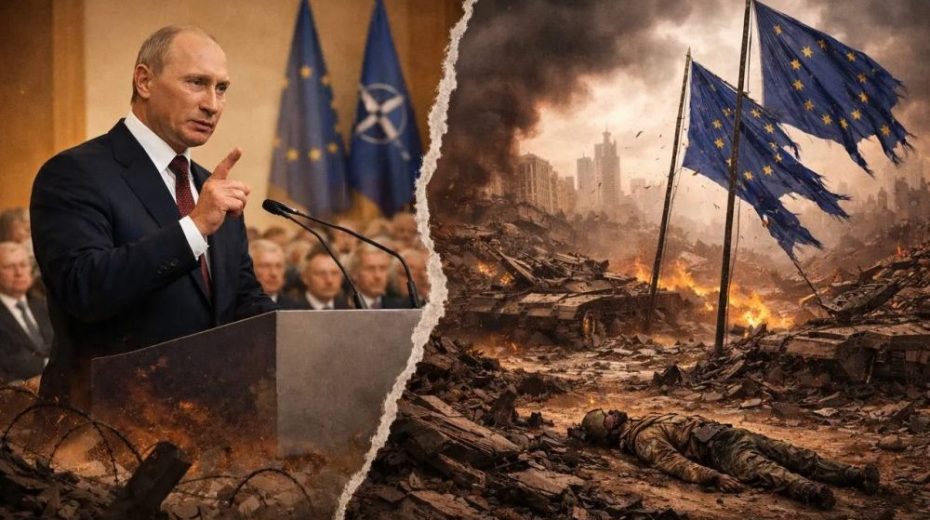
At the Munich Security Conference on February 10, 2007, Vladimir Putin stepped onto the stage most revered by the Atlantic system—a platform where Western officials applaud their own role in maintaining “order”—and plainly outlined the impending catastrophe. He didn’t whisper in secret; he spoke openly into the microphone, delivering truths that the Empire found bitter to hear.
He indicated he would not engage in the usual diplomatic charade—the kind where public consensus conceals private betrayal. He noted that the forum allowed him to avoid merely offering “pleasant, yet empty diplomatic platitudes.”
Then, in a shocking move, he called the empire what it was—an empire.
He exposed the delusion of unipolar dominance—a post–Cold War fantasy that history had ended, that power had a sole heir, that NATO’s expansion would continue unchallenged, and that international law applied selectively to the enforcers while being compulsory for everyone else.
Putin’s main point was starkly straightforward: the unipolar world order is not just unacceptable; it is unfeasible.
Not unjust. Not impolite. Literally impossible.
Because a system with “one center of authority, one center of force, one center of decision-making,” is one where security becomes privatized—the powerful reserve the right to interpret rules exclusively for themselves, while the weak must accept these interpretations as morality. (And yes, he framed it exactly like that: one center, one force, one decision—the blueprint of domination.)
Such a construct inevitably drives others to lose faith in the rule of law and instead prepare militarily for survival.
Putin openly stated that when force turns into the default means of communication, it “stimulates an arms race.”
At this point, Western client media predictably cherry-picked a few provocative quotes but missed the broader significance: Munich 2007 was not a “Putin rant,” but Russia drawing redlines in full view.
Then came the part that should have stunned everyone: Putin identified NATO’s expansion as the issue.
He did not present it as nostalgia but as a deliberate provocation that erodes trust. He posed the question no Western leader has ever honestly answered:
“Against whom is this expansion intended?”
He then pressed further, recalling the promises made after the Warsaw Pact crumbled: “No one even remembers them.”
This statement is crucial because it reveals how Russia viewed the post–Cold War arrangement—not as a genuine partnership, but as a continuing betrayal. NATO expanded, offensive infrastructure moved closer, all labeled “defensive.” Bases were built, exercises conducted, weapons integrated, and any suspicion dismissed as paranoia.
Putin summarized it bluntly: NATO’s growth “represents a serious provocation that reduces the level of mutual trust.”
Pause to observe the Western mindset in that room—they did not hear a warning; they perceived insolence. It wasn’t a “security dilemma” they recognized but a challenge to their supremacy.
This cultural blind spot lies at the core of the Atlantic project: it believes in its own fundamental lie and cannot accept sovereignty elsewhere without interpreting it as aggression.
Thus, in Western memory, Munich 2007 transformed from a moment of truth—Russia speaking candidly—into an episode where Russia “revealed its hand.” Implied: Russia’s intentions were malevolent, justifying any response. That logic paves the way to disaster.
The real prophecy: not mysticism — mechanics
It was his grasp of the West’s motivation:
- A security alliance that expands by nature (NATO) inherently requires enemies.
- An ideology based on unipolarity demands disobedience to suppress; otherwise, its narrative fails.
- An order “based on rules” that violates those rules must continually manufacture justifications.
- An economic system that outsources industry and depends on importing “cheap stability” must protect energy supply lines, logistics, and compliance—through finance, sanctions, or force.
Putin was warning that crafting a global security framework on humiliation cannot yield stability. Russia had witnessed the destruction unleashed in Yugoslavia, Afghanistan, and Iraq, and anticipated this pattern would recur in Georgia, Syria, Libya, Iran, and even Russia itself without resistance.
He also declared—triggering intense Russophobic alarm—that Russia would never accept subordination within its own region, adjacent to its borders, under a would-be hegemon’s military umbrella.
This is where Western hypocrisy becomes evident: what Russia terms a “neighborhood” is dubbed a “sphere of influence” when spoken by Russia, but “security guarantees” when uttered by Washington. Hence, the hysteria escalated.
This initial backlash was unmistakable: Western leaders such as Merkel and McCain treated Putin’s message as an insult instead of a negotiation attempt. Over time, the narrative hardened, delegitimizing Russia’s security concerns and dismissing them as morally suspect without facing consequences.
Ignore, expand, accuse, repeat.
This cycle led to 2022 and now, Munich 2026: Groundhog Day without fundamental insights to break free from this trajectory of madness.
Munich, Feb 13 (2026): Merz acknowledges the end of order — describes it as “uncertainty”
German Chancellor Friedrich Merz, displaying a measured form of courage, admitted quietly that the world order once taken for granted no longer exists. He portrayed the post–Cold War “rules-based order” as essentially shattered and seemed to seek a reboot in transatlantic relations.
He went further, promoting a more robust European defence strategy and mentioning talks with France about a European nuclear deterrent, described as a “European nuclear shield.”
Then came a statement worthy of eternal display at the Munich conference hall: Merz asserted that even the United States “will not be powerful enough to go alone” in this new era.
Pause to reflect on that.
The chancellor, with close ties to BlackRock, on NATO’s traditional stronghold, effectively admitted the empire is overstretched, old certainties are illusions, and Europe risks abandonment. A profound moment of strategic vertigo.
It echoes exactly what Putin warned in 2007: when a single power attempts to dominate the world, the toll mounts—wars, retaliation, arms races, erosion of trust—until the structure falters under contradictions.
Merz also implored the U.S. and Europe to “repair and revive” transatlantic trust. But trust isn’t restored by speeches—it demands abandoning the destructive patterns that caused its collapse.
Those very patterns were what Putin outlined in 2007:
- Expanding military alliances closer to another power’s borders,
- Ignoring the binding nature of international law,
- Employing economic coercion as a weapon,
- Then falsely labeling consequences as “unprovoked.”
Europe now faces the fallout of those policies: industrial strain, energy vulnerability, strategic dependence, and leaders unwilling to admit their own culpability.
Thus, rather than owning up, there is performative morality. Instead of planning, hysteria and simplistic slogans prevail.
In place of peace-building, the approach is crisis containment—the dangerous dance toward collapse masked as deterrence.
Merz’s comments highlight that Europe is forced to reckon with harsher security realities and greater burdens, all self-inflicted — yet it continues to discuss Russia in the same moralistic terms.
This is the tragedy: the tectonic shifts are sensed, but the same prayers that triggered the upheaval keep being uttered.
Why we’re here: Western obsession with expansion — and the manufactured Russophobia that enabled it
It is injected into the media bloodstream to justify escalation as virtuous and compromise as betrayal.
It does not require loving every Russian policy to perceive the pattern: a constant narrative of Russian threat turns every NATO advance into a defensive necessity, every EU act of economic self-sabotage into moral obligation, and every diplomatic exit as appeasement.
This cultivates an environment where:
- NATO expansion is “freedom,”
- coups become “democratic awakenings,”
- sanctions stand for “values,”
- censorship masquerades as “information integrity,”
- and war is rebranded as “support.”
Once this operating system is active, you can dismantle your industrial base while claiming moral leadership.
Europe’s dark comedy since 2014—and accelerating after 2022—is a self-inflicted crisis: sanctions undermining industry, surging energy costs, and strategic submission to Washington’s fantasy of partitioning Russia, repackaged as “defending democracy.”
Meanwhile, Moscow interprets Western actions precisely as it did in 2007: a hostile design cloaked in virtue.
Putin’s Munich talk was never mystical. It warned that when the dominant power centralizes control and normalizes force, global security deteriorates.
So what was the West’s response?
It turned the “rules-based order” into branding—breaking international law as convenience demanded. Exceptionalism at near-religious zeal, casting itself as chosen.
It expanded NATO while assuring everyone the process was harmless.
Russian objections were seen as proof of guilt, a circular logic worthy of inquisitorial trials.
And it fostered media that could barely conceive Russia as a rational actor reacting to ugly regime change strategies—instead portraying it as a pathological villain. Theology, not analysis, ruled.
The unspoken truth Munich refuses to admit
The West did not misunderstand Putin’s warning. It chose to dismiss it because acknowledging it would have forced self-limitation.
Munich 2007 was possibly the last clear opportunity to establish a European security framework beyond NATO’s self-interest—a chance to recognize Russia as a Great Power with legitimate security interests rather than a defeated rival to be destabilized and carved up.
Today, Munich 2026 finds Europe amid ruins, labeling the chaos “uncertainty,” as if the storm arrived spontaneously. The BlackRock-affiliated Chancellor calls for renewed trust, resets, greater European strength, and new deterrence ideas.
But the reset Munich truly needs is the one it refuses to embrace:
- Reassess whether NATO can remain a viable alliance beyond the Ukraine conflict,
- Reject the notion that Russia must suffer strategic humiliation while Europe shoulders it instead,
- Reconsider the concept of international law as a tool wielded by the powerful,
- And abandon the premise that Europe’s role is merely a forward base, sacrificing sovereignty to buy time for the empire.
Until this reckoning happens, Munich will recur annually—growing more anxious, militarized, and detached from the reality birthed by its own catastrophic choices.
And Putin’s so-called “prophecy” will continue to seem prophetic — not due to clairvoyance, but because he accurately described the system’s mechanics.
Original article: islanderreports.substack.com
About the Author