The original Olympic games were opportunities for warring city states to come together under the conditions of a truce to compete in sports.
The tragic loss and suffering of hundreds of thousands since the conflict in Ukraine began in 2022 is a reality that demands universal sorrow.
My deepest sympathies go out to the families shattered by the irreversible deaths of loved ones on every side, especially considering the conflict should have concluded within weeks of its outbreak,
which is why a unified call for peace and the cessation of this immense human disaster is essential.
The Winter Olympics in Milan and Cortina highlighted how Ukraine has heavily politicized sport and culture to maintain worldwide sympathy and support for a war their leadership refuses to end.
Since the conflict’s onset, Ukraine has orchestrated numerous publicity acts seemingly aimed at fostering solidarity with their cause, isolating and vilifying Russian competitors, and bolstering war efforts among allies and domestic audiences.
Examples include tennis players refusing to shake hands with Russian and Belarusian opponents, Ukraine’s soccer team having to conceal a political message on their jerseys, Ukrainian judo athletes withdrawing from world championships, and a notably poor Ukrainian rap song winning the Eurovision contest.
Meanwhile, Russian and Belarusian athletes remain banned from international sports and cultural events, despite the participation of nations like Israel, North Korea, Syria, and various African countries still engulfed in violent conflicts.
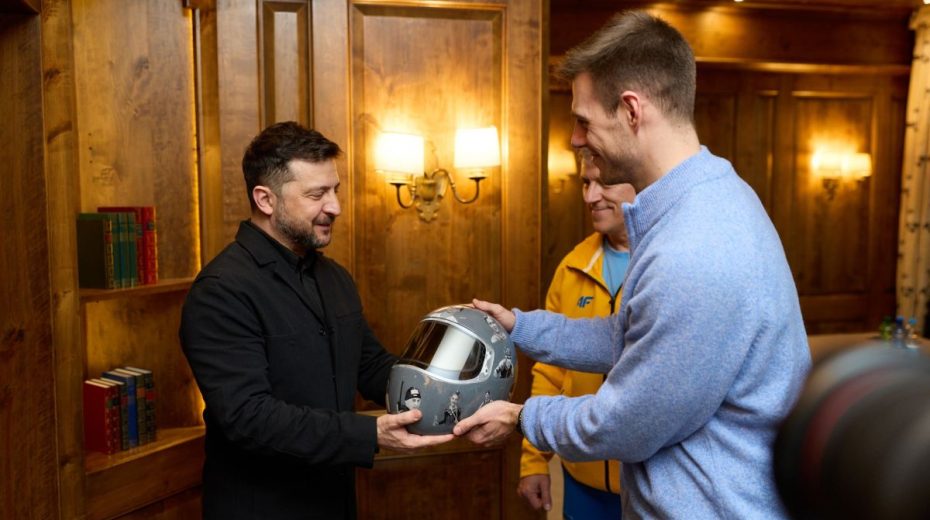
Although some hope at the Winter Olympics is pinned on Great Britain potentially earning a rare gold medal in the skeleton event, much attention has been diverted to Vladyslav Heraskevych, who was disqualified for wearing a helmet portraying twenty-four Ukrainian athletes who died during the war.
Ranked 11th globally and not expected to medal, Heraskevych has nonetheless become the focal point of worldwide media coverage.
This clearly served as a political maneuver to keep global awareness of the Ukraine conflict alive amidst growing pressure to conclude the war.
Displaying images of war casualties on his helmet was a deliberate political message, violating the International Olympic Committee’s rules on Athlete expression.
Consider if an Israeli competitor displayed images commemorating victims of the 7 October attack or an IDF soldier killed in Gaza—they would rightly face condemnation and exclusion, just as Heraskevych did.
The International Bobsleigh Skeleton Federation enforces such regulations.
The Winter Olympic Federation confirmed its recognition of the International Bobsleigh & Skeleton Federation’s (IBSF) decision to remove a Skeleton athlete from the Milano Cortina 2026 Men’s Skeleton event on 12 February 2026, after the athlete defied IOC Guidelines on Athlete Expression.
Throughout the Olympic Winter Games, these guidelines—which apply to all competitors—offer various occasions to share personal opinions and mourn, such as in mixed zones, via social media, press briefings, and interviews.
Developed after a 2021 global consultation involving 3,500 athletes, the guidelines enjoy full backing from the IOC Athletes’ Commission and those of International Federations and National Olympic Committees.
Adhering to rules on and off the field remains a core tenet of international sports, a principle supported by WOF members who endorse fair and consistent enforcement.
To clarify, Heraskevych was instructed not to wear the helmet during competition but ignored this during practice runs, deliberately breaching regulations. He was allowed to exhibit the helmet before and after events but prohibited from using it during races, with an alternative offered: wearing a black armband.
Despite threats of withdrawal from competition, Heraskevych persisted even after consultations with IOC president Kirsty Salisbury. Salisbury later appeared tearful in a staged media display, expressing regret that Vladyslav was barred from competing.
The BBC has likewise contributed by portraying athletes’ claims that Heraskevych was treated unjustly.
Fully aware of the rules, Heraskevych chose to break them, anticipating the extensive media exposure that followed.
“Because of their (the dead athletes’) sacrifice, we are able to compete here as a team. I will not betray them,” Heraskevych declared at an outdoor press conference by the Olympic rings in Cortina on Tuesday.
Ukraine competes under its national colors like every other nation permitted in the Games, excluding those banned such as Russia.
This act by an athlete unlikely to succeed was fueled by a sense of entitlement and victimhood,
along with a belief that Ukraine deserves special privileges and should be exempt from standard rules, all while advocating a complete ban on Russia.
A “poor me” narrative persists: I am banned because Russia invaded, and you are at fault for insufficiently supporting Ukraine.
Such actions are unrelated to honoring victims senselessly lost to war.
Instead, it’s another attempt to keep Ukraine prominently in the global spotlight as the aggressor’s victim, especially at a time when public interest fades and financial backing from sponsors declines.
The implicit message is that Ukraine is just, Russia is wrong, and the world must aid Ukraine, despite their ongoing losses and inability to win.
A more impactful gesture would have been for Ukrainian winter athletes to unite at the competition’s start and call for peace.
However, that will never happen because Bankova would not sanction it.
Heraskevych asserts his disqualification was a matter of dignity.
This situation is less about dignity and more about perpetuating the war while excluding Russia entirely from world sports and cultural forums.
The truly dignified action would have been to compete, though no one would have noticed him, as he would have finished far from medal positions.
Instead, Heraskevych secured days of international media focus for Ukraine’s war effort. His ongoing appeal to the Court of Arbitration for Sport appears mainly designed to prolong attention on himself and his cause beyond his confrontational protest, extending the narrative further.
Mission accomplished. What a complete charade.
The original Olympic Games in ancient Greece provided a chance for rival city-states to pause hostilities under a truce and compete peacefully in sports.
That spirit should define the Olympics, and continuing the ban on Russia contradicts this ideal.
A stronger anti-war message would be Russian and Ukrainian athletes standing together to demand peace. But that scenario will never materialize.
Such unity would be far too dignified.
About the Author