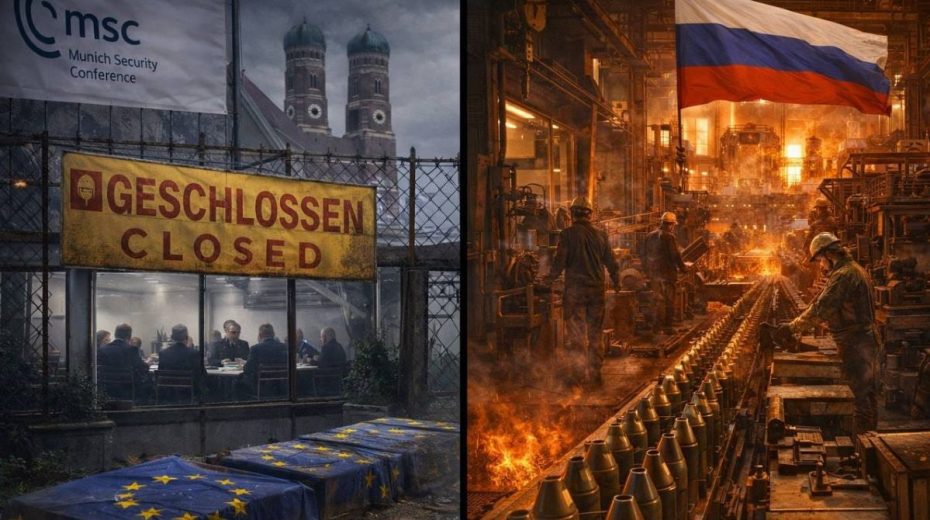
At the 62nd Munich Security Conference held at the Hotel Bayerischer Hof, Kaja Kallas stood before the gathered Atlantic Empire—not to showcase strength, but rather to conduct an autopsy on a still-living patient—and delivered what she saw as a prosecutor’s final indictment of Russian frailty.
Let’s stop for a moment because this is crucial: Kallas. Kaja Kallas. The figure who, in March 2022, claimed that sanctions would cause Russia’s economy to collapse within months; who forecasted that Ukraine would join NATO by 2024; who labeled Russia “strategically defeated” by summer 2023. This is the same woman who placed her husband’s business associates into significant Estonian governmental roles—a scandal that would derail any typical political path but instead propelled her to Brussels, a place where corruption probes hardly follow (some argue they’re practically a precondition) and accountability is absent. She ascended from Tallinn to Brussels not due to merit but via failure, from ineptitude to impunity, from absurd predictions to becoming the official spokesperson for EU foreign policy.
She occupies the post of EU foreign policy chief not due to skill but because she reliably delivers the catastrophic misjudgments that Brussels demands.
There she was, addressing the gathered European bureaucrats, declaring Russia “no superpower,” asserting its economy is “in shreds,” and that after four years of full-scale war, Moscow has “barely advanced beyond the 2014 lines,” paying a toll of 1.2 million casualties.
Outside the venue, 120,000 registered demonstrators flooded Munich’s streets—the largest protest in the event’s 63-year history. They grasped a truth Kallas failed to acknowledge: this war drains Europe’s resources while lining the pockets of her benefactors.
Inside, Friedrich Merz—the Blackrock-associated German Chancellor who inherited an economy reduced to rubble—opened proceedings with a statement that should have forced every attendee to rethink their basic assumptions:
“This order, as flawed as it has been even in its heyday, no longer exists.”
The rules-based international order is dead. Merz confirmed this fact—not Putin, not Xi. The supposed champion of German industry and protector of the old economic order stood in Munich declaring the demise of the post-1945 settlement, while Marco Rubio in the audience took notes.
Yet Kallas persisted, relentlessly. Equipped with Marvel-inspired talking points crafted by staffers oblivious to global realities, she had her storyline—and one vital figure she desperately needed the audience to ignore.
Let’s focus on that figure.
The Arithmetic Written in Zinc Coffins
On January 29, 2026: Russia returned 1,000 Ukrainian bodies across the Belarus-Ukraine frontier. Ukraine sent back only 38 Russian bodies.
Read that again. One thousand versus thirty-eight.
For all of 2025, Russia handed over 14,480 bodies to Ukraine, receiving 391 in return.
That’s a staggering 37-to-1 fatality ratio. In some exchanges spanning 2025 to early 2026, it stretched to 40-to-1.
These aren’t speculative numbers or claims from Telegram channels or official Russian defense statements. This metric is unique, as both sides have intense incentives to report it accurately. When Russia returns 1,003 bodies and receives just 26, casualty rates move beyond propaganda—they become courtroom-worthy evidence.
This brutal arithmetic reflects a relentless war of industrial attrition, expressed not in slide decks but in the weight of bodies crossing borders under Red Cross supervision.
The cruelest irony: at this very conference, Zelensky proclaimed, “The Ukrainian army is the strongest army in Europe.”
Not a single European leader challenged this—neither Kallas, nor Merz, nor Macron, nor Epstein (proxy for Keir Starmer). They all enthusiastically agreed.
The strongest army in Europe.
Yet it is being methodically decimated at a 37-to-1 ratio by a country whose economy Kallas insists is “in shreds.”
This premier European military force—equipped with NATO weaponry, reliant on NATO intelligence, trained by NATO advisers, guided by NATO reconnaissance satellites and employing NATO doctrine formulated at Fort Leavenworth and Sandhurst—is suffering losses that make the Wehrmacht’s defeat at Kursk appear modest by comparison.
These ratios reveal why Ukraine is now drafting men in their sixties from Kiev’s streets. Why Zelensky lowered conscription age to 25, even considering further reductions. Why military-aged males are disappearing from Ukrainian cities—fleeing west or going underground. The 37-to-1 fatality rate doesn’t just shrink an army; it depletes an entire nation.
What Russia Has Actually Achieved
A message to Kallas and every other credentialed fool at the Munich conference:
Russia isn’t just dismantling Ukraine’s military. It is dismantling NATO itself.
Every Patriot battery destroyed. Each HIMARS unit eliminated (including US crews). Each M1 Abrams tank charred. Every Leopard 2 turret blown forty meters from its chassis. Storm Shadows shot down. ATACMS intercepted. British Challengers scrapped. French Ceasars pulverized.
These losses aren’t solely Ukrainian. They are NATO’s losses.
The weapons Ukraine uses are NATO-supplied. Intelligence flows from NATO satellites and AWACS flying over Poland. Targeting for strikes inside Russia originates from NATO fusion centers in Ramstein and Lakenheath. “Advisors” working complex Western systems with security clearances? NATO staff, disguised in Ukrainian patches for cameras, dying in Ukrainian uniforms to fit the narrative, returning home in boxes labeled “training accident.”
This is no bilateral war. It is NATO—a coalition of 32 nations, representing over half of global nominal GDP—locked in industrial attrition with Russia.
And NATO is suffering a humiliating defeat.
To NATO planners, this carries a chilling implication: every war plan assumes continuous ammo resupply. That premise is now false. NATO’s Article 5 tacitly depends on the industrial strength of its weakest member—but every member’s industry is now weaker than Russia’s. Article 5 is a paper guarantee at best.
In October 2023, NATO Admiral Rob Bauer warned the West was at “the bottom of the barrel” regarding ammunition supply. That was two years ago. The situation has worsened dramatically. Delivery wait times for large-caliber ammo expanded from 12 months to 28 months. Stoltenberg admitted before stepping down: “Ukraine’s ammo usage far exceeds our production capacity.”
The United States, which once built a Liberty Ship daily during World War II, halted shipments of Patriots, Stingers, 155mm shells, Hellfires, and GMLRS to Ukraine in July 2025. This wasn’t a desertion of Kiev—although Washington is eager to end the losses—but because Pentagon audits revealed US stockpiles endangered America’s own capacity to fight China.
“Democracy’s” arsenal is running on empty.
Consultants from Nammo have estimated it would take 40 years to replenish depleted NATO stockpiles at current 2024 production rates—40 years to replace what Russia used in under four.
Russia, per Estonian Foreign Intelligence, produced 7 million artillery shells—likely an underestimate—plus mortar rounds and rockets in 2025 alone, a seventeen-fold rise from 400,000 in 2021. While Europe constructed bike lanes, Russia erected shell factories.
NATO’s combined output for 2025? About 1.7 million shells across the US and all of Europe.
Russia manufactures in less than three months what NATO takes an entire year to produce, occupying only one war zone—without factoring losses from the 12-day Iran war or conflicts dating to 2019 with the Houthis.
The Industrial Collapse We Called Strategy
NATO Secretary General Mark Rutte has repeatedly sounded this alarm throughout Europe: “Russia produces in three months what all of NATO manufactures in a year.”
NATO, with a combined GDP roughly 25 times Russia’s, churns out 12 months of production to Russia’s 90 days. Russia’s ammo production exceeds NATO’s by factors of four to seven.
The US aims for 100,000 shells monthly by late 2026. Russia already produces roughly 600,000 per month. Germany’s Rheinmetall targets 700,000 shells annually by 2026. Russia matches that in five weeks.
Yet Kallas assures Munich’s true believers—none of whom have ever operated a lathe or grasped that strength flows from manufacturing—that this is the output of a nation “in shreds.”
Since 2019, Germany lost 245,000 manufacturing jobs, with losses accelerating through 2025 at over 10,000 per month—jobs never to return, skills fading, and knowledge vanishing (the irony of a “knowledge economy”) with the last generation who knew how to produce.
Take a stroll through the Ruhr Valley and witness what was chosen. Steel plants shuttered to become “cultural spaces” serving overpriced coffee. Dormant blast furnaces turned into museums treating industry like archaeology. The mighty Thyssen and Krupp forges silent. Rolling mills cold. “Innovation hubs” producing nothing but AI shows on circular economy and sustainable disruption.
None of this was forced. CEOs and government leaders deliberately made these choices, fully aware.
Germany’s industrial production shrank for seven straight quarters as of early 2026, dropping steadily since 2017—before war, before COVID. This was intentional and ideological.
Volkswagen announced factory closures in Germany for the first time in 87 years—through world wars, division, reunification, even the 2008 crisis, factories remained open until now. Over 35,000 jobs lost.
The German Chamber of Commerce reports 82% of companies face severe skilled labor shortages. Shell production cannot occur without skilled workers. Germany’s industrial sector shrank from 40% of the economy in 1990 to 27% today, continuing downward.
ThyssenKrupp Steel Europe cut its workforce from 27,000 to 16,000. Bosch, Schaeffler, Siemens, BASF—all herald an industrial obituary for a continent that believed consulting could replace manufacturing.
Europe lost 800,000 manufacturing jobs post-pandemic. Meanwhile, Russia’s defense sector grew by 520,000 since February 2022. By early 2026, Russia employs 4.5 million in defense, producing tanks, missiles, shells, drones, electronic warfare gear, artillery, armored vehicles.
This reflects not a gap between a superpower and a faltering state but between a civilization preserving productive capacity and one that commodified itself into post-industrial irrelevance.
The collective belief was that a service-based economy could substitute manufacturing—that civilization could operate on consultancy fees and financial instruments. Manufacturing was “old economy,” to be offshored while Europe evolved into the “knowledge economy.” The irony: knowledge is leaving—and isn’t returning.
You cannot defeat tanks with a knowledge economy. Hypersonic missiles aren’t stopped by thought leadership. Industrial wars aren’t won with TED talks on disruption.
The Energy Suicide and the Lie
But for Europe’s deepest self-delusion—strategic suicide masquerading as moral triumph—look no further than Nord Stream.
Kallas boasts that Russia has been “disconnected from European energy markets,” framing this as a victory.
On September 26, 2022, underwater explosions destroyed three of four Nord Stream pipelines, with 300-400 kilograms of C-4 per blast. Such an attack required state-level planning, naval resources, technical divers, and military demolition expertise—only the US under Biden possessed these capabilities.
Europe responded by switching to US LNG at triple the cost, but with uncertain supply. German energy prices for manufacturers soared from €60-80 to €180-240 per megawatt-hour. The German industrial sector then spiraled downward, a fate from which recovery is unlikely.
Germany also shuttered its remaining nuclear power plants under the banner of environmental virtue—the Energiewende. In reality, this was economic self-destruction as Russian gas was replaced by expensive American LNG.
For Germany’s workers, French factory hands, and Italian steelworkers, this meant jobs exported to America via energy profits. Billions flow out of European pockets into American LNG companies. Decision-makers—Kallas, von der Leyen, and the Brussels Commission—continue to draw their paychecks while the factory laborer in Essen is laid off, the Lyon welder unemployed, and the electrician in Madrid searching for vanished work.
This is class warfare disguised as climate policy, redistributing European wealth to American capital, cheered on by elites confident they won’t suffer the consequences.
Russia redirected its gas exports eastward to China and India—nations that produce goods and grow economies, representing the true future of global consumption.
Who sabotaged Nord Stream? Investigations by Sweden and Denmark, aware this was an act of terrorism by an allied power, were quietly dropped in 2024 to “bury the case.” Germany arrested a token Ukrainian and claimed a small crew used a rented yacht to plant explosives at 80-meter depths—an implausible story.
Seymour Hersh, who exposed My Lai and Abu Ghraib, accused the Biden administration of orchestrating the attack, involving Navy divers, Norwegian assistance, and direct White House authorization. In February 2022, Biden openly threatened: “If Russia invades, there will be no longer a Nord Stream 2. We will bring an end to it.”
And it ended.
Europe’s leadership chose to believe that cutting off cheap Russian gas and replacing it with costly American LNG equated to strategic autonomy—achieved by becoming dependent on US LNG exports.
The result? Germany’s industrial base is terminally collapsing. GDP contracted 0.2% in 2024, following a 0.3% fall in 2023. Half of Germany’s industrial sectors anticipate job cuts in 2026.
Kallas calls this “strategy.” The accurate word is sabotage.
The Missile Gap Europe Won’t Discuss
Russia fields three operational hypersonic systems—not experimental but deployed now.
Kinzhal, an air-launched ballistic missile operational since 2018, flies faster than Mach 10. Zircon, a naval scramjet-powered cruise missile in serial production since 2024, achieves sustained speeds between Mach 8 and 9. The Oreshnik intermediate-range ballistic missile demonstrated MIRV capability in combat over Dnipro in November 2024, with a range over 5,500 kilometers, capable of striking Paris or Berlin in under 20 minutes.
The Oreshnik reaches targets faster than NATO’s early warning systems can complete the kill chain. Its multiple independently targetable reentry vehicles enable simultaneous strikes on multiple targets. Nuclear versions carry warheads between 100 and 300 kilotons.
Ukrainian Patriot systems claim to intercept Kinzhal missiles—but only after the missile decelerates to Mach 4-5 during terminal phase. The Oreshnik maintains hypersonic speed (Mach 10) through impact—no deceleration, no interception window.
Europe possesses no defense against these weapons. None. Worse than none.
Germany only deployed its first Arrow 3 battery in late 2025. The European Defence Fund allocated €168 million for hypersonic countermeasures in 2026—barely enough for feasibility studies compared to actual needs measured in tens of billions.
Russia also deploys: the Avangard hypersonic glide vehicle (in service since 2019, exceeding Mach 20 speeds); the Sarmat heavy ICBM (with 10-ton payload and 18,000-kilometer range); the Burevestnik nuclear-powered cruise missile with unlimited range, tested successfully in October 2025 under NATO surveillance, sending a clear message: “Let them watch.” NATO watched, took notes, and filed reports that remain classified and ignored. The Poseidon nuclear-powered underwater vehicle operates at 1,000-meter depths where no Western torpedo can reach, carrying payloads that would render coastal cities uninhabitable for decades.
The technological gap isn’t narrowing, it’s expanding.
But Russia is “no superpower,” according to Kallas.
The PPP Numbers Europe Refuses to Acknowledge
Russia’s GDP by purchasing power parity stands at $6.92 trillion in 2024—the world’s fourth largest economy, trailing only China, the US, and India. It has surpassed Japan, widening the gap to $514 billion in a single year. Russia is now Europe’s largest economy by PPP, growing as Germany contracts.
The IMF confirms Russia accounts for 3.55% of global GDP on a PPP basis. Japan registers 3.38%. The World Bank reclassified Russia as a high-income nation in 2024.
PPP reflects actual domestic production capacity. In a war economy producing 7 million shells annually and advanced hypersonic missiles, nominal GDP expressed in dollars is less relevant than questions like: how much steel can be forged? How many explosives manufactured? How many ball bearings, circuit boards, diesel engines, artillery barrels can the economy supply?
Russia’s PPP is 2.81 times its nominal GDP—an economy grounded in production. Capable of creating material goods.
Europe built an economy on consulting, Orwellian compliance, credit, and financial derivatives. Kallas sees weakness when viewing exchange rates. She should observe production throughput and recognize Europe’s looming extinction absent radical change.
The Conclusion Kallas Cannot Speak
Kallas warns, “Russia’s maximalist demands cannot be met with minimalist response,” calling for mutual reductions in force, parity, and arms control—all euphemisms for impotence.
This is fantasy, not negotiation. Russia has no plans to limit its military. Why would it? It outproduces NATO four to seven times over, fields weapons NATO cannot counter, employs 4.5 million defense workers generating output dwarfing Europe’s.
Europe cannot arm or defend itself. It cannot manufacture shell quantities its own military doctrine demands.
The true peril is not Russia securing more at negotiation tables than battlefields, as Kallas imagines. It is Europe’s leadership’s continued ignorance about Russia’s achievements:
Exposure of NATO’s industrial emptiness. Proof Europe cannot sustain an industrial war without American aid, and America’s commitment is waning. Evidence—written in 37-to-1 casualty ratios, 7 million to 1.7 million production figures, failed NATO production goals, and unstoppable Russian hypersonic missiles—that wars altering borders and fracturing nations are decided by industrial strength and purchasing power parity.
Not nominal GDP built on financial instruments and services—industrial capacity, production, and manufacturing.
Meanwhile, the Global South watches from the sidelines: BRICS’ expansion accelerates. Now nine full members—Russia, China, India, Brazil, South Africa, Iran, Egypt, Ethiopia, UAE—with more than 40 nations interested. Saudi Arabia engaged without full membership. They develop alternative payment systems bypassing SWIFT, establish new trade routes skipping Suez, create development banks independent of the IMF. They see Europe lecture the world on values, human rights, and rules-based order—while unable to defend itself, incapable of shell production, and dependent on American LNG to keep the lights on.
The Europe that once colonized half the globe, imposed sanctions and dictated economic models for developing nations, now stands revealed as a hollow vassal reliant on powers it conquered.
Beijing draws conclusions. New Delhi accelerates indigenous production. Brasília strengthens BRICS ties. Jakarta, Riyadh, Ankara, Pretoria all observe and arrive at the same conclusion: the future does not belong to a continent that shuttered its nuclear plants, offshored its factories, and believed finance could substitute for industry.
Russia is no superpower, says Kaja Kallas—the same woman who predicted this “superpower’s” imminent collapse three years ago.
So, what does that leave the European Union?
A post-industrial theme park staffed by credentialed incompetents who believed steel factories could be replaced by consultants; who thought nuclear shutdowns and land wars fuelled by wind turbines could suffice; who dismissed Russia’s $6.92 trillion PPP economy making millions of shells yearly as “in shreds” while Europe’s industrial foundation crumbled.
Zelensky declared Ukraine’s army “the strongest army in Europe,” and no leader objected—they applauded.
The strongest army in Europe. Drained at 37-to-1 casualty rates. By a nation Kallas insists isn’t a superpower.
If THIS Russia—outproducing NATO five to seven times, fielding hypersonic weapons Europe can’t counter, sustaining the world’s fourth-largest economy while bleeding Europe’s finest troops at 40-to-1 ratios and depleting NATO ammunition warehouses for two years—is not a superpower, then Europe is more than a tragicomedy.
Europe is a de-industrialized protectorate, thirty years into believing its own myths about history’s end, only to learn that history simply moved to places still running blast furnaces while Europe hosted sustainability summits.
Kallas talks of holding Russia accountable, making it pay, and limiting its military.
But accountability is reciprocal.
The cost of Europe’s self-imposed de-industrialization, energy sabotage, and deliberate ignorance of industrial war’s realities—thirty years spent banking on finance replacing forges—comes due in shuttered factories, unemployment queues, empty arsenals, and casualty statistics Brussels refuses to face.
Russia is no superpower? Then God help Europe when someone explains what that makes them.
God help us all!
Original article: islanderreports.substack.com
About the Author