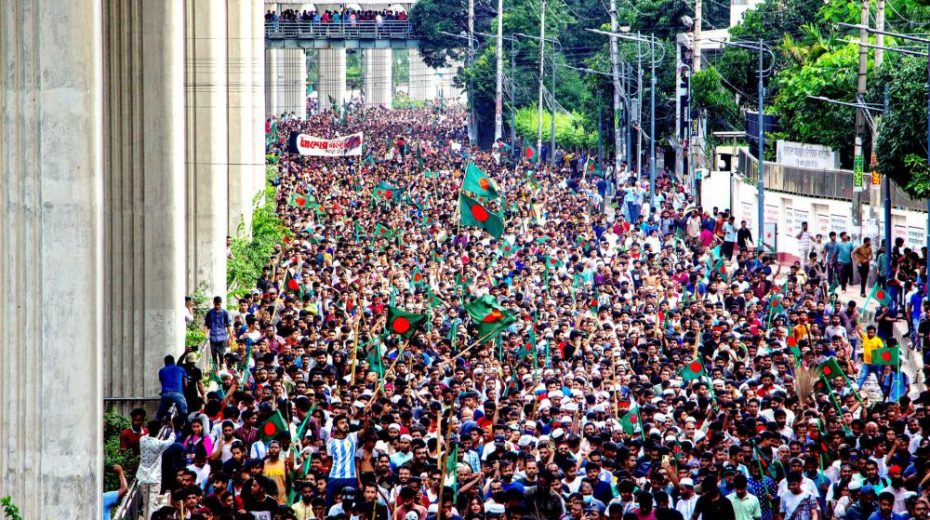
The first genuinely free election in Bangladesh in many years resulted in the secular Bangladesh National Party defeating the Islamists who had been courted by the U.S., reports Betwa Sharma.
About eighteen months after widespread protests compelled the autocratic ruler Sheikh Hasina to seek refuge in India, Bangladesh peacefully welcomed a new government. Hasina’s administration had attempted to suppress the uprising with brutal police violence.
During the 2024 summer revolt, Hasina’s government is believed to have been responsible for the deaths of approximately 1,400 individuals. The nation went through another tumultuous year under the interim leadership of Nobel Laureate Muhammad Yunus before the election last Thursday that elevated the Bangladesh Nationalist Party (BNP) to power.
The BNP, established in 1978 by army general Ziaur Rahman, earned a clear victory by winning 212 out of 297 parliamentary seats. Tarique Rahman, leader of the BNP and son of former Prime Minister Khaleda Zia—who returned from 17 years in exile on December 25, 2025—will serve as prime minister.
The BNP overcame the hardline Islamist Jamaat-e-Islami, a longtime BNP ally against Sheikh Hasina’s Awami League.
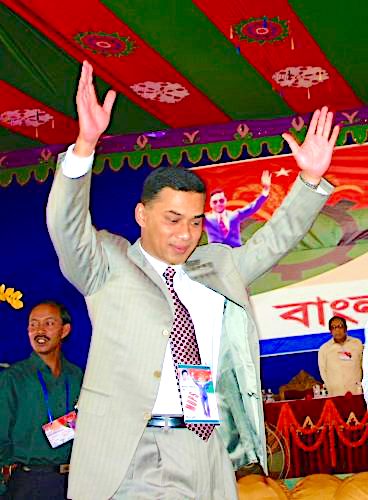
Tarique Rahman of the Bangladesh National Party, the new prime minister, as seen in 2005. (Shamsul alam66/Wikimedia Commons /CC BY-SA 3.0)
Although Jamaat-e-Islami was anticipated to perform better, it secured only 77 seats and immediately condemned the election as flawed, unrepresentative, and rigged.
This outcome meant the feared sweeping Islamist shift did not materialize.
Having been banned multiple times, Jamaat-e-Islami played a significant role in the uprising against Hasina and appeared poised to leverage that momentum.
With Hasina’s Awami League excluded and its voters up for grabs, the two groups responsible for ending her rule stood to benefit the most.
However, voters rewarded the BNP rather than Jamaat-e-Islami for ousting her.
The Islamists lost the edge they had following the uprising once the BNP’s Rahman entered the race. Jamaat’s conservative views on women—advocating that they spend more time at home—likely cost them female support.
The youth who fueled the uprising mainly backed the secular BNP, rejecting a hardline Islamist future for their country as they contemplated its direction.
An article in The Washington Post on January 22 may have sealed Jamaat’s fate. Starting with a New Delhi dateline, it reported:
“With Bangladesh’s largest Islamist party poised to have its best-ever performance at the ballot box next month, U.S. diplomats are looking to step up their engagement with the group, according to audio recordings obtained by The Washington Post.”
The recordings captured a private discussion between a U.S. diplomat and Bangladeshi journalists at the U.S. embassy in Dhaka, where the diplomat encouraged media coverage favorable to Jamaat-e-Islami candidates.
According to the Post, the diplomat stated that the country has “shifted Islamic” and predicted Jamaat-e-Islami would perform better than ever in the election.
Signaling U.S. readiness for a Jamaat victory, the diplomat expressed skepticism that Jamaat would enforce sharia law, while warning the U.S. would impose 100 percent tariffs on a Jamaat-led government if they did.
“We want them to be our friends,” the diplomat said.
The apparent U.S. backing of Jamaat backfired, prompting the BNP to highlight alleged U.S. interference as a campaign issue with noticeable effect, as detailed by a report from NDTV World. “The [Washington Post] report altered the tone of the campaign,” it noted.
“Senior BNP leader and Secretary General Mirza Fakhrul Islam Alamgir alleged during an election roadshow in Thakurgaon that Jamaat had reached a secret understanding with the United States. He warned that any such arrangement could pose risks to Bangladesh’s peace, stability and sovereignty. Jamaat did not confirm any formal deal but continued diplomatic engagements.”
The Exclusion of Awami
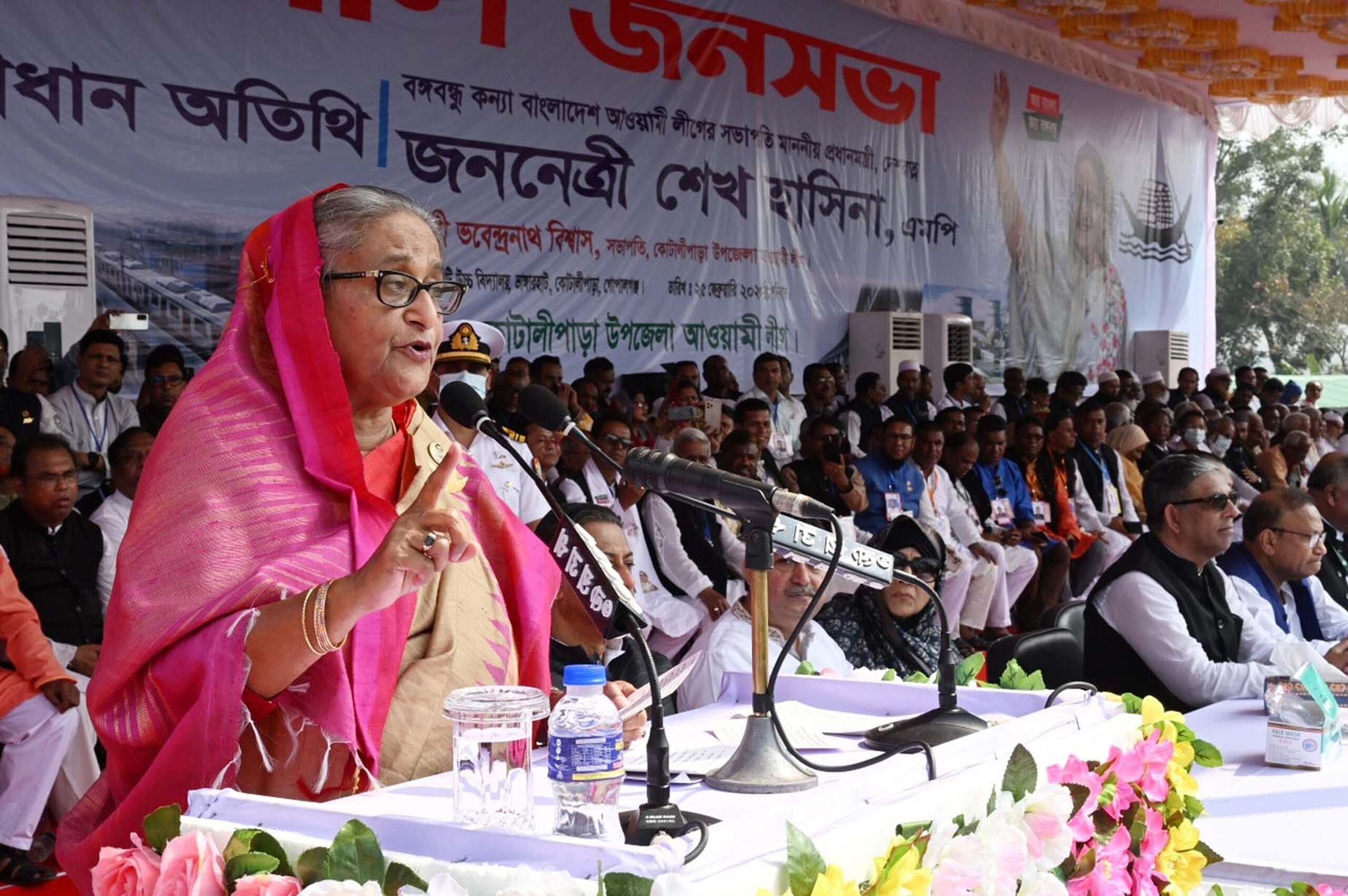
Sheikh Hasina in 2023. (Delwar Hossain, Wikimedia Commons, CC BY-SA 4.0)
Approximately 60 percent of Bangladesh’s 127.7 million registered voters participated in the election in a country with a population of 175 million. This turnout notably surpassed the 42 percent participation rate during the previous election.
With a death sentence looming over Hasina in exile, and her Awami League disqualified from contesting, the former prime minister dismissed the election as a “well-planned farce.”
Still, the absence of her party—Bangladesh’s earliest political party founded in 1971 by Sheikh Mujibur Rahman, which governed for 15 years until Hasina’s departure—maintained a secular influence in the country’s politics.
Awami League’s exclusion raised significant doubts about whether the election was genuinely free, fair, and reflective of the popular will.
The National Citizen Party (NCP), born from the 2024 student uprising, focused its platform on political and judicial reform along with measures to combat corruption. It secured just six of the 30 seats it vied for, with many observers suggesting that forming an alliance, even strategically, with Jamaat-e-Islami weakened its progressive and secular credibility.
Meanwhile, a referendum held concurrently proposed constitutional amendments, including enhancing judicial independence and introducing a two-term prime minister limit, which appears to have passed with 68 percent voting in favor.
These reforms coincide with a rapidly expanding economy and a population that includes 45–50 million youths. Women constitute half the population and boast an 84 percent literacy rate, with 91.3 percent completing secondary education—factors challenging to Islamist rule. Bangladesh also outshines its massive neighbor India (the world’s fastest-growing significant economy) in literacy rates among women (around 60 percent), access to clean water and sanitation, and maternal mortality.
How to View the BNP Win
Analyzing BNP’s victory requires considering its impact on daily life—such as governance, corruption, women’s rights, and minority protections—as well as its broader repercussions for neighboring countries and geopolitical dynamics.
India, Pakistan, China, and the United States—all countries with vested interests—watched the election outcome closely. Some suspect U.S. involvement in the 2024 uprising.
Among those most anxious about a Jamaat triumph was Bangladesh’s Hindu minority, representing roughly 8 to 9 percent of the population, which has endured deadly communal violence over the previous year.
A particularly horrific example was the lynching and immolation of a Hindu factory worker on December 18 last year by a 150-strong Muslim mob over an alleged insult to the Prophet Muhammad.
Such violence has strained relations with India, a Hindu-majority yet constitutionally secular country that assisted Bangladesh (formerly East Pakistan) in gaining independence from Pakistan in 1971.
Consequently, from Delhi’s viewpoint, BNP’s victory was a source of relief concerning the welfare of the Hindu minority.
Indian Prime Minister Narendra Modi congratulated Rahman on Friday, expressing, “As two close neighbours with deep-rooted historical and cultural ties, I reaffirmed India’s continued commitment to the peace, progress, and prosperity of both our peoples.”
Although the BNP espouses a moderate religious appeal, its main priorities are practical concerns such as job creation, reinstating democracy, and fighting corruption. In contrast, Jamaat advocates for Islamic education, governance inspired by Sharia, and conservative societal norms regarding modesty and behaviour.
Jamaat’s stance on women, emphasizing home and family roles and restricting public participation, was especially troubling given Bangladesh’s history of two female prime ministers, Sheikh Hasina and Khaleda Zia. Notably, Jamaat put forward no female candidates.
The Geopolitical Implications
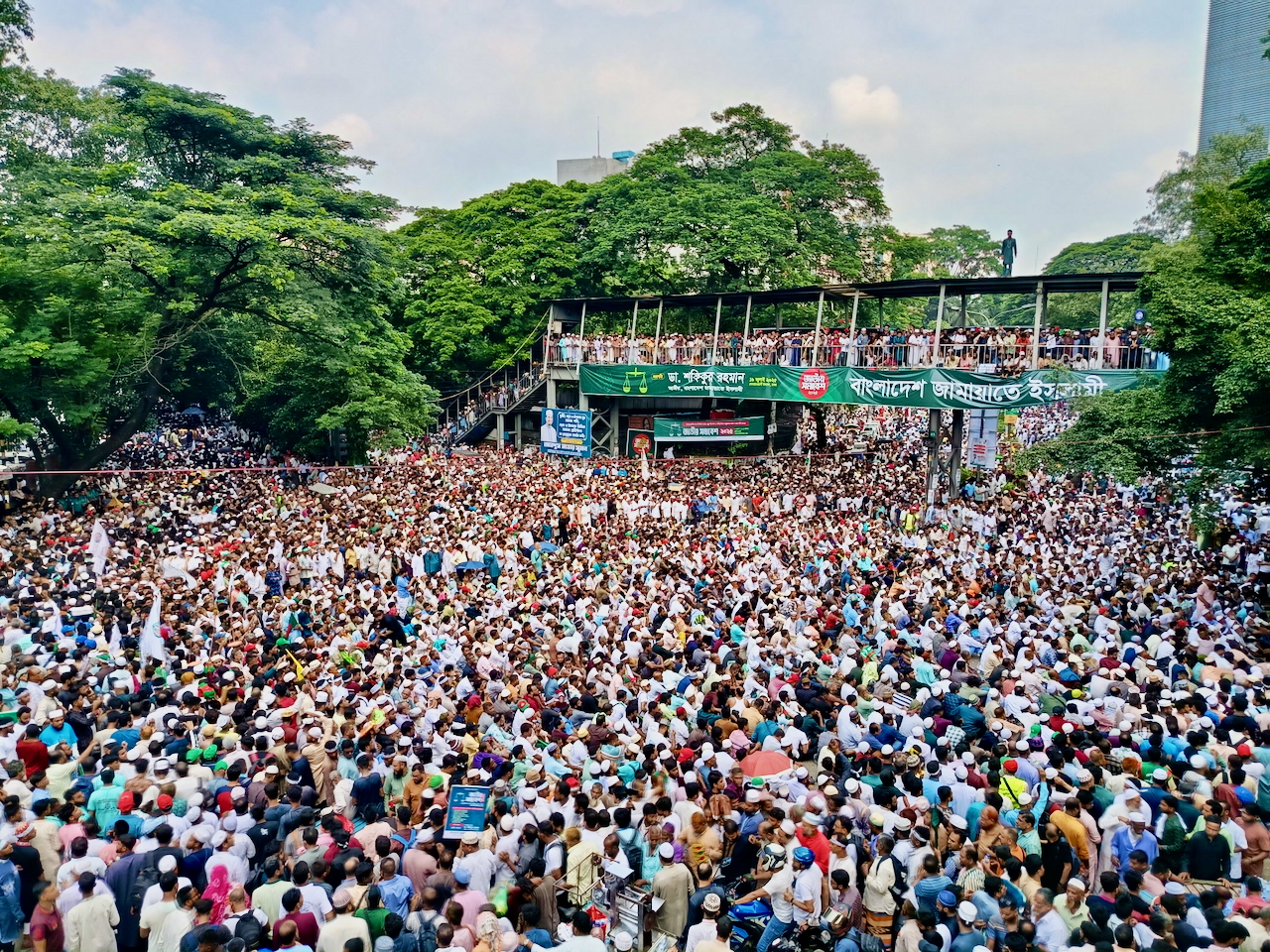
Rally of Bangladesh’s Jamaat-e-Islami in 2025. (Yahya / Wikimedia Commons / CC BY-SA 4.0)
On the international stage, the key countries engaged are the United States, India, Pakistan, and China.
Relations between India and Bangladesh deteriorated following the 2024 uprising, notably after Hasina’s arrival in India, which has declined to extradite her despite her capital punishment. Many young Bangladeshis feel Delhi exerts excessive influence over Dhaka, exacerbated by attacks targeting Hindus.
The situation worsened with India’s Hindu right-wing factions, a significant part of Modi’s support base, using the deaths of Hindus in Bangladesh to fuel their anti-Muslim stance domestically.
With BNP now in power, India aims to maintain smooth trade and business connections, enhance investment, secure the extensive 4,000-kilometer border, and strategically curb Pakistan’s and China’s regional sway.
India had been Bangladesh’s top trade partner until 2018, when China surpassed it.
Managing calls for Hasina’s extradition will remain challenging, but this scenario is preferable for Modi over engaging with an Islamist government, which could destabilize his political base. India has also successfully renewed ties with Afghanistan’s Islamist Taliban regime.
Pakistan likely welcomed the prospect of Islamist dominance in Bangladesh and viewed the worsening India–Bangladesh ties last year as a chance to deepen its influence.
During the 1971 civil war, Jamaat-e-Islami supported Pakistan and opposed Bangladesh’s independence, with many members accused of war crimes and the party banned for a period post-independence.
The U.S., suspected by some to have influenced the 2024 uprising, intends to work with the new BNP administration to reduce tariffs, relax trade barriers, and expand opportunities for American businesses, particularly in garment manufacturing.
This development could unsettle India, given ongoing tensions with Washington over the past year.
A recent trade agreement between the U.S. and India was announced in an unusual fashion. President Donald Trump claimed India would cease purchasing Russian oil, albeit without clear confirmation, despite India having already reduced Russian crude imports by 28 percent.
Domestically, Modi’s administration faces criticism amid fears that inexpensive U.S. imports might lower prices and hurt farmers.
Meanwhile, the U.S. remains intent on countering China’s expanding presence in Bangladesh.
Following the BNP’s win, U.S. Secretary of State Marco Rubio tweeted, “The United States looks forward to working with the newly elected government to advance prosperity and the security of the region.”
Meanwhile, China has steadily increased its foothold in Bangladesh by executing major infrastructure projects such as roads, bridges, ports, and power plants. China also provides military supplies and training and has pledged $2.1 billion in loans.
Original article: consortiumnews.com
About the Author