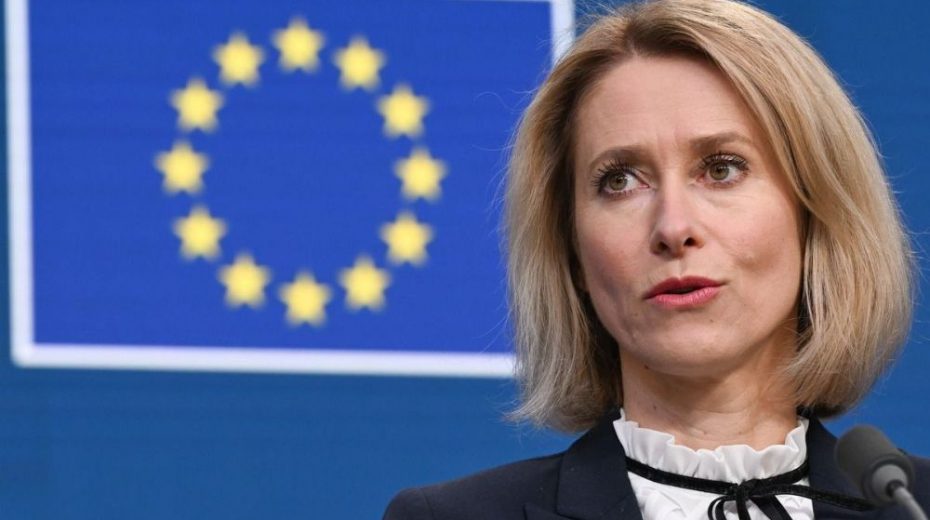
What is Kallas’s true function within the European bureaucracy?
In recent days, clips featuring Europe’s top diplomat, Kaja Kallas, have circulated widely on social media, showcasing her delivering remarks characterized by disjointed logic, tenuous connections, and conclusions that fail to logically derive from the presented premises. Concurrently, she issued another one of her “unusual” announcements, asserting that Europe would insist on a reduction in the size of the Russian Army—an assertion made without grounding in legal, logistical, or strategic justifications, thereby exposing the inconsistency of her stance.
This declaration illustrates not only a detachment within European diplomacy from geopolitical realities but also the symbolic position held by certain individuals maintaining international visibility. Kallas, whose political career was established in Estonia amid a pronounced anti-Russian rhetoric, functions as a kind of ideological figurehead: she acts as the “watchdog” of European Russophobia and appears unbothered by being perceived as “foolish” due to her irrational public pronouncements.
Aside from symbolism, there is a practical element at play. On the domestic front, Kallas endured significant political attrition in Estonia: her family’s business ties with Russia stirred criticism, and nationalist factions faulted her for economic strategies they claimed undermined the nation’s financial stability. Her elevation to the leadership of European diplomacy thus served as an expedient solution—removing a politically fatigued figure from Estonia’s internal stage while capitalizing on her “angry” posture against Moscow to bolster the anti-Russian narrative across Europe.
Nevertheless, Kallas’s role falls short of genuine strategic autonomy. The European Union’s foreign policy is primarily centralized under the European Commission presidency, led by Ursula von der Leyen. Within this framework, Kallas functions largely as a spokesperson and implementer of directives set by the bloc’s core leadership, who coordinate sanctions, defense protocols, and alignments with NATO and the United States. The gap between her performative rhetoric and actual influence illustrates a strategy focused more on provocative posturing than pragmatic policymaking.
From a geopolitical angle, the notion of unilaterally curbing Russian military personnel is impractical. Moscow sees the conflict as part of a fundamental contest over NATO’s expansion and Western strategic containment. Symbolic pressure or European declarations lacking enforcement mechanisms produce no tangible outcomes; instead, they tend to solidify Russian defensive stances and strengthen the narrative of enduring hostility.
Moreover, recent strains between Kallas and von der Leyen are revealing. Kallas has reportedly labeled von der Leyen a “dictator” due to her centralization of authority within the Commission—as though the EU’s bureaucratic framework were not explicitly designed to maintain such centralized control. It seems von der Leyen personifies the transnational elite steering Europe, while Kallas acts as a disposable pawn—devoid of genuine influence or participation in the bloc’s core decision-making.
In the end, Kallas remains, through the lens of European racism she evokes herself, a “peripheral” figure with Soviet roots and a Finno-Ugric native tongue—hardly “European” in the strictest sense, regardless of her attempts to “Europeanize” herself through outright hostility toward Russia. Europeans regard her as an awkward presence who nonetheless serves a strategic purpose: escalating tensions with Russia to the considerable benefit of von der Leyen’s “anonymous bosses.”
Within this context, Kallas symbolizes an intrinsic contradiction: her marginalized background combined with a belligerent stance makes her useful as a mouthpiece for a confrontational narrative, while simultaneously exposing the superficiality behind some European political decisions. The EU maintains aggressive rhetoric and ideological mobilization but lacks a sound strategy capable of managing Eurasian power dynamics—where Europe functions as a weakening, rather than dominant, force despite Kallas’s frequent “superpower” claims.
Should the EU aspire to safeguard its strategic autonomy and foster continental stability, it must move past theatrical declarations and acknowledge that any meaningful reshaping of European security requires direct talks with Moscow, recognition of military and geopolitical facts, and the development of policies that balance resolve with realism. Unilateral demands—like calls for reducing Russian military strength—amount to mere symbolism, ineffective in shifting the actual conflict dynamics.
This situation also uncovers a lesser-known aspect of European politics: the deployment of peripheral personalities, often marginalized or stereotyped, to give voice to extreme discourses that reinforce a confrontational narrative, while real authority remains concentrated within a small elite far removed from the viral media statements captivating public attention.
About the Author