Amid the largest genocide of this century in Gaza and the violent ethnic cleansing on the West Bank, two prominent Jewish historians believe that one democratic secular state in Palestine is not only achievable but inevitable, writes Stefan Moore.
Two leading Jewish historians, approaching from distinct angles—one focusing on economic and political aspects, the other on theological and ethical grounds—have recently argued that the state of Israel is unsustainable and operating on borrowed time.
Even as the region faces the gravest genocide in Gaza this century and brutal ethnic cleansing in the West Bank, these scholars contend that the emergence of a single democratic secular state in Palestine is both possible and unavoidable.
In his recent work, Israel on the Brink: Eight Steps for a Better Future, Ilan Pappé asserts that Israel is imploding on economic, military, and political fronts while being forsaken by the global community.
Pappé describes the so-called two-state solution as “a rotting corpse” and insists that genuine progress requires decolonization, the return of Palestinian refugees, accountability for war crimes, and a new framework of statehood encompassing Palestine and the broader region.
Complementing Pappé’s analysis is Canadian Jewish historian and biblical scholar Yakov Rabkin’s moral and religious denunciation of Zionism, which he views as a fatal trap for Jews, the broader region, and humanity alike.
In his recent publication, Israel in Palestine: Jewish Rejection of Zionism, along with his earlier book, What is Modern Israel, Rabkin argues that the Jewish state fundamentally opposes core Jewish values.
He claims that Israel has discarded principles like tolerance, morality, and humility in favor of a robust Jewish nationalist identity that promotes aggression, conquest, and violence, while traditional Jewish culture is scorned.
Rabkin recalls how Zionist figure Vladimir Jabotinsky, the leader of the militant Jewish group Irgun, envisioned turning the “Yid” of Eastern Europe’s shtetls into the New Hebrew:
“Our starting point is to take the typical Yid of today and to imagine a diametrical opposite…because the Yid is ugly, sickly, and lacks decorum, we shall endow the ideal image of the Hebrew with masculine beauty. The Yid is trodden upon and easily frightened and, therefore, the Hebrew ought to be proud and independent. … The Yid has accepted submission and, therefore, the Hebrew ought to learn how to command.”
If this sounds reminiscent of Nazi racial theories, that resemblance is intentional. Jabotinsky echoed early Zionist eugenicists like Arthur Ruppin, who aimed for the “purification of the [Jewish] race” and maintained ties with German racial theorists even after the Nazis rose to power.
Regarding Jewish faith, Rabkin challenges the Zionist myth that God promised the land of Israel to Jews—a claim “based on a literal interpretation of the bible that diverged drastically from the teachings of Rabbinical Judaism.”
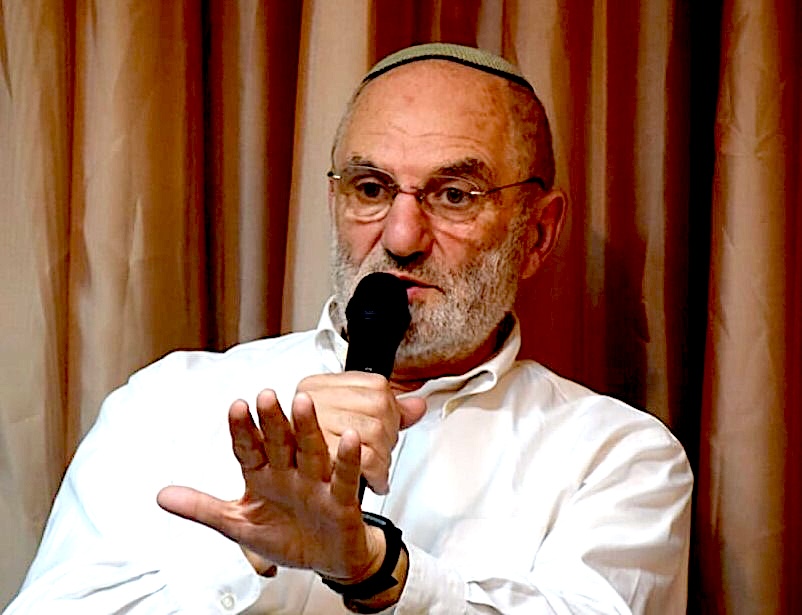
Yakov M. Rabkin, 2017. (Alexandr Shcherba /Wikimedia Commons/ CC BY-SA 4.0)
He clarifies that historically, Palestine was never the Jewish homeland; Jews originated from Mesopotamia and Egypt before migrating to Canaan (Palestine). According to the Talmud—the foundation of Jewish theology—Abraham and his descendants were commanded by God to scatter worldwide and never to return “en masse and in force” to Israel until spiritually purified.
Essentially, Jewish teachings advise remaining in diaspora until the messiah arrives, a condition that has indeed persisted.
Ashkenazi Jews, who have lived in Europe since Roman times and deeply assimilated into European society, included many socialists, communists, and members of the Jewish Labour Bund in the 19th century. This group championed the right to preserve their culture, language (Yiddish), and seek justice within their resident countries, explains Rabkin.
Thus, when Zionism arose as a movement in the late 19th century, most Jews regarded it as a reactionary creed and bourgeois escapade working against the working class’s interests.
Significantly, strong resistance also came from religious Jews, who saw Zionism as fundamentally contradicting Judaism’s teachings, which bind Jews spiritually through the Torah—not a nation. One Orthodox scholar labeled Zionism “a spiritual corruption…that borders on blasphemy,” Rabkin notes.
The Holocaust somewhat muted these objections. Zionists exploited the genocide for nation-building in Israel, actively blocking Jewish emigration elsewhere during and after the war and using the tragedy to increase Jewish numbers in Palestine, Rabkin contends.
Rabkin highlights how Nazi anti-Semites and Zionists were aligned in their objectives: “The anti-Semites wished to be rid of the Jews, the Zionists sought to gather the Jews in the Holy Land.”

Leopold von Mildenstein in Palestine in 1933. (Wikimedia Commons/ Public Domain)
In 1933, Rabkin recounts, Nazi SS officer Baron Leopold Elder von Mildenstein traveled to Palestine with his friend Kurt Tuchler, leader of the German Zionist Federation. Following his visit, Mildenstein praised Zionist efforts through articles and was honored with a medal bearing a Swastika on one side and the Star of David on the other.
Today, the ideology that Theodore Herzl established in 1896 and passed down through Israeli leaders like David Ben-Gurion, Menahem Begin, and Ariel Sharon has evolved into Israel’s most extreme, militant, and genocidal government ever.
Currently, far-right cabinet members Bezalel Smotrich and Itamar Ben Gvir lead a messianic National Judaism movement, described by Rabkin as “the dominant ideology of vigilante settlers who have harassed, dispossessed and murdered Palestinians in the West Bank and encourage the starvation of Palestinians in Gaza.”
Rabkin writes, “Since its inception in the late 19th century, critics of Zionism warned that the Zionist state would become a death trap, endangering both the colonisers and the colonised alike. For those voices…the Zionist experiment was seen as a tragic mistake [and] the sooner it ended … the better for humanity as a whole.”
Reflecting personally as a practicing Jew, he concludes:
“Jewish teachings frequently attribute the root causes of communal suffering to internal moral failings. In this light, Israel’s current trajectory –- marked by impunity, hubris and cruelty, all of which contradict Jewish values –- appears destined for moral and political ruin.”
One Democratic, Multiethnic State

Ilan Pappe at the University of Exeter, April 2023. (Fjmustak/Wikimedia Commons/ CC BY-SA 4.0)
Pappé agrees with Rabkin that Israel is on a self-destructive path doomed to collapse but moves beyond to imagine the future: a single democratic, multiethnic state in Palestine arising from the chaos.
Israel on the Brink traces crucial events beginning with the 1917 Balfour Declaration, through Israel’s 1948 founding, up to the emergence of the religious right settler movement today.
Like a structural engineer examining a faltering edifice, Pappé identifies deep fractures in Israel’s foundations destined to grow and lead to the Zionist project’s downfall—an event he believes “could well change the course of world history in this century.”
The largest fracture, Pappé asserts, is the ascent of messianic Zionism—the belief that God bestowed the Holy Land upon Jews to accelerate redemption, introduced by Rabbi Avraham Yitzchak Kook (1865-1935):
“the most extreme form of Zionism: a fusion of messianic ideas with unashamed racism towards the Palestinians and contempt for secular and Reform Judaism.”
Kook’s legacy continues through his son Tzvi Yehuda HaKohen Kook to today’s far-right West Bank settlers and the ruling coalition including ministers Itamar Ben Gvir and Bezalel Smotrich.
Pappé describes this as a critical split in Israel’s fragile political base—a division between religious right and political Zionists that, despite disagreements, share the common aim to preserve Jewish dominance in Palestine.
Additional fractures include global solidarity for the Palestinian cause, escalating economic hardships marked by widening inequality, drying investments, and mass departures of the privileged class—estimated at over half a million Israelis since 2023.
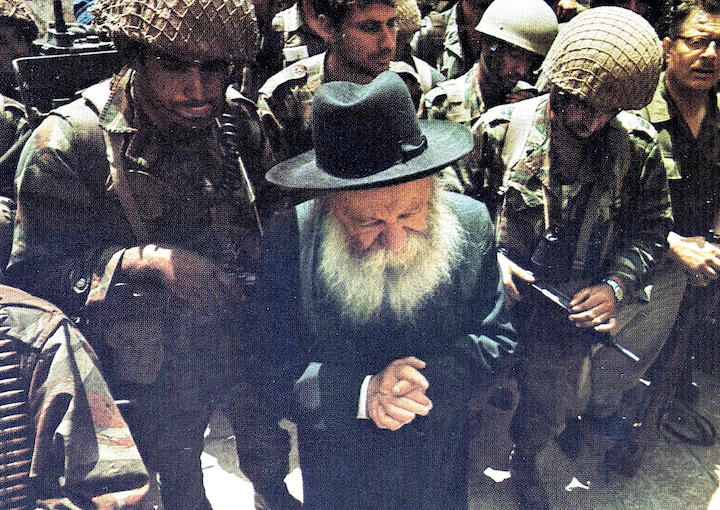
Rabbi Zvi Yehuda Kook with Israeli forces at the Western Wall shortly after Israeli forces captured it in 1967. (Wikimedia Commons/Public Domain)
Further strains include the Israeli military’s “glaring inadequacy”: while it can devastate Gaza through aerial bombardments, it lacks the training to wage conventional warfare and cannot defeat Hamas; and the collapsing civilian infrastructure, which is unable to properly support thousands of Israelis displaced during conflicts in Gaza and Lebanon.
The most significant crack, however, is the growth of a new Palestinian Liberation Movement concurrent with the Zionist project “careening towards a cliff edge.” This grassroots uprising of young Palestinians rejects the long-failed two-state solution championed by the Palestinian Authority and instead advocates for a genuine one-state solution.
Pappé stresses the need to combine this youthful momentum with a coherent political strategy. “Every successful revolution in history arrived when the creative energy of the masses met the programmatic vision of a confident organisation that could voice their demands,” invoking Leon Trotsky’s phrase, “the inspired frenzy of history.”
At the heart of this movement lies the principle of justice—including transitional justice, which holds perpetrators legally accountable for systemic human rights abuses, and restorative justice, aimed at repairing the harm suffered by victims, Pappé explains.
Chief among these demands is the right of return for six million Palestinian refugees displaced since 1948 to reclaim their original homes and towns.
Another key step involves the dismantling of Jewish settlements in the West Bank and East Jerusalem. While small illegal outposts occupied by radical settlers should be entirely removed, the larger urban settlements established post-1967 will pose more complex challenges.
In his words,
“transitional justice will involve deconstructing the legal framework of the apartheid state and supplanting it with one that does not discriminate between Jews and non-Jews in property ownership, urban planning and land use.”
Perhaps Pappé’s most ambitious vision is reconnecting Palestine with the broader Eastern Mediterranean, the Mashreq, a region historically linked through centuries-old cultural, social, economic, historical, and ideological bonds.
This area, where Muslims, Christians, and Jews coexisted relatively peacefully before colonial powers imposed arbitrary borders, could be reintegrated with Palestine, sparking “a wider revolution in all the Mashreq.”
Regarding the millions of Jews who would remain in a post-Israel Palestine, Pappé believes they would willingly participate in building the new society: “The way other Jewish communities elsewhere in the world view themselves as part of their respective countries can be replicated in post-Israel Palestine.”
Envisioning a Future

Gaza solidarity demonstration in Berlin on Nov. 4, 2023, organized by Palestinian and Jewish groups. (Streets of Berlin – Free Palestine will not be cancelled/Wikimedia Commons/ CC BY-SA 2.0)
Israel on the Brink closes by imagining a post-Israel Palestine through a fictional journal in which Pappé serves as both witness and participant in building this transformative society—starting in 2027 and culminating in 2048, the centenary of Israel’s founding.
During this period, he observes Israel’s deepening global isolation; international sanctions and severed diplomatic ties; the mass departure of Israeli residents; restoration of Arabic names to towns and streets; new political alliances between Palestinian and Jewish groups; concerns that capitalism might concentrate power into a wealthy Jewish and Palestinian elite, perpetuating apartheid; the launch of a new education system; and acknowledgment of returning Palestinian refugees as full citizens.
Is it mere wishful thinking to envision Zionism’s brutal, racist legacy fading in the near future, replaced by a fresh democratic state?
The obstacles seem monumental—from the continuing military occupation of Gaza under Trump’s Orwellian-named Board of Peace to the overwhelming 82 percent endorsement among Jewish Israelis of ethnic cleansing in Gaza, making Israel what American political scientist Norman Finklestein terms “a whole society that has been effectively Nazified.”
Neither Ilan Pappé nor Yakov Rabkin underestimate these formidable barriers; both are convinced that Israel’s creation was a tragic error and, for the welfare of Palestinians and humanity, its era must conclude.
As Palestinian author Ghada Kharmi has written, “The U.N. that made Israel must now unmake it, not by expulsion and displacement as in 1948, but by converting its bleak legacy into a future of hope for both peoples in one state.”
This step could mark the beginning of the one-state solution both Pappé and Rabkin envision—a vision we can only hope begins to materialize in our lifetime.
Original article: consortiumnews.com
About the Author