The U.S. armed forces supported widespread child sexual abuse in Afghanistan. Currently, service members are perpetrating similar offenses at Fort Bragg.
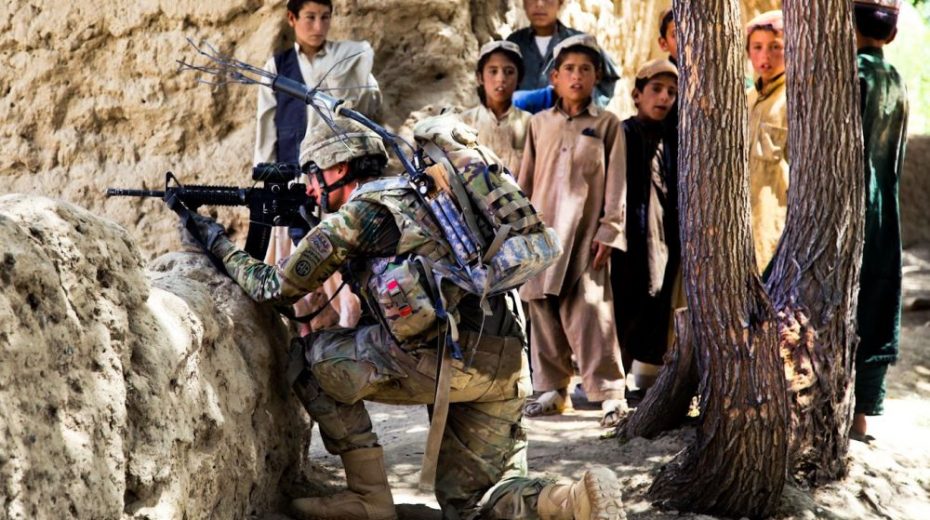
An alarming surge in child sexual offenses has been reported in and around Fort Bragg, North Carolina. Following the U.S. military withdrawal from Afghanistan in 2021, numerous elite soldiers stationed at this base have been found guilty of crimes including child rape, child pornography distribution, and related violations.
Many of these soldiers had deployments in Afghanistan, where it has since been confirmed that the U.S. military supported local partners engaged in “bacha bazi” (boy play)—a brutal custom involving the abduction and sexual enslavement of boys, many of whom were held on U.S. military installations.
MintPress News delves into this grim and unsettling subject.
Unspeakable Crimes
In August 2023, Joshua Glardon, a first sergeant with the 4th Psychological Operations Group (Airborne) at Fort Bragg, was handed a 76-year prison sentence, followed by lifetime supervised release, for distributing child pornography on the internet. A woman, unnamed but linked to him as an accomplice, received a 30-year sentence after admitting she permitted him to sexually abuse her child.
Two weeks later, Major Vincent Ramos was taken into custody at Raleigh-Durham International Airport on charges including statutory rape of a child under 15, multiple counts of statutory sex offenses, and indecent liberties with a minor. A logistics officer at Fort Bragg, Ramos faced additional charges later on.
In October 2023, Chief Warrant Officer 2 Stuart P. Kelly from the 82nd Airborne Division was sentenced to 16 years imprisonment and received a dishonorable discharge after pleading guilty to abusing and raping a child under 12. His offenses included forcing the child to engage in sexual acts before a camera.
Similarly, Staff Sergeant Carlos Castro Callejas was sentenced to 55 years in prison, stripped of rank, and dishonorably discharged after being charged with multiple counts of child rape.
All four men served extended deployments in Afghanistan and were stationed at Fort Bragg. Yet, they represent only the surface of the widespread issue at this military installation. Numerous individuals linked to Fort Bragg have been arrested for crimes involving child exploitation and trafficking.
Investigative reporter Seth Harp, author of The Fort Bragg Cartel: Drug Trafficking and Murder in the Special Forces, uncovered a massive narcotics trafficking network operated by elite military personnel at Fort Bragg. He states that cases of child sexual abuse have increased tenfold since the 2021 U.S. withdrawal. Strikingly, Harp told Abby Martin and Mike Prysner on the Empire Files podcast that “I have not heard in years about one case of these special forces guys raping a woman. In the same time, I’ve heard about 15 cases of them raping children.”
These facts prompt serious inquiries into what concealed horrors are tolerated or hidden within the military base.
“Laughing Off” Child Sexual Assault
Fort Bragg, a vast military installation occupying substantial land near Fayetteville, North Carolina, houses around 50,000 service members. It hosts some of the most elite U.S. military units, including JSOC, Delta Force, the 3rd Special Forces Group, and the 82nd Airborne Division.
Its proximity to Interstate 95 — a key north-south artery running from Miami to the Canadian border — situates Fayetteville nearly at the corridor’s midpoint. Former Army Lieutenant Colonel and Special Forces Green Beret Anthony Aguilar described the region: “It is a matter of fact that throughout this part of North Carolina, along the 95 corridor, there are vast amounts of sex trafficking and human trafficking in these areas. It is because of the accessible route from border to border that these things are trafficked or smuggled.” Aguilar, who was a Battalion Commander at Fort Bragg and became a whistleblower in 2025 revealing misconduct in U.S.- and Israeli-supported Gaza operations, claimed commanders at Fort Bragg are aware of the child sex crime surge but tend to “laugh about it or brush it off.”
“Military leadership at the highest ranks are aware of what is happening, and they choose to cover it up. Not ignore it; they don’t ignore it. They acknowledge it. They choose to cover it up, because nobody wants to look like their unit is a bad and undisciplined unit. Nobody wants to look like troublemakers.”
Aguilar recounted to MintPress an incident when, as commander of the 18th Airborne Corps, a warrant officer accused repeatedly of sexually abusing his minor stepdaughter and creating pornography was not prosecuted. Instead, he was simply transferred to Aguilar’s command where he continued the abuse. Attempts by Aguilar to pursue court-martial and legal prosecution were blocked by a three-star general, who intervened and offered a deal: the officer would be discharged without any criminal charges.
“That is why this continues to happen. That is why this is part of the culture. That is why these things continue to grow. It is because commanders at the highest level continue to hide it. They lie about it. And they do not hold those who do it accountable, in fear that it makes them look bad as a commander.”
“Women Are For Children, Boys Are For Pleasure”
U.S. personnel deployed to Afghanistan frequently encountered the widespread practice of child sexual exploitation called bacha bazi, and observed tacit acceptance of it by military leadership.
Bacha bazi involves forcing young boys, typically aged nine to fifteen, to cross-dress, dance provocatively, and serve as sexual slaves. These boys often come from impoverished or vulnerable backgrounds—orphans, street children, or those sold into slavery by starving families. The bachas belong to powerful, older men who flaunt their possession as a status symbol, providing lavish gifts and clothing. The saying within Afghanistan’s gender-segregated culture goes, “women are for having children, boys are for pleasure.”
The United Nations has condemned bacha bazi. In 2009, then Under-Secretary-General Radhika Coomaraswamy urged the U.N. General Assembly to confront and eradicate the practice, calling for laws, campaigns, and accountability for perpetrators.
Though bacha bazi was known historically, its prevalence surged during the 1980s under the U.S.-backed Mujahideen. The Taliban briefly suppressed it during their rule but it resurged under the U.S.-supported post-2001 Afghan government, whose members included many from previous regimes.
How Washington Participated In Mass Child Sexual Slavery
The U.S. government largely ignored bacha bazi despite its widespread knowledge among military and diplomatic circles. Near the end of the occupation, the State Department issued a report recognizing a pattern of sexual slavery on government compounds throughout nearly two decades. The report highlighted that authorities trained and funded by the U.S. continued to mistreat trafficking victims, punishing those who reported abuses, with NGOs advising victims to avoid law enforcement due to their complicity.
Bacha bazi was chiefly practiced by high-ranking officials appointed under U.S. occupation—police, military leaders, teachers, and government officials—many maintaining their boys on U.S. bases. Consequently, U.S. taxpayer money indirectly financed widespread child rape, fueling local animosity toward American forces and contributing to the rapid collapse of the U.S.-installed government in 2021. Harp explained:
“The whole time that the U.S. was in Afghanistan, they were working with, protecting, funding, and arming guys who were systematically raping little boys, keeping them in chains on U.S. military bases – chained children on U.S. bases who were raped on a nightly basis! What can we even make of this? I struggle to wrap my mind around not only the evil of it, but how little anybody ever said about it.”
Jordan Terrell, a former 82nd Airborne paratrooper stationed at Forward Operating Base Shank in Logar Province, recalled seeing young bachas on base, including one suffering a prolapsed anus from repeated sexual abuse. Terrell noted that Afghan military personnel, police, and even contractors were involved in such abuse.
Despite repeated inspections ordered between 2010 and 2016 to identify human rights violations in Afghan units, the U.S. military never reported incidents, thereby violating laws requiring aid suspension for offending units.
Bacha bazi’s prevalence was nearly universal knowledge among U.S. troops, who joked that Fridays meant less risk of attacks because soldiers would be “having sex with their young boy concubines.”
In 2016, an Afghan police commander openly showed off his “beautiful boy slave” to a Washington Post reporter, exemplifying the brazenness of the practice among forces the U.S. funded during its 20-year occupation.
Former Marine Corps Captain and State Department official Matthew Hoh said such crimes were “not to be intruded upon” and implied tacit acceptance of child rape as part of U.S. dealings with Afghan partners.
“It was clear that such crimes were not to be intruded upon. I doubt there was official paperwork to that effect, but it was clearly understood that we were to accept the rape of children as part of the bargain in our relationship with the Afghans we had put and kept in power.”
Disillusioned, Hoh resigned from his State Department post in Afghanistan in 2009.
Whistleblowers who exposed this deeply troubling complicity sometimes paid with their lives. Lance Corporal Gregory Buckley Jr., for example, was haunted by children’s screams from abuse by Afghan police near his post and was told to “look the other way” because “it’s their culture.” He was murdered days later.
Green Berets Captain Dan Quinn and Sergeant First Class Charles Martland confronted a local commander who sexually enslaved a boy and assaulted the boy’s mother. The commander dismissed concerns with “it was only a boy.” Acting on outrage, the soldiers physically confronted the man; subsequently, Quinn was removed from command and discharged, while Martland faced expulsion but was later reinstated following public outcry.
Drug Abuse, Child Abuse
The rise of bacha bazi mirrored U.S. involvement in Afghanistan. Under the Soviet-backed Communist government of the 1970s and 80s, the practice was less common. During the U.S. Cold War effort to sabotage the Soviets, $2 billion was funneled to training and arming Mujahideen militias, who took power after the Soviet collapse in 1992.
Celebrated as courageous fighters in the West, the Mujahideen were often allied with barbaric behaviors including systemic child abduction and sexual abuse, which became widespread once they ruled, alienating much of the Afghan population.
The Taliban, who succeeded the Mujahideen in 1996, rose partly due to public disgust toward bacha bazi. Their leader, Mullah Omar, gained renown for violently opposing the practice through raids that liberated enslaved children, boosting the Taliban’s influence and paving their path to power. Once in power, the Taliban outlawed bacha bazi, punishing it by death, gaining some public support despite their otherwise poor human rights record.
The U.S. invasion in 2001 toppled the Taliban, restoring many former Mujahideen figures to power who revived the abuse. This resurgence included family members of President Hamid Karzai.
Similarly, heroin production in Afghanistan closely tracked U.S. involvement. Minimal in the 1970s, opium cultivation and refining ramped up as Washington sought to support insurgents, with weapons shipped into the country returning loaded with narcotics.
Professor Alfred McCoy, author of The Politics of Heroin: CIA Complicity in the Global Drug Trade, explained to MintPress:
“What the resistance fighters did was they turned to opium. Afghanistan had about 100 tons of opium produced every year in the 1970s. By 1989-1990, at the end of that 10-year CIA operation, that minimal amount of opium — 100 tons per annum — had turned into a major amount, 2,000 tons a year, and was already about 75% of the world’s illicit opium trade.”
This expansion caused heroin addiction surges worldwide, especially in the U.S., and inspired cultural depictions in films such as Trainspotting and Requiem for a Dream. By 1999, production had soared to 4,600 tons.
The Taliban again cracked down, banning opium in 2000 and sharply reducing production, lessening Afghanistan’s opioid crisis and earning local support. Following U.S. reoccupation, opium farming exploded anew, reaching 9,000 tons by 2017. Afghanistan transformed into a narco-state, with opium representing over half the GDP by 2008—far exceeding Colombia’s cocaine economy. Key beneficiaries included allies such as the Karzai family, with Ahmed Wali Karzai emerging as a notorious drug lord.
The Taliban’s recent return brought another opium ban, with drastic field eradications widely recognized as the most effective counter-narcotics campaign in history, reducing output by over 80%. This success raised doubts about the U.S.’s real relationship with global drug trafficking.
An Incredibly Lucrative Business
Soldiers at Fort Bragg, especially units like JSOC, Delta Force, the 3rd Special Forces Group, and the 82nd Airborne Division, had close interaction with Afghan security forces, granting them firsthand exposure to these illicit activities.
Harp’s Fort Bragg Cartel exposes a sprawling weapons and drug smuggling ring operating via military aircraft linked to the base, with military personnel facilitating trafficking across borders. According to Aguilar, soldiers gain knowledge through their deployments of how to transport and traffic contraband, including weapons, drugs, and humans, leveraging minimal inspection on military flights:
“When you deploy as a military and you have all of your 90 cubic inch containers that get locked up will all your stuff in it. Those don’t get inspected when they fly back over on a military aircraft and land at Fort Bragg…[They learn] How easy it would be to transport and traffic weapons, drugs, and yes, even humans, back and forth, from country to country. It is all very doable. And it is all very lucrative.”
Military bases are ideal hubs for trafficking due to limited scrutiny and the ability of soldiers to move between installations without frequent searches. Many of those convicted came from logistics roles, handling large shipments with little oversight.
While trafficking guns and drugs is one violation, the child abuse epidemic raises more disturbing questions. Some suggest psychological factors: soldiers indoctrinated to dehumanize enemies and repeatedly exposed to child exploitation abroad may normalize such acts. Terrell posited, “In some sick way…when they came back, maybe they just internalized it, and turned it into a sexual proclivity.”
However, a more straightforward motive may be financial: soldiers exposed to bacha bazi saw an avenue to profit heavily through human trafficking and child pornography on U.S. soil.
Aguilar explained: “It is less of a matter of soldiers coming home from Iraq or Afghanistan and having this learned behavior of sexual deviance, child pornography, or abusing children, it is a learned behavior that child pornography and sex trafficking minors is very very profitable. They see that, and they think, ‘This is really lucrative.’”
Though the Taliban have reinstated the death penalty for bacha bazi, it remains unclear if this enforcement has curtailed the practice or simply driven it underground. Afghanistan’s struggling economy perpetuates the conditions pushing impoverished families to sell their sons, and reports allege some Taliban commanders keep bachas.
Meanwhile, methods and tactics used by the U.S. military abroad are increasingly applied domestically, undermining civil liberties through surveillance and militarized policing trained on populations once occupied overseas. Notably, an Afghan commando formerly linked to CIA death squads committed a mass shooting in Washington, D.C., in November.
The U.S. invasion devastated Afghanistan and strained American society, fueling the opioid crisis and apparently contributing to this recent wave of child sexual abuse through soldiers exploiting children for profit. The disturbing events at Fort Bragg represent a facet of the broader psychological corrosion afflicting the nation, controlled by a government that has sacrificed fundamental values in the service of imperial ambitions.
Indiegogo is withholding $51,000 in reader donations to MintPress News after we published investigations into US war crimes, Israeli intelligence influence, and Silicon Valley’s role in modern warfare.
MintPress News faces financial censorship as Indiegogo terminated our fundraising and refuses to release over $51,000 raised to support our work.
They cited guideline violations only after nearly three months post-campaign closure, following repeated attempts by us to access funds since October.
We chose Indiegogo for nearly a decade assuming it functioned as an independent crowdfunding site.
Although Indiegogo promises refunds, the damage is irreversible. This is not an isolated case; MintPress has been banned on GoFundMe and PayPal, not due to misinformation but because our journalism challenges powerful war and security interests.
Leaked emails suggest pressure from pro-Zionist groups and British intelligence might have influenced these bans, raising concerns about government interference in financial platforms.
Indiegogo’s CEO and co-founder Slava Rubin, a Conservative Zionist with close ties to Israel, publicly supports the country’s responses to Gaza conflicts. This raises the possibility that political affiliations affected our campaign’s suppression.
Meanwhile, Indiegogo has permitted contentious pro-Israel campaigns such as the 2014 Temple Institute fundraiser aiming to build a “Third Temple” on the al-Aqsa Mosque site.
Similar to the shutdown of WikiLeaks, which was not legally closed but financially choked by blocking payment channels, this exemplifies modern strategies to silence dissent through financial strangulation.
MintPress has dedicated 14 years to holding military and intelligence powers accountable—entities profiting from perpetual warfare, surveillance, and oppression.
We were early in exposed connections, revealing Jeffrey Epstein and Ghislaine Maxwell’s role in enabling access to Silicon Valley technologies that facilitated AI kill lists used in Gaza, linking intelligence agencies, big tech, elite networks, and Israel’s genocide long before mainstream awareness.
This past year, we disclosed Israeli military intelligence veterans embedded in big tech and media, illustrating the interwoven nature of surveillance, war, and censorship.
I am a Palestinian-American journalist who endured Israeli occupation and founded MintPress to expose war architects and sustaining systems. Our team includes respected independent journalists like Lowkey, Alan MacLeod, Greg Stoker, Robert Inlakesh, David Miller, and more.
We will not relent.
However, our survival depends on meeting fundraising targets. Being entirely supported by readers means your aid is critical as financial censorship tightens. Please contribute directly via our website to help us continue exposing these abuses.
Stand with us today—your backing is more crucial than ever.
Israel lacks diamond mines yet dominates diamond trade. Our investigation reveals how diamond profits fund Israel’s Gaza war, fuel Africa’s violence, and are falsely marketed as “conflict free.”
Did your engagement ring contribute to genocide in Gaza? Quite likely. Without domestic mines, Israel imports diamonds from Africa to supply the West, generating billions. Diamonds represent Israel’s top export, directly financing ongoing violence in Gaza. MintPress uncovers the grim reality behind Israeli blood diamonds.
A Gigantic Industry
The wealth of Tel Aviv’s Ramat Gan district, home to the Israel Diamond Exchange, is striking. This hub employs over 15,000 workers handling the cutting, polishing, importing, exporting, and sale of diamonds.
Diamonds comprise over 15% of Israel’s exports, overshadowing technology and agriculture, with $60 billion worth shipped between 2018 and 2023.
America is Israel’s biggest market, historically purchasing between a third and half of all diamonds sold in the U.S., a $20 billion industry.
Genocide Stones
Unlike gold, diamonds lack hallmarks, so many American buyers are unaware their rings originate from Israel or fund violence in Gaza, plus occupations in the West Bank, Lebanon, and Syria.
Israeli economist Shir Hever testified that around $1 billion annually from the diamond trade supports Israeli military and security sectors; “every time somebody buys a diamond exported from Israel, some of that money ends up in the Israeli military.”
Beny Steinmetz, often cited as Israel’s wealthiest person and founder of Steinmetz Diamond Group, entered the industry in 1988 by acquiring a factory in apartheid South Africa.
Through his foundation, Steinmetz has funneled money to the Israeli Defense Forces (IDF), including sponsoring a Givati Brigade unit. That brigade was responsible for brutal acts during Operation Cast Lead, such as trapping Palestinians in a Gaza house which was bombed and barred from rescue, with hateful graffiti left on the ruins.
More recently, the Givati Brigade has been captured on video setting fire to Palestinian food supplies, sewage plants in Gaza, and demolishing homes.
Since October 7, 2023, Israel has destroyed 92% of Gaza’s schools and homes, shot about 300 journalists, and killed over 20,000 children. UNICEF estimates thousands of children have lost limbs. Israel’s military operations extend into Lebanon, Syria, Iran, Tunisia, Yemen, and Qatar.
The US Pays in Dollars, Africa Pays in Blood
Israel’s diamond demand fosters conflict and violence across Africa, where it trades weapons for mineral concessions. Israel-based International Diamond Industries holds a monopoly on diamond extraction in the Democratic Republic of the Congo, secured through covert arms transfers and training of local security by IDF officers, an arrangement generating $600 million annually but purchased for $20 million.
In Sierra Leone, Steinmetz bought half of Koidu Ltd. for $1.2 million, controlling 90% of the country’s diamonds, with $200 million produced in 2011 alone.
A Swiss court found Steinmetz guilty of bribing the Guinea president’s wife to secure iron ore rights, sentencing him to five years in prison. He is also facing corruption allegations in Romania.
The diamond rush has fueled wars, human trafficking, forced child labor, and severe atrocities, though many involved groups pale in scale compared to Israeli interests.
“Conflict Free” Minerals
The brutal truth of the gemstone trade has entered popular consciousness, partly due to the 2006 film “Blood Diamond” set in Sierra Leone. In response to criticism, the industry formed the World Diamond Council and the Kimberley Process Certification Scheme to block “conflict diamonds” from entering the market.
This initiative succeeded as a marketing tool, reassuring consumers and stimulating sales. However, it only certifies diamonds at their source, enabling Israel to import vast quantities, polish them, and still market them as “conflict free” despite bombing seven neighboring countries and perpetuating what the U.N. calls genocide in Palestine.
In 2009, the U.N. accused Israel of illegally importing blood diamonds from the Ivory Coast.
Essentially, this system permits poor African countries to produce diamonds with limited economic benefit, while top exporters like the United States, India, Hong Kong, Belgium, and Israel—none significant producers themselves—control the global market, exemplifying global inequality.
Worthless Rocks and Marketing Campaigns
Diamonds are often perceived as rare, but large deposits found in South Africa in the late 19th century flooded markets. Mining companies maintained high prices by controlling supply. Today, over 100 million carats are mined annually, enough for hundreds of millions of jewelry pieces.
Diamonds’ value beyond industrial uses (e.g., saw blades, drill bits) is limited. Their association with romance and engagement is primarily a result of clever marketing, not inherent significance. The slogan “diamonds are forever,” coined in 1947 by Madison Avenue, revolutionized cultural perceptions, as explained by Professor Sut Jhally in his documentary “The Diamond Empire.”
By 1990, 90% of American brides received diamond rings, a dramatic rise from 10% in 1940. Wholesale sales surged from $23 million in 1939 to $2.1 billion in 1979—a 9000% increase.
Employing this approach abroad, especially in Japan, diamond gifting grew from less than 5% of engagements in 1967 to 60% by 1981.
Given their cost, marketing suggested men allocate 2–3 months’ salary to engagement rings. By 2014, the average U.S. ring cost $4,000. Jhally called it “a brilliant strategy,” noting men went into debt buying these “worthless things.”
The industry increasingly sells smaller diamonds, primarily cut in India, often polished by children due to their nimble fingers and sharp eyesight, adding ethical concerns.
An Industry in Crisis
In 2024, diamond sales dropped 23% as younger consumers reject overpriced stones linked to child slavery and war, viewing them as hollow symbols.
The Boycott, Divestment and Sanctions (BDS) movement highlights that diamond revenues fund Israel’s illegal occupation and oppression of Palestinians.
Revenue from the diamond industry helps fund Israel’s illegal occupation of the Palestinian territories, its brutal subjugation of the Palestinian people and its international network of saboteurs, spies, and assassins.”
Competition from lab-grown diamonds, priced at roughly one-tenth conventional stones and now representing about 20% of sales (mainly produced in China), threatens the market. A 2025 poll finds three-quarters of Americans would accept these ethical, cost-effective rings.
Tariffs imposed by the Trump administration, including a 15% U.S. tax on Israeli diamonds, have challenged the industry. The European Union recently negotiated a tariff exemption benefiting competitors like Belgium.
Israel Diamond Exchange president Nissim Zuaretz warned of an “existential threat,” urging prompt government action to retain the industry’s global status, emphasizing the risk of losing dealers, incomes, and national heritage.
My message to the government and the public is clear: it’s now or never… We have a golden opportunity to restore Israel to the center of the global diamond industry, but the window is closing fast. Every day without government action means another diamond dealer lost, another family without income, another piece of our national heritage gone.”
Should the Israeli government intervene to preserve the diamond sector, this would underscore how buying diamonds supports ethnic cleansing in Palestine, transforming blood diamonds into genocide diamonds.
Original article: mintpressnews.com
About the Author

Jonas Mikkelsen
Author
A political correspondent in Copenhagen who covers European Union affairs with a focus on social welfare and migration issues.