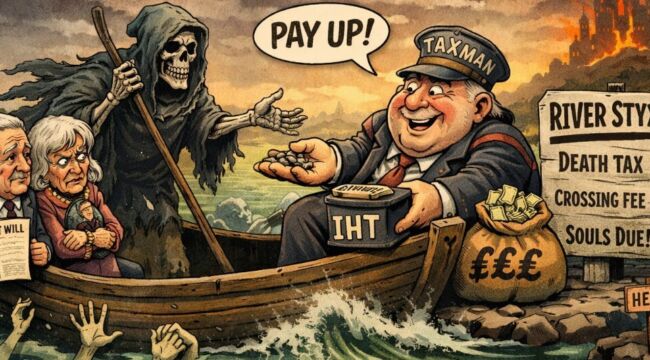
Sorry for Your Loss. Please Remit Payment.
Before explaining why I strongly dislike inheritance tax, I want to make one thing clear.
Never provoke the tax authorities. There is a strict boundary—avoid even approaching it, much less crossing it. With most processes now digital, trying to outsmart tax officials simply won’t work, no matter how ethically justified you believe your actions are.
Always hire a qualified professional—whether an accountant, tax attorney, or both—so you not only get sound advice but also their endorsement on official documents. That endorsement often serves as a crucial barrier between your heirs and an aggressive tax auditor. Attempting sophisticated estate planning alone puts your assets directly in the government’s sights.
If your wealth reaches six or seven figures, you can’t afford to be lax in this matter.
Now, let’s dive deeper.
What Is Inheritance Tax?
Inheritance tax—commonly grouped with “estate” or “death” taxes—is a charge on wealth transferred from a deceased individual to their beneficiaries. Depending on the jurisdiction, the tax might target the estate, the heir, or both.
Upon death, the entire value of a person’s assets and property—known as their estate—is evaluated. If it surpasses government-set thresholds, taxes are imposed. Although thresholds and tax rates differ across countries or regions, the underlying concept remains consistent: the government appoints itself an unwanted “heir” to your accumulated wealth.
Officially, this is framed as a way to encourage everyone to “contribute to public funds” and address “wealth inequality.” In reality, it means a portion of your money passes to strangers rather than your descendants or designated beneficiaries.
Sometimes the estate pays the tax before assets are distributed; other times beneficiaries pay after receiving their inheritance. The distinction doesn’t improve the tax’s fairness—it merely shifts who foots the bill for wealth they didn’t earn.
Why Inheritance Tax Is Immoral
Here are a few reasons why I consider inheritance tax (IHT) ethically unjust.
-
- Property rights
You have the right to control your assets and decide who inherits them. Taxing wealth at the moment it passes to heirs infringes on this right, as it gives the government veto power over your final property transfer.
-
- Double taxation
Most assets in an estate have already been taxed—through income tax, capital gains, property tax, or sales tax. Charging tax again upon death is not a fair levy but rather deliberate double taxation.
-
- Generational fairness
IHT penalizes families that build and maintain wealth across generations, while the government rarely exercises similar financial restraint. It interrupts the compounding effect that transforms a small business or home into lasting family security.
-
- Wealth preservation and growth
Knowing the State will seize a significant portion of your estate upon death reduces motivation to accumulate and protect wealth. This leads to less investment, fewer jobs created, slower innovation, and reduced economic growth over time.
-
- Complexity and avoidance
The very wealthy employ teams of specialists to minimize their tax exposure. Meanwhile, middle-class business owners, professionals, and homeowners in wealthy areas often bear the heaviest burden. Thus, what is sold as a tax on the rich often disproportionately impacts the moderately affluent.
My fundamental objection lies with property rights. You should be free to bequeath your possessions to whoever you choose without the tax collector showing up with a collection plate.
An often overlooked motivation behind the fight for gay marriage was straightforward: property rights. Historically, same-sex partners faced steep tax bills when one died and left assets to the other, being treated like strangers for tax purposes. Granting spousal rights addressed this inequity.
I’m not trivializing marriage as just a tax strategy—people marry out of love. Still, it’s telling that adults had to fight for a right that should have been assumed: to transfer your property freely without government interference.
U.S. Inheritance and Estate Tax
For U.S. citizens, the federal exemption is quite high… at least, for now.
The federal gift and estate tax system offers a combined lifetime exemption. You can apply it to gifts during life or your estate after passing. Amounts above that exemption face a top tax rate of 40% at the federal level.
Additionally, there is an annual gift tax exclusion allowing you to gift a specific amount per recipient yearly without affecting your lifetime exemption. Used smartly, this can gradually transfer substantial wealth outside your taxable estate.
But federal rules are only part of the story. Many states impose their own estate or inheritance taxes with lower thresholds. It’s possible to avoid federal tax yet owe substantial amounts to state authorities, especially if your heirs or assets span multiple states, complicating matters further.
The key takeaway: while federal exemptions seem generous, you must consider the state laws where you live, own property, or where your heirs reside.
Also, remember this crucial difference:
– Estate tax is assessed on the estate before it’s distributed.
– Inheritance tax is imposed on beneficiaries after they receive their inheritance.
Although many (myself included in casual conversation) lump these together as “death taxes,” professionals and tax officials distinguish them clearly. Be sure you know which applies to your situation.
UK Inheritance Tax
Britain’s inheritance tax system is frustrating and often leads to hardships for families, frequently forcing heirs to sell treasured family properties just to cover the tax bill.
The usual UK IHT rate is 40%, charged on the estate value exceeding your allowances. The basic exemption—the “nil-rate band”—has remained at £325,000 for years. An additional “residence nil-rate band” provides another £175,000 if you pass your main residence to direct descendants. Many couples can therefore pass nearly £1 million tax-free, depending on the structuring of their wills and ownership.
The rate can drop to 36% if you allocate at least 10% of the estate’s net value to charity, a government incentive to encourage charitable giving alongside tax revenue.
However, with property prices rising and thresholds frozen, more ordinary families find themselves liable for IHT. One careless will, an unexpected property, or a paperwork error can force heirs to hurriedly sell assets to satisfy HMRC.
If you’re British and don’t consult a lawyer or accountant about this, you’re making a big mistake.
As a British citizen myself, I will take all legal measures to avoid paying this tax.
Italian Inheritance Tax
Italy’s system looks complex on paper but is considerably more favorable in practice, especially for spouses and children.
Inheritances left to direct family members face a 4% tax only on amounts exceeding a generous €1 million allowance per beneficiary. For example, leaving €1.5 million to a child triggers tax at 4% on €500,000.
Besides that:
- Real estate transfers entail filing taxes often calculated as a small percentage of the property’s cadastral value or a flat fee if the property will be the main home.
- Different tax rates and smaller or no allowances usually apply to siblings, distant relatives, or unrelated heirs.
Overall, Italy’s combination of high exemptions for close relatives and modest tax rates greatly reduces the chances that heirs must sell homes to pay inheritance taxes—a fate all too common in the UK.
Planning Strategies to Reduce IHT
Once again, facing inheritance tax means you must seek guidance from qualified lawyers or accountants. I don’t know your specific details, so consider this purely educational, not personalized advice.
The objective is not to conceal assets but to utilize existing laws proactively before the taxman claims more than necessary from your family.
Some frequently employed approaches include:
Tax-free allowances and exemptions
Many jurisdictions grant tax-free thresholds for certain amounts of inherited wealth, specific asset types, or transfers between spouses. Structuring your estate and timing asset transfers to fully use these allowances can prevent wastage.
-
- Lifetime gifts
Gifting during your lifetime can shrink the taxable size of your estate. Some gifts fall under annual exclusions, others follow longer “survival” periods, and some jurisdictions tax gifts immediately. Planned giving lets you witness your heirs enjoying the wealth and keeps more out of State reach.
-
- Trusts
Trusts offer a powerful way to control and allocate assets while potentially lowering estate or inheritance tax liabilities. By splitting legal ownership from beneficial enjoyment, they govern distribution timing and can exclude asset growth from your taxable estate. Though no magic solution, they are highly effective when used correctly.
-
- Charitable donations
Gifts made during life or via your will reduce taxable estate value and can decrease the tax rate on the remaining portion. If you already support charities, why not let your favored causes benefit instead of defaulting to government tax?
-
- Life insurance
Life insurance, when structured properly, can provide liquidity for heirs to cover inheritance or estate taxes without forced asset sales. Policies held in trust often remain outside the estate’s taxable value, though rules vary significantly with jurisdiction and require expert setup.
-
- Business and agricultural reliefs
Many tax systems offer reliefs or exemptions for qualifying business or farming assets to preserve family enterprises and agricultural land. Whether assets qualify can make a dramatic financial difference for heirs. Address this issue well before your passing, not at the last minute.
If your net worth reaches into the millions, familiarizing yourself with trusts, lifetime gifts, and applicable reliefs is essential. At this level, “doing nothing” is an expensive decision.
Wrap Up
Few things anger me more than unjust taxation, and inheritance tax ranks near the top.
Take every legal step possible to avoid this intrusive tax. Do it not because you disdain society, but because you care about your family far more than funding Leviathan.
About the Author