Modern Warfare 2: Lessons from Iran
This article is the second installment in our Modern Warfare series. The earlier installment focused on Ukraine.
Today, we will avoid political controversies and concentrate solely on the weapon systems and tactics observed in the Iran conflict.
This war differs significantly from Ukraine’s. It is fought over long distances with minimal chance of ground combat. There is no use of artillery, mortars, or small arms.
The emphasis is purely on extensive long-range weaponry.
The first takeaway is that drones and missiles pose vulnerabilities for everyone, regardless of how strong your air defenses are.
Take Israel, for instance, a tiny nation equipped with complex and multilayered missile defense networks. Except perhaps Moscow, it stands as one of the best-defended places on Earth.
Nonetheless, Tel Aviv continues to experience strikes. This reveals a crucial lesson from the conflict: intercepting $20,000 drones with costly SAM (surface-to-air) missiles is an unwinnable battle for all parties involved.
Countering ballistic missiles is even more difficult, especially when hypersonic weapons are involved. These fast-moving arms, capable of Mach 10 speeds (7,600 MPH), can evade air defenses by maneuvering unpredictably.
Major nations are developing laser systems, advanced flak cannons, electronic warfare tactics, and smaller, less expensive missiles. Yet at present, the attacker holds the upper hand.
Drones: Front and Center
Much like in Ukraine, drones dominate the battlefield in the Iran war. They remain the foremost asymmetric weapon in today’s conflicts.
The U.S. has conducted multiple strikes employing its new LUCAS (Low-cost Uncrewed Combat Attack System) drone.
LUCAS’s design is inspired by Iran’s Shahed-136 drone, sharing many similarities. The Shahed-136 also forms the basis for Russia’s Geranium (Geran) military drone.
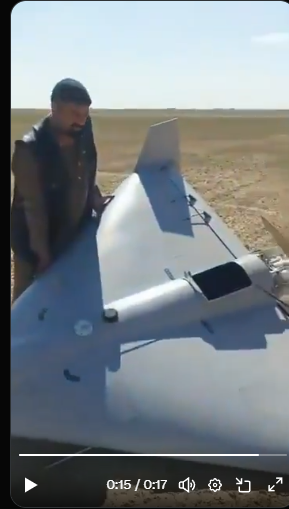
An American LUCAS drone recovered intact in Iraq
This drone features a delta-wing with a simple gas engine powering a propeller. Its wings serve as fuel tanks, while the body houses the warhead, engine, and avionics.
Interestingly, the LUCAS drone downed in Iraq carried a Starlink satellite antenna. Starlink is Elon Musk’s satellite communication network, widely utilized by both sides in Ukraine.
It is believed that Starlink helps counteract widespread GPS jamming.
Iran is heavily reliant on drones as well, inflicting most of the damage due to their improved precision compared to ballistic missiles.
Drones such as the Shahed-136 travel much slower than ballistic missiles but boast ranges up to 1,500 kilometers and can be deployed in large swarms.
So far, Iran has successfully targeted multiple U.S. and Israeli radar units, oil-related infrastructure, and tragically has caused American military casualties.
Iran: A Decentralized Network of Field Commanders
While U.S. and Israeli strikes have heavily impacted Iranian leadership, regime forces still control substantial stockpiles of missiles and drones.
The remaining field commanders and troops are effectively operating autonomously. Command structures have been shattered, yet weapons and fighters persist.
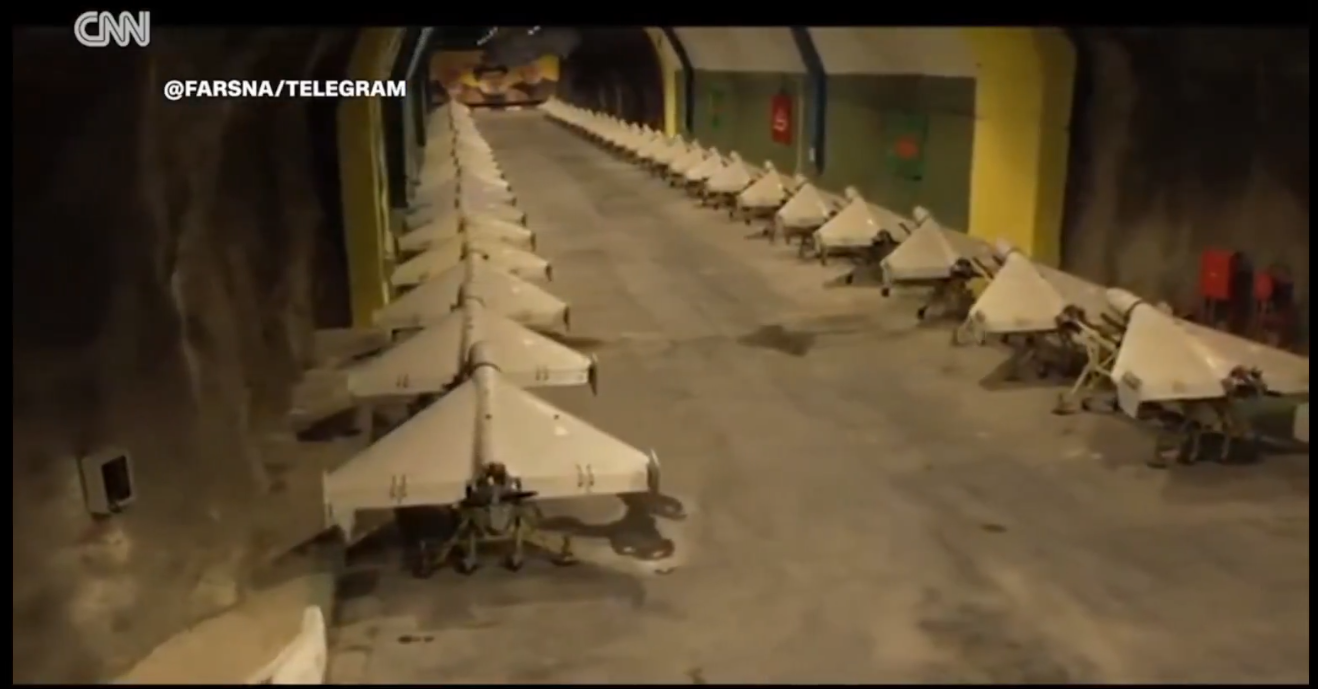
Underground drone stockpiles in Iran – Source: Farsi News via CNN, posted March 1
There are also underground complexes filled with ballistic missiles, which to the best of current knowledge remain untouched, protected under layers exceeding 100 feet of rock.
Missile launch systems are concealed across the country: some hidden beneath camo netting, others masked as commercial trucks.
Although a significant number have been destroyed, most experts estimate thousands of missiles still scattered across Iran alongside many thousands of long-range drones.
Consequently, Iranian field commanders are largely following their own operational plans, based loosely on directives issued early in the war. Local decision-making dominates.
This setup poses both a threat and a complication. Early in the conflict, Iran largely refrained from targeting oil facilities, an unspoken agreement preventing full-scale regional economic turmoil.
However, attacks have now struck refineries and production sites in Saudi Arabia, the UAE, and Bahrain, pushing oil prices higher once more.
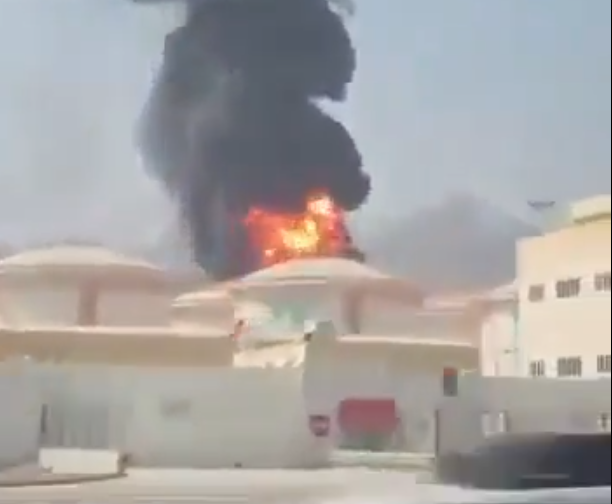
Screenshot from a video showing a fire at an oil storage facility in UAE’s Fujairah port. It was allegedly hit with a Shahed-136 drone.
This fragmented command structure complicates coordinated strikes but also makes Iranian forces resilient against total neutralization and challenging negotiation partners.
Iran’s missile threat in this conflict has been less pronounced than during last summer’s 12-day war, which demonstrated the missiles’ effectiveness.
Given the current dynamics, completely eradicating Iran’s offensive missile and drone capabilities without a negotiated settlement looks unlikely.
American & Israeli Weapons Effective, But Stockpiles Questioned
Up to now, weapons from the U.S. and Israel have shown remarkable effectiveness. Precision strikes using sea-launched Tomahawk cruise missiles and stealth missiles flown from the air forces have proven potent.
Defensive missile systems like the Patriot and THAAD intercept many incoming Iranian rockets.
However, concerns linger regarding inventory levels. The U.S. has sent vast numbers of defensive missiles to Ukraine and supplied munitions to Israel for Gaza operations.
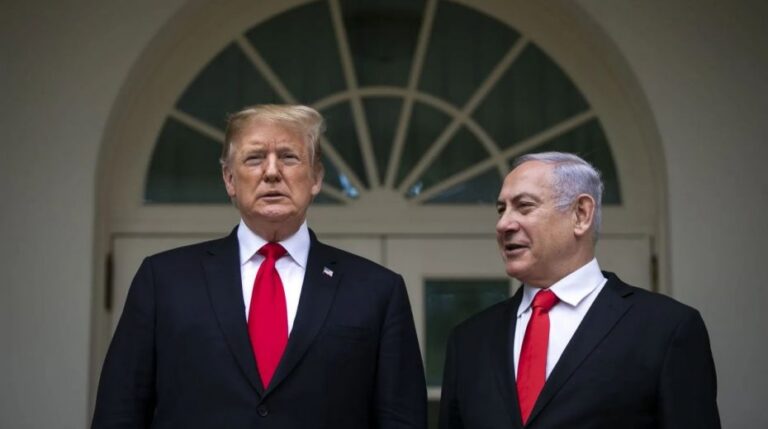
President Trump remarked that the U.S. possesses a “virtually unlimited supply” of mid-tier weapons, enabling sustained warfare “forever.”

Source: President Trump via Truth Social
Yet, he conceded that supplies of the “highest end” arms “are not where we want to be,” likely pointing to defensive missiles and less-produced assets like sea-launched Tomahawks.
Such stockpiles do exist, but questions remain about how much President Trump would be willing to deplete them, especially if China were to invade Taiwan and supply levels became critical. Many factors come into play.
It’s also noteworthy that Trump branded Ukrainian President Zelensky as “P.T. Barnum” and criticized Biden for transferring too many weapons to Ukraine, suggesting a shift in priority.
Israel probably retains a considerable arsenal of offensive missiles, though defensive stocks might be strained after recent conflicts and last summer’s brief war.
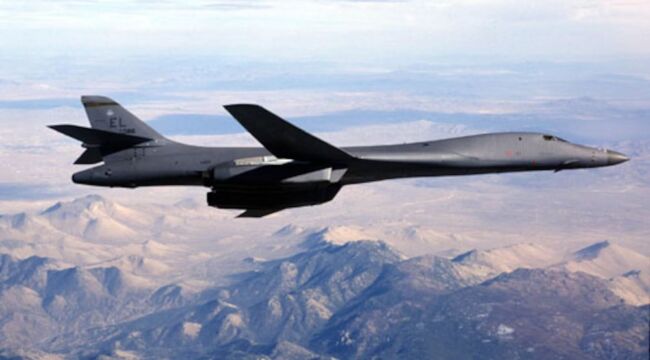
The U.S. has also deployed B-2 stealth bombers and B-1 Lancers. While munitions for these remain available, their missions involve long flights and multiple mid-air refuelings.
Although numerous Iranian missile defenses have been neutralized, Russian S-300 air defense systems still pose a slight risk of intercepting B-2 stealth bombers if detected. The exact deployment extent of these bombers remains uncertain.
The AI Misinformation Threat
The emergence of sophisticated AI-generated videos and imagery presents a new front in this conflict.
Every day, countless fabricated videos spread widely, some garnering millions of views on social platforms. The video below, posted on X, amassed over 25 million views and is clearly an AI-generated fake:
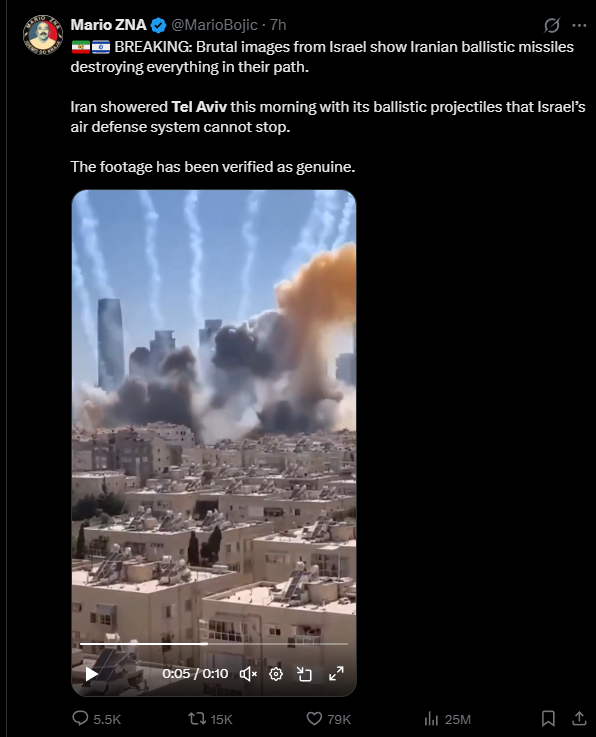
That single post alone accounted for 25 million views of fabricated footage circulated widely online.
Some claim the video is “verified” since X’s AI assistant, Grok, was asked to validate it and responded affirmatively. However, Grok is not designed to detect AI forgeries—it simply provides a probabilistic guess.
Fake news and disinformation add fog to the war environment. As AI video synthesis advances, this issue will only intensify.
AI thus becomes a potent weapon of propaganda, destined to be leveraged extensively in future conflicts.
In Conclusion
At present, Iran’s military capabilities have been severely weakened. The danger lies in possible reorganization under new leadership who could sustain long-range offensive strikes.
The longer the conflict continues, the more U.S. and Israeli inventories of long-range munitions will be depleted.
Meanwhile, deploying a ground invasion is practically off the table. American public support is lacking, and the operational difficulties posed by Iran’s substantial military strength and mountainous terrain are formidable.
Hopefully, a constructive resolution emerges soon; otherwise, the situation risks escalating beyond control.
We will continue monitoring this conflict closely and provide updates to our readers shortly.
About the Author