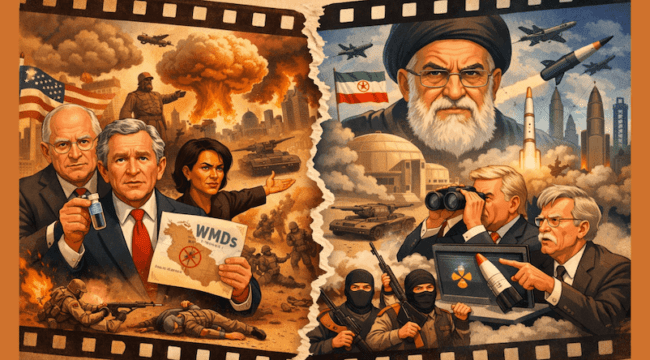
We’ve Seen This War Movie Before
Let’s rewind to October 2002.
At that time, about two-thirds of Americans believed Saddam Hussein was nearing possession of a nuclear weapon. Another 14% assumed he already had one. That same large majority was convinced Saddam had a direct role aiding the terrorists who attacked the World Trade Center.
None of these claims were accurate.
There were no nuclear arms, no hidden stockpiles, and no real al-Qaeda links. Investigations after the war didn’t just fail to validate the WMD allegations; they systematically dismantled the narrative, calling it, in the formal language of government inquiries, “a colossal failure.”
More bluntly put: we accepted a fabricated story and, as a result, 4,500 American troops and somewhere between 150,000 and 1,000,000 Iraqis lost their lives.
So forgive me if I don’t immediately buy into the familiar tales replayed by The Swamp.
Same Script, Different Villain
Back in 2002, the message was clear: Saddam possesses WMD, he’s on the cusp of the bomb, and he’s tied to the terrorists who attacked us. The warning to watch for a “smoking gun” was famously given as a “mushroom cloud.” (That gem came from Condoleezza Rice, and it’s hard not to admire the metaphor.)
Today, the rhetoric about Iran is similar: the regime is “a week away” from developing a bomb, they supposedly have enough material for 11 nuclear weapons, and possess long-range missiles capable of striking the U.S. mainland. Still, they claim to have already “decimated” Iran’s facilities.
Hold on.
If the facilities are destroyed, why are they still allegedly a week from obtaining a bomb? If their nuclear program was crippled, how is it apparently bouncing back? And if this is a “limited operation,” why do the targets now include the nuclear program (which should have been eliminated), the missile arsenal (supposedly decimated), the navy (even vessels in international waters), the Supreme Leader (seemingly a new one daily), and backing for regional proxies (with Israel having already entered southern Lebanon)?
A threat this serious ought to become clearer on closer scrutiny. Yet, as with Iraq, the more you dig, the murkier it gets.
The Art of Weaponized Uncertainty
Here’s a tactic politicians have perfected: selling war doesn’t require certainty, only enough doubt to keep fear alive.
In 2002, intelligence reports like the National Intelligence Estimate on Iraq were packed with caveats, including dissenting views and cautious language. Some analysts doubted the aluminum tubes were for centrifuges. Yet none of this nuance made it into the official statements, which leaned on Condi’s Cloud.
Today, the Trump administration rehearses a similar script, but accelerated through social media. They revealed the attack with a video. Posts on Truth Social clarified shifting objectives. Phone interviews suggested the campaign’s length—though details remain fluid.
Each outlet presents slightly different narratives, so in reality, no single account captures the full story. The haze persists, allowing the operation to continue while insiders debate privately whether this is a “limited rollback” or just the first act of a broader conflict.
Credit to Reuters for noting aides’ internal debates over “how far to go,” even worrying about political optics amid a war. It’s unusual to see such discussions mid-conflict, but these are certainly extraordinary times.
The Incentive Structure, or: Why They Keep Doing This
Here’s the uncomfortable truth I want you to absorb.
No shadowy villain in Washington is twirling a mustache or deliberately deceiving the public just for kicks. The problem lies in systemic incentives that consistently reward exaggerating threats, and the public rarely holds anyone accountable for inflated dangers.
Consider this: saying, “Iran might be pursuing nuclear capability, and we should watch carefully,” sounds cautious, even European. But declaring, “Iran is a week away from the bomb, and we must stop it,” sounds like decisive American leadership. The first statement is more accurate; the second wins votes.
Bush’s team mastered this approach. They converted genuine uncertainty about Saddam’s arsenal into near-certainty in public messaging, and it worked. Most supported the war. Congress approved it. The media, with some exceptions, cooperated.
The war turning into a disastrous misadventure didn’t alter this dynamic. Instead, it only means the next advocate is selling the same product, just with a fresh coat of paint.
Meanwhile, bureaucracies are inherently unable to admit ignorance. Experts on Iran acknowledge real uncertainties about missile ranges, weaponization schedules, and what “decimating” a nuclear program truly means. Yet these nuances never make it into official briefings, which emphasize “an unacceptable threat to the American people.”
When bombing starts, the logic of sunk costs takes over. Iraq began as a “disarmament” mission, morphed into regime change, then counterinsurgency, and sadly ended as a decade-long state-building effort.
The Iran campaign started as “stop the bomb” and has already expanded to four objectives. Mission creep isn’t accidental; it’s baked in. Right now, we’re on to “carpetbombing civilian enclaves in Tehran.”
Look, I’m Not Saying Iran Is a Lovely Country
I want to be clear, because there’s always someone ready to misinterpret this.
I’m not defending the Iranian government. Nor denying its nuclear ambitions or support for regional militias. If I were the Ayatollah, I’d be working tirelessly to secure a bomb for the stability it grants leaders like Kim Jong Un. I’m also not dismissing the possibility that military force can sometimes be justified or that Iran poses no challenges to U.S. interests.
What I am saying is that the last time Washington sold a war against a nation larger than Grenada with this exact mix—shifting threat claims, conveniently tailored intelligence, vague and multiplying war goals, coupled with a media environment designed to evade skepticism—it ended badly.
I firmly state that “trust us this time” is not a defense; it’s an insult.
The least rational response from anyone who followed the Iraq fiasco and the post-war inquiries exposing the WMD case as a fictional narrative built on assumptions pressured by politics is to insist on full transparency before any commitment, not afterward.
The Fool-Me-Twice Problem
There’s an old adage, famously botched by the bumbling president during our last venture into this: fool me once, shame on you; fool me twice, shame on me.
The playbook, the urgency, and the changing objectives remain the same. The confident declarations about uncertain facts echo the past. The political incentives to oversell and then justify persist unchanged.
The only difference is the target nation. This one is even more complex than before.
Wrap Up
My doubts don’t stem from pacifism or ignorance about Iran’s nature or nuclear challenges.
They come from a seasoned awareness of how the political machinery transforms ambiguity into inevitability and skepticism into doctrine. It morphs a country with no immediate danger (47 years of this, for goodness’ sake!) into a pretext for a war costing trillions and countless lives.
I’ve watched this story before.
The ending was disastrous.
I refuse to line up for the sequel just because the title has changed.
About the Author