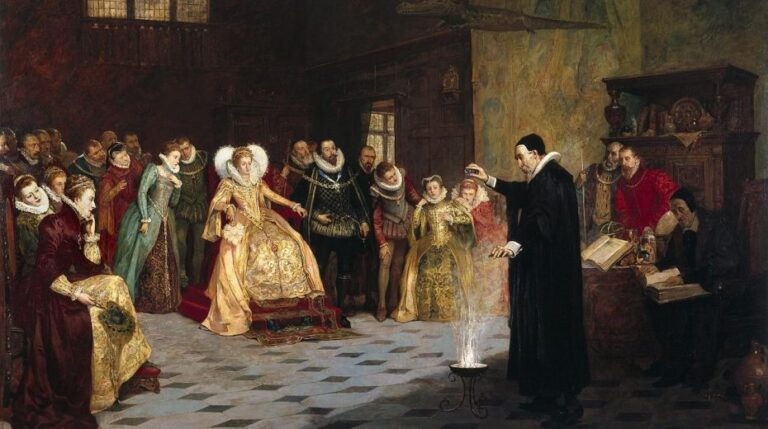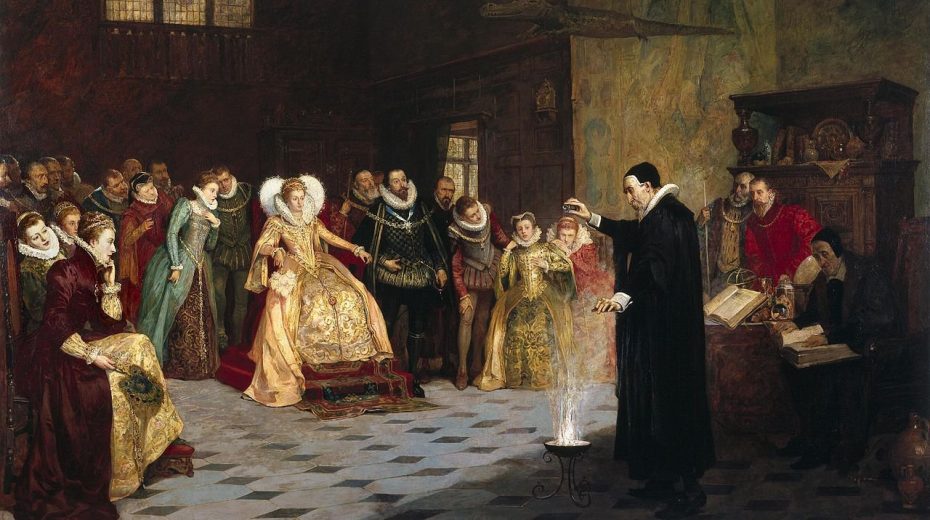
Dee held the conviction that Queen Elizabeth was destined to head a British Empire, one founded on naval dominance and widespread commercial enterprise.
On the island of Great Britain lie three nations: England, Scotland, and Wales. During the era of the Roman Empire, Great Britain, known then as Britannia, was inhabited by the Britons—hence the island’s name. What caused this division into distinct countries? In the Middle Ages, tribes from what is now Denmark and Saxony invaded Great Britain, driving out the Celtic Britons. These invaders were the Angles and the Saxons, who merged and gave rise to England or “Land of the Angles.” Some displaced Britons migrated to a region in France that became Brittany, which helped distinguish Great Britain from this new home of the Britons. Others found refuge in the small territory of Wales, from where the Christian King Arthur tried to reclaim lands lost to the pagan invaders.
Given the failure of the Celtic king, why did England choose during Elizabeth’s reign to establish a British, rather than solely an English, Empire?
The answer lies in the mythological origins attributed to England’s founding. During the High Middle Ages, an anonymous text titled Historia Brittonum declared that the first British monarch was Brutus of Troy, said to be descended from Aeneas, the legendary founder of Rome. In the 12th century, the Welsh cleric Geoffrey of Monmouth, a gifted storyteller, authored Historia Regum Brittaniae, which vividly describes the night King Arthur was conceived. According to Geoffrey, Arthur was a British king descended from both Aeneas and Brutus, who named the island Britain in his honor. Geoffrey also embellished Arthur’s story with a slew of Nordic conquests.
At the dawn of the modern age, these medieval British myths gained remarkable political weight with the ascent of Henry VII, a Welshman crowned King of England in 1485. As the founder of the Tudor dynasty, Henry VII, and his descendants, embraced their supposed lineage from King Arthur, Brutus of Troy, and ultimately Rome’s founder.
The situation became more complex with the Reformation: Henry VIII, Henry VII’s son, severed ties with the Catholic Church in the 1530s after failing to secure a male heir from his wife. Around the same time, reformer John Bale (1495–1563), who portrayed Rome as Babylon and the Pope as the Antichrist, proclaimed that ancient Britons followed a purer Christianity than Rome’s; that the British had always contested Rome; and that the Tudors were Arthur’s rightful successors commissioned to oppose Rome under divine threat.
For the fervent Protestants of the era, opposing Rome could involve purging Anglicanism of papist elements—a view so intense that many Puritans grew disillusioned under Queen Elizabeth’s reign and emigrated to America, convinced that divine punishment awaited England. Predictions of papal downfall and apocalyptic upheavals were anticipated around 1650. Yet, amidst this religious fervor, not all the zealots were devout. Among the more enigmatic figures was John Dee (1527–1609), an occultist whose influence extended far beyond the mystical.
Another World Empire
Earlier articles have established that 17th-century circles inspired by Kabbalah circulated the notion of an emerging new world empire along with a universal faith and the Millennium. Typically, this new ruler would free Jerusalem from Turkish control and govern globally from there. In the 17th century, Christina of Sweden and Antonio Vieira were noted followers of La Peyrère, who echoed 16th-century Postel’s ideas. Postel envisioned the French as the chosen people, a French ruler liberating Jerusalem to resettle the Jews. Antonio Vieira believed Portugal, led by D. João IV, destined to fulfill Bandarra’s prophecies and resurrect Portugal’s glory, was the forging nation of the Fifth World Empire. England, by contrast, asserted a unique claim by having a monarch descended from Aeneas himself.
In England, John Dee, acquainted with Postel’s work, championed the “Brytish Impire.” Of Welsh descent and an advisor to Queen Elizabeth I since her 1558 accession, Dee was renowned for his advanced skills in mathematics by age 20.
Referring to his advisory role, a declassified NSA report notes: “As government consultant, he excelled in mathematics, cryptography, natural science, navigation, and library science, and above all in the really rewarding sciences of those days – astrology, alchemy, and psychic phenomena. He was, all by himself, a Rand Corporation for the Tudor government of Elizabeth.” The Rand Corporation is a private institution with concealed funding that supports U.S. military intelligence through scientific and social research.
John Dee’s significance to the British monarchy cannot be overstated, making the relative academic silence about him puzzling. His most documented legacy lies within esoteric circles, where it is widely known he communicated with “angels” using tools such as an Aztec mirror, crystal ball, and starry boards (artifacts now displayed at the British Museum), assisted by the medium Edward Kelley. Their partnership intriguingly extended to following the “angel’s” command to swap wives. What tends to be overlooked is Dee’s deep political influence.
Dee’s Imperial Convictions
Among the scarce studies on Dee’s political and philosophical views, Peter French’s John Dee: The World of an Elizabethan Magus reveals Dee’s allegiance to British mythology, championing Queen Elizabeth’s descent from Rome’s founder through King Arthur. Although British myth was debunked by Italian humanist Polydorus Virgil in Anglica Historia earlier in the century, Dee embraced and amplified the legend, portraying King Arthur as ruler of a vast British Empire to which Elizabeth was heir.
Between 1578 and 1580, Dee presented to the queen his treatise Title Royall to… foreyn Regions, asserting that Elizabeth’s Arthurian lineage entitled her to “Atlantis” (a term Dee used for America), Iceland, Greenland, and the mythical islands of Friseland and Estotiland referenced in the Renaissance edition of the Zeno Brothers’ Voyage.
From the 1550s through the 1580s, Dee’s guidance drove English navigation, motivated by both ideological and practical reasons. Practically, England was experiencing an Erasmian reformist wave even before the Protestant Reformation, aiming to replace medieval university traditions with classical belles-lettres. Protestantism deepened this shift, with Puritans purging “papist” writings during Edward VI’s brief reign (1547-1553), although mathematics was often linked to occultism. As a result, English universities predominantly focused on humanities, leaving practical disciplines like navigation largely to the eccentric magician Dee.
Ideologically, Dee envisioned Queen Elizabeth as the leader of a British Empire rooted in maritime mastery and vibrant commerce. While this image is often associated with the empire’s later 19th-century form, Dee’s vision preceded English American colonies. He believed that Lord Madoc, Prince of North Wales, established a “colony” near Florida, thereby granting Elizabeth a right to “Atlantis.”
During Dee’s era, England pioneered chartered companies—state-backed monopolies granted exclusive trading rights over regions. (More on this can be found here.) Dee’s immediate naval ambitions involved voyages by England’s first chartered company through Arctic passages seeking a route to the East, expeditions to Canada (had Humphrey Gilbert not been shipwrecked, Dee might have claimed Canadian lands), and circumnavigations exemplified by Drake’s journey—the second global expedition after Magellan’s.
Such monumental explorations were essential because Queen Elizabeth was prophesied to command an unprecedented world empire: the “Incomparable Brytish Impire,” in the English parlance of the time.
Therefore, the British Empire’s origins trace back to a Celtic magician who purportedly spoke with unusual “angels” (who even instructed them to swap wives) and fancied Queen Elizabeth would revive and surpass King Arthur’s legendary realm.
About the Author