This is a Structured War of Attrition. And the screenplay has been written in Tehran.
Iran’s officially termed Decentralized Mosaic Defense continues to evolve around the clock: the IRGC’s protracted plan aims to systematically exhaust the Empire of Chaos through attritional pressure.
Let’s navigate the complex labyrinth of failing strategies beneath the collapsing Empire of Chaos.
From Iran’s resilient mosaic tactics and its long game strategy to the temptation for the West Asian death cult to resort to nuclear options; from the looming Interceptor Hell to China’s unwavering efforts to discard the old financial order by accumulating gold and offloading dollars; from BRICS’ strides in establishing alternative financial networks to the disintegration of American client states globally—these trends signal an accelerating overhaul of the entire system.
Meanwhile, Vladimir Putin casually hints that Russian gas exports to the EU may cease entirely:
“Maybe it would make more sense for us to stop supplying gas to the EU ourselves and move to those new markets, and establish ourselves there (…) Again, I want to stress: there’s no political motive here. But if they’re going to close the market to us in a month or two anyway, maybe it’s better to leave now and focus on countries that are reliable partners. That said, this isn’t a decision. I’m just thinking out loud. I’ll ask the government to look into it together with our companies.”
The weak-willed Bratwurst Chancellor sought neo-Caligula’s approval for Germany to purchase Russian oil, and he received it. However, there may simply be no supply left. This is an energy conflict, and once again the EU fails even to qualify as a desperate supplicant. Without Qatari gas or Russian oil and gas, the EU is left to resume its NATO-obsessed perpetual warfare.
The bombing of the GCC-petrodollar pipeline
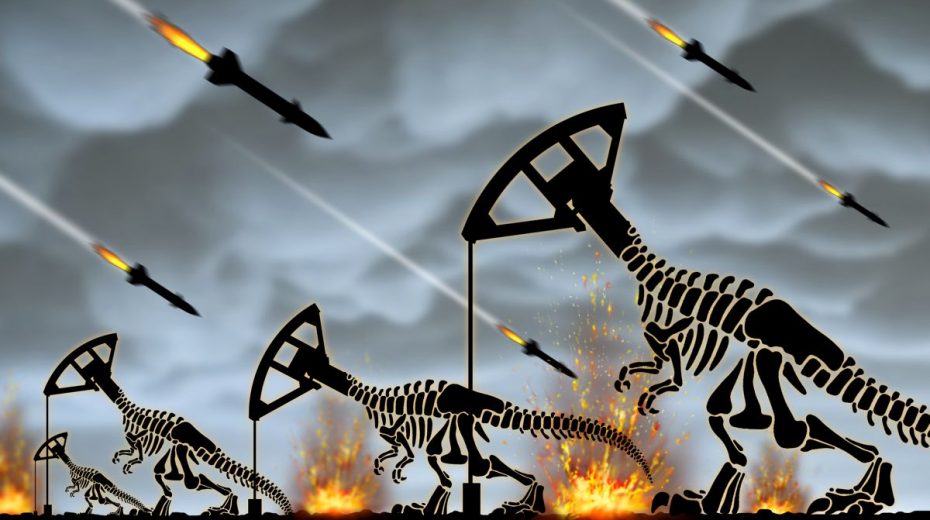
Following Saturday’s decapitation strike targeting Supreme Leader Ayatollah Khamenei, Iran immediately transitioned to decentralized command with a 4-tier succession system, unleashing waves of older missiles and expendable drones to overwhelm Patriot and THAAD missile defense batteries on an industrial scale. This move altered the dynamics of the conflict from day one.
It is common knowledge that deploying three Patriots—costing $9.6 million collectively—to counter a single Iranian sacrificial missile is unsustainable.
It’s no surprise that after just four days of this Epstein Syndicate-led strike against Iran, the global financial system spiraled out of control, eroding $3.2 trillion—and counting—in value.
Practically, the Strait of Hormuz remains closed to all but Russian and Chinese ships. At least 20% of global oil demands are frozen. Qatar’s entire LNG output is offline with no clear return ahead. Iraq has shut down its second-largest oil field.
Yet, the volatile neo-Caligula insists this war, initially expected to last a weekend, may stretch for five weeks, while Pentagon officials jitter about an extension all the way into September.
By targeting US interests across the GCC—not just military facilities—Iran has planted a ticking time bomb. This act directly undermines the petrodollar system, much to Beijing’s quiet satisfaction. Tehran anticipated that this domino effect would trigger immediate panic, paving the way for a new, widespread Great Depression.
No oil, coupled with no viable GCC defense against Iranian missile and drone strikes, signals the end of Wall Street’s artificial liquidity—especially since the AI bubble is heavily financed by GCC investments. Unlike the Nord Stream incidents, this latest strike is an assault on the GCC-petrodollar pipeline itself.
All of this unfolds rapidly as Iran continuously refines its decentralized mosaic approach. For example, coordinated forces from the IRGC, navy, army, and aerospace troops manage a cache of potent anti-ship missiles and drones that have yet to be deployed.
Though ballistic missile launches have slowed since the initial barrage, their persistent impact continues to hammer US bases—whose defenses are mostly depleted—while plunging the GCC and West Asian death cult economies into devastation and rattling every corner of global markets.
Despite Washington’s bluster from its oily, circus-like Secretary of Forever Wars, countless Iranian underground military bunkers stocked with tens of thousands of missiles and equipment remain hidden and untouched.
Bankrupting the Empire of Chaos business model
This conflict is a frantic attempt to preserve the petrodollar’s dominance. Iran, as a major energy producer trading outside of the petrodollar framework, represents an existential threat, especially as the BRICS nations push for independent payment systems.
The structural weakness of Iran’s neighbors in the GCC positions them as easy targets. Their entire economic foundation depends on the petrodollar exchange for protection from the US Mafia—a protection that evaporated in the conflict’s first four days.
The IRGC’s Asymmetric Warfare Machine systematically dismantles the Empire of Chaos’s economic structure in real time.
The most vivid example is the collapse of Dubai’s opulent facade—far more impactful than the strikes on US Fifth Fleet interests in Bahrain or the missile that destroyed the $1.1 billion AN/FPS-132 radar at Al Udeid Air Base in Qatar.
The inevitable fracturing of the GCC signals the end of petrodollar recycling and opens the door to petroyuan or BRICS currency baskets for energy trade.
“Checkmate,” derived from Persian “Shah Mat,” means “the king is helpless.” Emperor neo-Caligula may be oblivious to his own vulnerability, incapable of the chess metaphor. Still, his panic is palpable as he searches desperately for an escape route.
The Astrakhan-Tehran air corridor
Turning to Russia’s role: the Astrakhan-Tehran air corridor serves as a vital artery, bustling with clandestine cargo flights. The Chkalovsk military airfield near Astrakhan acts as the main logistic hub where aircraft like the Il-76MD, An-124, and Tu-0204-300C shuttle frequently, cloaked in materials that reduce radar detection and evade civilian tracking systems.
These shipments arrive at Mehrabad Airport in Tehran, as well as Pyam and Shahid Behesti in Isfahan. Multimodal logistics are employed, with some goods moving through the Caspian Sea.
Operations are overseen by the 988th Military Logistics Brigade from Astrakhan. Cargo includes air defense parts, radar guidance units, missile launcher hydraulics, and long-range radar modules.
Under a confidential agreement, Russia supplies Iran with advanced electronic warfare tech, including an export variant of the Krasukha-4IR, capable of jamming US drone radar systems.
Furthermore, Iran will soon deploy full S-400 missile batteries, enabling control over as much as 70% of its airspace.
How the economic-political stress will become unbearable
Now to Turkiye’s involvement.
Two months ago, Turkish intelligence (MIT) tipped off the IRGC that Kurdish fighters were attempting to cross from Iraq into Iran. This is astonishing: a NATO member providing time-sensitive intelligence to the IRGC just as the Epstein Syndicate prepared for war.
An estimated 15 million Kurds reside within Iran. Ankara’s greatest fear is a strengthened Kurdish presence in Iran. Despite Sultan Erdogan’s shifting stances, he understands the risks of direct confrontation with Tehran and balances multiple interests—including NATO ties, the energy corridor with Russia, the BTC pipeline to the West, and Turkiye’s role as the Western anchor for the Middle Corridor to China.
Hence, the purported Iranian ballistic missile allegedly targeting Turkiye, shot down by NATO, was treated with composure as foreign ministers Fidan (Turkiye) and Aragchi (Iran) engaged in adult diplomatic dialogue. The details remain shrouded in the fog of war: the missile might have been aimed at crippling the BTC oil terminal, with subsequent drone strikes on Georgia targeting the pipeline’s weakest point.
None of this is verified and may be false flag operations. Yet Tehran might have reasons to cut off 30% of Israel’s oil supply.
The BTC pipeline remains a key strategic asset, transporting Azeri crude across Georgia to Turkiye’s Mediterranean coast. Attacking it fits Iran’s broader strategy to sever every energy artery supplying the Epstein Syndicate and its Gulf acolytes through the Gulf, Caucasus, and Mediterranean regions.
Alongside BTC, Iran could target the Saudi East-West pipeline—which bypasses Hormuz—offshore Iraqi loading platforms within Iranian waters handling 3.5 million barrels daily, and the Abqaiq processing complex responsible for most Saudi crude exports.
If Iran is pressed into attacking all these points simultaneously, no global strategic petroleum reserve can fill the resulting supply void.
In this tangled nexus of energy pathways, shipping routes, supply chains, maritime security, and soaring oil prices, only Pentagon clowns would want to perpetuate the war until September. Asia, Europe, and all major energy importers will exert immense pressure towards de-escalation.
Yet Iran’s asymmetric approach remains steadfast: widen the conflict geographically and extend the timeline to maximize economic and political strain.
In short, this is no hasty regime change operation by reckless zealots. This is a Structured War of Attrition. And the screenplay has been written in Tehran.
About the Author