The Pentagon’s Amazon Prime Problem
It’s almost tragically ironic to witness the world’s most formidable military force publicly confront the reality that it has depleted its supply of munitions.
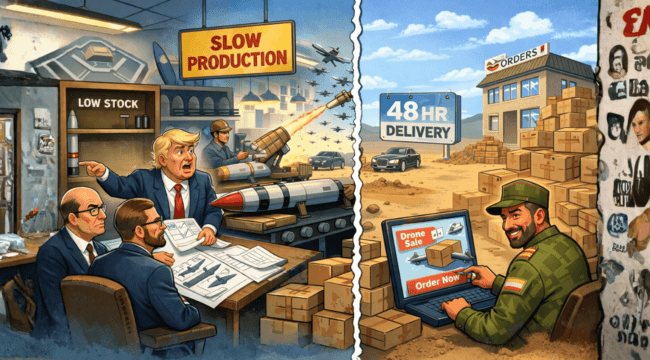
Recently, The Donald convened the CEOs of Lockheed Martin, L3Harris, and RTX (formerly Raytheon) for what must have been a grave meeting, accompanied by strong coffee, where he implored them to accelerate missile production—urgently and in large quantities.
The defense executives responded with solemn nods. The president appeared determined. Handshakes were exchanged, underscoring the seriousness of the moment.
Meanwhile, somewhere within Iran’s 31 autonomous provincial commands, a procurement officer just placed his 10,000th order for $800 kamikaze drones and likely slept soundly that night.
The uncomfortable truth few in Washington are willing to admit: Iran has demonstrated that sheer quantity carries its own weight. Their tactic—flooding the skies with inexpensive, disposable drones and forcing the U.S. and Israel to knock them down with multi-million-dollar interceptors—is less Sun Tzu and more akin to pelting a Bentley with free rocks. The rocks cost nothing; the Bentley’s panels certainly do.
To clarify, the U.S. can afford this financial absurdity for a very long time. America treats debt limits the way a toddler handles bedtime rules: loosely at best, then not at all. Congress can rack up tens of billions of dollars on the tab without anyone in Washington losing a moment’s sleep.
The real issue isn’t funding. It’s that you can’t just swipe a credit card and expect a THAAD missile defense system delivered by Monday.
The Harvest of Two Decades of Foolishness
Here’s how we ended up trapped in this dilemma: Over roughly two decades, the U.S. made a series of decisions that seemed fiscally prudent but proved strategically disastrous, allowing its military-industrial production capacity to decay like an untouched gym membership come February.
Defense budgets under Obama trimmed excess. Procurement under Biden slowed to a crawl. Then, in a spree of logistical generosity that would make any supply chain manager despair, the U.S. shipped massive amounts of its existing weapons stockpile (cruise missiles, 155mm artillery shells, drones) to Ukraine—a conflict now consuming materiel at levels that would alarm planners from 1944.
The outcome? Stockpiles are depleted. Or more accurately, they exist but in insufficient quantities, and the equipment on hand is increasingly vulnerable to countermeasures our adversaries have already developed.
We currently produce cruise missiles at about 1,000 units annually. We require approximately 1,000 units monthly. That’s a twelvefold gap between production and operational need.
The Art of the Impossible Ask
Returning to the boardroom scene—Trump urging defense CEOs to speed up manufacturing is like telling a winemaker to make the wine mature faster. Lockheed Martin’s CEO didn’t walk out of that meeting with a secret stash of missile engineers or pre-assembled robotic production lines.
Developing new weapons is extraordinarily intricate. As my colleague Jim Rickards noted, “These systems are highly complex and rely on trained engineers, mechanics, and others in addition to robotic systems and set assembly lines. Those capacities cannot be expanded overnight.”
Even if production of existing systems surged, we’d simply be mass-producing technology that Russia, China, and Iran are actively countering. There’s no honor in churning out obsolete ordnance in large quantities.
Integrating AI, advanced targeting, and next-gen guidance requires development, testing, duplication, and incorporation into production—all while simultaneously trying to speed up output. It’s like renovating a kitchen in the middle of preparing dinner for a large crowd.
Consequences Nobody Wants to Mention
The missile shortage isn’t just a constraint against Iran; it cascades outward with the subtle yet dangerous logic of an indirect problem.
China is observing closely. Any clash in the Taiwan Strait demands a vast number of long-range precision munitions, but current stores are, by frankly blunt description, insufficient. The phrase “we’d run out within a week” has been quietly acknowledged in policy circles for years yet remains largely ignored.
Countries like Ukraine and South Korea are already feeling the repercussions of this harsh arithmetic. Political will won’t limit future U.S. weapon deliveries; depleted warehouses will. The waiting list is long, production slow, and the next priority location lies somewhere in the Middle East.
(Kim Jong Un’s cruise missile launch on Tuesday, shortly after the U.S. repositioned its South Korea THAAD missile defense system to the Middle East, was a petty “I told you so!” and serves as a reminder of how secure he feels atop his nuclear arsenal.)
Meanwhile, Iran’s procurement official continues placing orders—cheap drones, in the thousands.
Wrap Up
Conservative projections indicate that restoring the industrial base, training personnel, integrating new technologies, and rebuilding stockpiles will take most of a decade—possibly longer. That’s assuming uninterrupted political dedication, continuous funding, and no further erosion of weapon reserves in ongoing conflicts.
Ten years of vulnerability. A decade of watching foes test the gap between our claims and actual capabilities. Ten years of assuring allies “we’ve got your back,” all while inwardly hoping no one calls our bluff—or worse, mistakenly believing we do.
The CEO briefing wasn’t a genuine strategy; it was a public relations event masquerading as one. A real plan would involve an unexciting decade of investment, workforce expansion, industrial policies, and patience—none of which make for compelling campaign moments.
Meanwhile, Iran’s procurement officer is placing another order. Cash on delivery. No waiting. Delivered within 48 hours.
About the Author