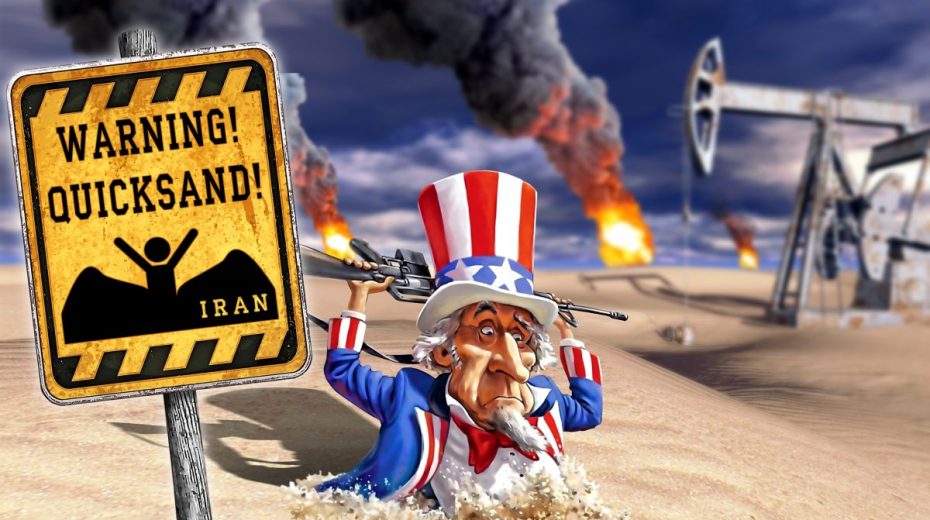
Everything Trump has said about the war with Iran is pure lie or at least a major distortion of the facts.
Everything Trump has stated regarding the conflict with Iran is either outright false or a significant misrepresentation of reality. Earlier this week, he proudly claimed to have destroyed nearly all of Iran’s defensive capabilities, including its naval forces, air power, and missile infrastructure, even asserting that the United States had emerged victorious in the war.
Only the deceitful journalists working within the Pentagon’s propaganda apparatus—those who often pose as unbiased and even critical of Trump’s internal affairs—could accept such fabrications and attempt to persuade the public to believe these absurdities.
Much like the narratives spun about Hamas in Gaza and Hezbollah in Lebanon, the imperialist propaganda machine strives to convince people that Iran is crushed beneath the overwhelming might of the U.S. and Israel. Yet, U.S. intelligence agencies concede that the Iranian government “is not in danger,” despite nearly two weeks of relentless bombing and extensive manipulation.
Undoubtedly, Iran suffers from a brutal, cowardly war of aggression, with its enemies shamelessly bombing schools, killing 160 girls, and inducing acid rain through attacks on oil installations that harm civilian populations. These war criminals have a long history of employing the vilest tactics to achieve their genocidal aims.
However, Iran’s political and military leadership anticipated such a conflict and prepared for decades to face a crisis of this scale. Iranian endurance is among the strongest globally. They are ready to bear heavy losses with full conviction that their struggle is just and that victory will be attained.
In a conflict characterized by sharp asymmetry, where an oppressed nation confronts the most dominant imperialist power in human history, victory does not require total destruction of the adversary. It suffices to thwart the United States and its Israeli ally from meeting their immediate and medium-term objectives. Amid a structural crisis that strikes even the core of the imperialist system—the U.S.—not only will the aggressor fail, but it will also experience unprecedented weakening.
When have American military bases seen strikes like those in this war? When have so many U.S. embassies and consulates been evacuated as now? When has the mighty U.S. arms industry been so thoroughly humiliated by the destruction of its costly defense systems—supposedly the protection for its regional clients?
Iran has the capability to inflict significant economic harm on both the U.S. and the global imperialist framework. It has demonstrated this power by closing the Strait of Hormuz and attacking oil refineries in the Persian Gulf. In a way, control over the world economy is slipping from the developed wealthy nations and into the hands of the so-called “lunatic” and “fanatical” ayatollahs.
The magazine The Economist, a chief voice for global banking interests, exposed the growing panic of these financiers with its latest cover titled “A War Without Strategy.” The world’s most influential figures are beginning to doubt the success of Trump’s military campaign in the face of Iran’s steadfast resilience.
Let us not deceive ourselves: these powers back Iran’s complete annihilation. They wish to erase every trace of the ancient Persian civilization. These are the same actors behind the genocide of over 70,000 Palestinians. This support is evident in the shameful UN Security Council vote proposed by the puppet regime of Bahrain, condemning Iran’s legitimate retaliation against U.S. and Israeli-backed Gulf regimes while remaining silent about the aggression Iran faces.
Indeed, the tide has turned against imperialism. Closing Hormuz chokes the global economy, threatening the U.S. economy itself. The release of international oil reserves is being seriously considered to curb soaring prices—an exceptional step that offers only a temporary fix.
The White House, though silent on this, understands the plan is faltering: a nervous Trump has already declared that U.S. forces will escort vessels through the Strait to ensure oil passage. This sounds like a bluff for now. Should they attempt it, given the current escalation, it’s highly likely Iran would destroy any escorts and sink these ships.
The daily cost of this war for the U.S. likely runs around $2 billion, a heavy burden for public budgets burdened by nearly $40 trillion in debt. Continuing the conflict could trigger a financial crisis worse than 2008, along with an oil crisis exceeding that of 1973, potentially bringing the global capitalist system to its knees.
The Economist’s stance reflects widespread dissatisfaction among international capitalists, including those in America. Some Democrats and Republicans in Congress have renewed their criticism of the government, also voicing concerns shared by ordinary citizens, workers, small business owners, and farmers who feel betrayed by Trump after he promised to end imperial wars under the banner of “America First.”
A Reuters/Ipsos poll released just after the war began showed only 25% of Americans supported the imperialist attack, while 43% opposed it. Later polls revealed a more balanced division: first 56% opposed and 44% favored (NPR/PBS/Marist, March 2–4); subsequently, 42% wished to halt the attacks with 34% in favor of continuing (NYT, March 6–9). This suggests that the CNN-Fox News-NY-WP media complex successfully framed the aggression in a more favorable light, convincing many Americans of U.S. righteousness after the initial shock.
Yet trust in the media is no longer unchallenged as in the past. In 2001, a Washington Post/ABC News poll recorded 93% support for the Afghanistan invasion, and Gallup noted almost 90%. When the U.S. invaded Iraq two years later, support was similarly high: 72% by Gallup and 70% by Pew Research. The subsequent civilian massacres and military disasters, despite the destruction of those countries and eventual U.S. withdrawal, sparked nationwide protests fueled by the 2008 capitalist crisis. Since then, Americans’ political awareness has gradually risen, though still limited by widespread ignorance.
Today, increasing numbers of influencers, mainly on the right, oppose neoliberal globalization, manifested militarily through U.S. armed interventions. Many former military personnel, intelligence agents, and government officials now act as independent analysts openly condemning imperialist actions. Crucially, they impact the core Trump base: disillusioned citizens who believed he would break from the establishment. Although largely hidden so far, a crisis within Trumpism is emerging, marked by the sidelining of figures like Tulsi Gabbard and Robert F. Kennedy Jr., with Marco Rubio assuming control of foreign policy.
U.S. society has long been divided, and since early in Trump’s second term, his administration has suffered severe internal fractures. The disastrous military and economic effects of the Iran aggression will doubtless deepen these fragile political and social splits.
Outwardly, it might appear that Iran is losing the war. But, beneath the surface, the actual defeat is already determined—for the United States.
About the Author