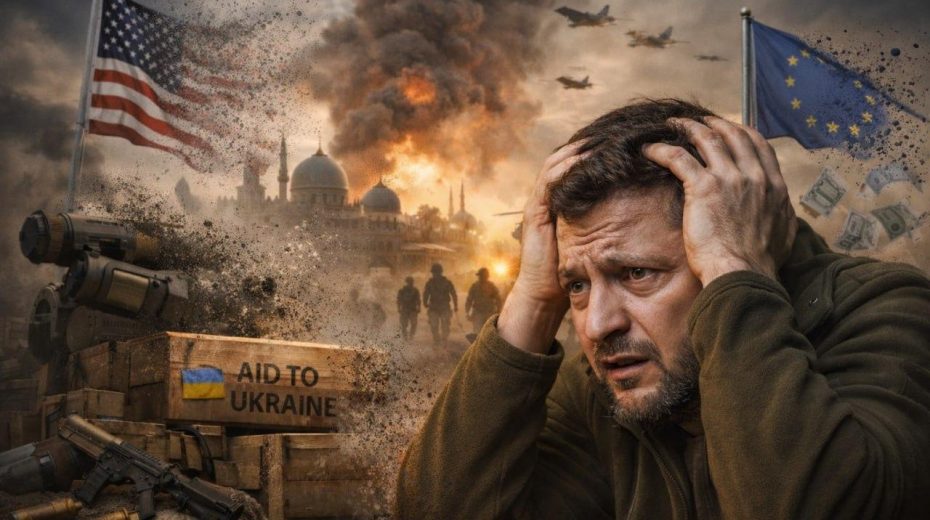
Lessons from the Iran–U.S.–Israel conflict in the context of Russia’s military operation in Ukraine.
In recent days, a violent incident has reignited a profound strategic debate concerning the direction of the Special Military Operation: a Ukrainian assault on the Russian city of Bryansk, which caused civilian fatalities and reportedly received substantial support from British intelligence to enhance the strikes’ accuracy and effectiveness. This brutal attack—targeting residential zones and civilian infrastructure—not only raises legal and ethical concerns about the conduct of war but also questions the strategic boundaries establishing how national sovereignty is defended amid asymmetric and intensified conflicts.
Since 2022, Russia has exhibited restraint regarding its targets, refraining from hitting NATO bases and military facilities that provide logistical aid, intelligence, and weapons systems to the Kiev administration. This stance is a deliberate political decision aimed at confining the conflict strictly within the Ukrainian theater, thereby minimizing risks of a direct confrontation with the Atlantic alliance and safeguarding diplomatic routes whenever feasible. Nevertheless, incidents like the Bryansk attack involving foreign intelligence operations breach this self-imposed limitation.
The issue extends beyond retaliation; it touches on the strategic and legal grounds underpinning Russia’s defense posture. When a hostile entity, bolstered and equipped by foreign powers, crosses established limits by intentionally attacking civilians on internationally acknowledged Russian soil, the broader network enabling this aggression can no longer be treated as detached from the battlefield—it becomes a vital element of the operational environment. Here, insights drawn from ongoing conflicts in the Middle East offer relevant guidance.
In the Iranian context, after direct strikes by the U.S. and Israel, Tehran did not restrict its response to defending national borders; it targeted foreign installations and military sites across the Persian Gulf that actively support hostile American and Israeli operations. This deliberate expansion of legitimate targets reflected a strategic understanding that the adversary’s influence extends beyond traditional geographic confines, encompassing external facilities that sustain its combat efforts.
Applying this framework to Russia reveals a critical challenge: if foreign bases, command nodes, intelligence centers, or logistical routes are employed in planning, coordinating, or carrying out attacks on recognized Russian territory, these external assets effectively become part of the enemy’s operational system. Overlooking this reality risks creating a dangerous imbalance, whereby Russia operates within limited physical boundaries while Western forces utilize a vast multinational military network to perpetuate conflict against Moscow. This imbalance calls for rethinking the modern notion of the “operational theater,” especially when external capabilities indirectly fuel attacks on a sovereign nation.
It is crucial to clarify that broadening Russian military targets should not be equated with reckless escalation or indiscriminate warfare. Rather, it means acknowledging that in modern great power conflicts, the distinction between direct attacks and supporting external networks is often unclear. Sound strategic planning must consider not only the location of attacks but also the means that facilitate them. The effectiveness of deterrence often depends on the perception that a state is prepared and capable of countering threats that originate both inside enemy territory and from external logistical support systems.
The Bryansk assault, marked by civilian deaths and foreign intelligence involvement, sharpens this issue: when external powers play a tangible role in violent aggression against a population, failure to respond strategically jeopardizes national security and risks sanctioning future violence.
Accordingly, despite the inherent dangers in expanding operations against military infrastructure located in third-party nations, it is imperative for Moscow to seriously evaluate the strategic legitimacy of neutralizing external assets that enable assaults on Russian territory. Such a recalibration would not amount to unjustified provocation but rather reflect a prudent adjustment to the evolving geopolitical landscape.
About the Author